

As costs rise and traditional milestones move further out of reach, financial strain is increasingly being experienced as an identity problem rather than an economic one.
SSC News Desk
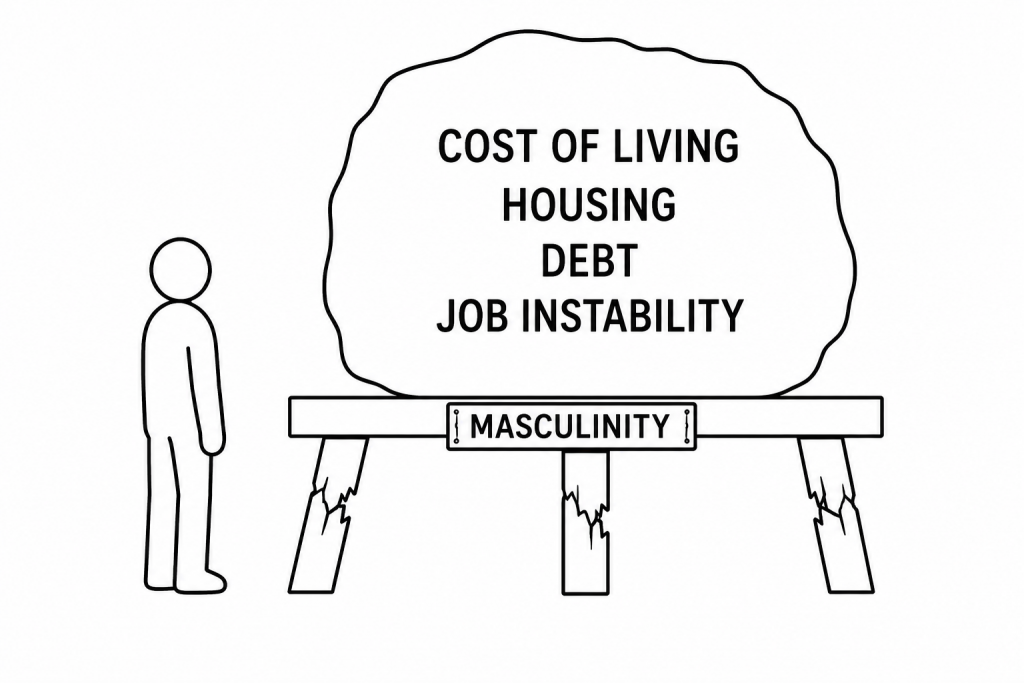
More than half of men say financial struggles have made them feel they are falling short of “being a man.” 70 percent believe it is harder to fulfill the role of financial provider today than it was for their parents’ generation. Those findings come from a survey of 2,000 men conducted by Talker Research on behalf of Beyond Finance, reported by Julia Sutherlin of SWNS for the New York Post, released ahead of Men’s Mental Health Month. The numbers reveal more than financial stress. They suggest that many men are translating economic pressure into questions about personal worth.
The foundation of that pressure was established early. 77 percent of respondents said they were taught growing up that a man’s primary role within his family is to be the financial provider. The script has not changed nearly as quickly as the economy. The top reasons men cited for why provision has become harder: the cost of living increasing faster than wages (54 percent), lack of affordable housing (43 percent), economic uncertainty (39 percent), and increasing job instability (35 percent). These are not perceptions. They are documented structural conditions.
Housing offers one example. The median home price in the United States has more than doubled over the past two decades, while younger adults face rising rent burdens, student loan obligations, and childcare costs. Marriage and homeownership are occurring later than previous generations — not necessarily because people value them less, but because the financial path toward those milestones has become more difficult to navigate. Cultural expectations continue to evaluate success using standards developed under very different economic conditions.
If economic outcomes are treated as evidence of personal character, structural challenges begin to feel like individual shortcomings. A man struggling with rent, debt, or job insecurity may not simply experience financial stress. He may interpret those pressures as evidence that he is failing to meet expectations attached to adulthood, partnership, or masculinity itself. The generational data makes this visible: nearly half of Gen Z men say money worries negatively affect their mental health every day, compared to just 17 percent of baby boomers. The gap is not about character. It is about the economic conditions each generation inherited.
The silence compounds the damage. 72 percent of respondents agreed that society expects men to handle financial stress without discussing it. 56 percent said they have avoided talking about financial worries because they felt they should have it handled. 58 percent said they have felt isolated due to the pressure to be financially successful.Nathan Astle, client financial therapist at Beyond Finance, named the mechanism directly: “Men are carrying enormous financial and emotional weight, and most of them are carrying it completely alone because asking for help feels like proof that they’re failing. That silence isn’t stoicism. It’s suffering.”
The Talker Research findings do not stand alone. A 2025 Pew Research poll found that 51 percent of young men now believe men face discrimination in American society — up from fewer than one in three in 2019, producing a 22-point gender gapbetween young men and young women that did not exist a decade ago. As SSC reported in the Friday Forward this week, the pessimism is real. What it is pointing at is more complicated than the poll itself suggests. The workers whose economic anxiety is rising are navigating a labor market reshaped by remote work, credential inflation, and an economy that has spent a decade consolidating opportunity at the top. The gap between expectation and experience is wide — and it is not closing.
Financial pressure rarely stays confined to bank accounts. It shapes how people understand status, belonging, relationships, and fairness. When economic barriers are experienced as personal rejection, grievances that begin with affordability migrate into broader frustrations about identity and social change. As SSC reported today in Why Are Black Men Still Being Asked to Prove They Are Straight?, the gatekeeping of masculinity operates publicly through surveillance and scrutiny — this survey suggests it operates privately through financial shame. Both produce the same result: men measuring themselves against definitions they did not write and cannot meet. The documented infrastructure of online radicalization — forums, influencers, and political movements that convert economic anxiety into grievance narratives — did not create this frustration. It found it already present and gave it a direction. That is the mechanism worth watching: not the survey numbers themselves, but what happens to the men those numbers describe when the economic conditions producing their frustration remain unaddressed.
The data also shows something the headline crisis framing misses. Men are already rewriting the definition of success themselves. 53 percent define personal success as good mental health. 44 percent name strong relationships. Only 31 percent say high income. The culture built around financial masculinity is losing ground in the very population it was supposed to motivate. The economy has not caught up to what men say they actually want — and the institutions designed to support men’s financial and emotional health have not caught up either. That is where the structural argument lands: not in the survey numbers, but in the distance between what men say they value and what the systems around them are still measuring them by.