
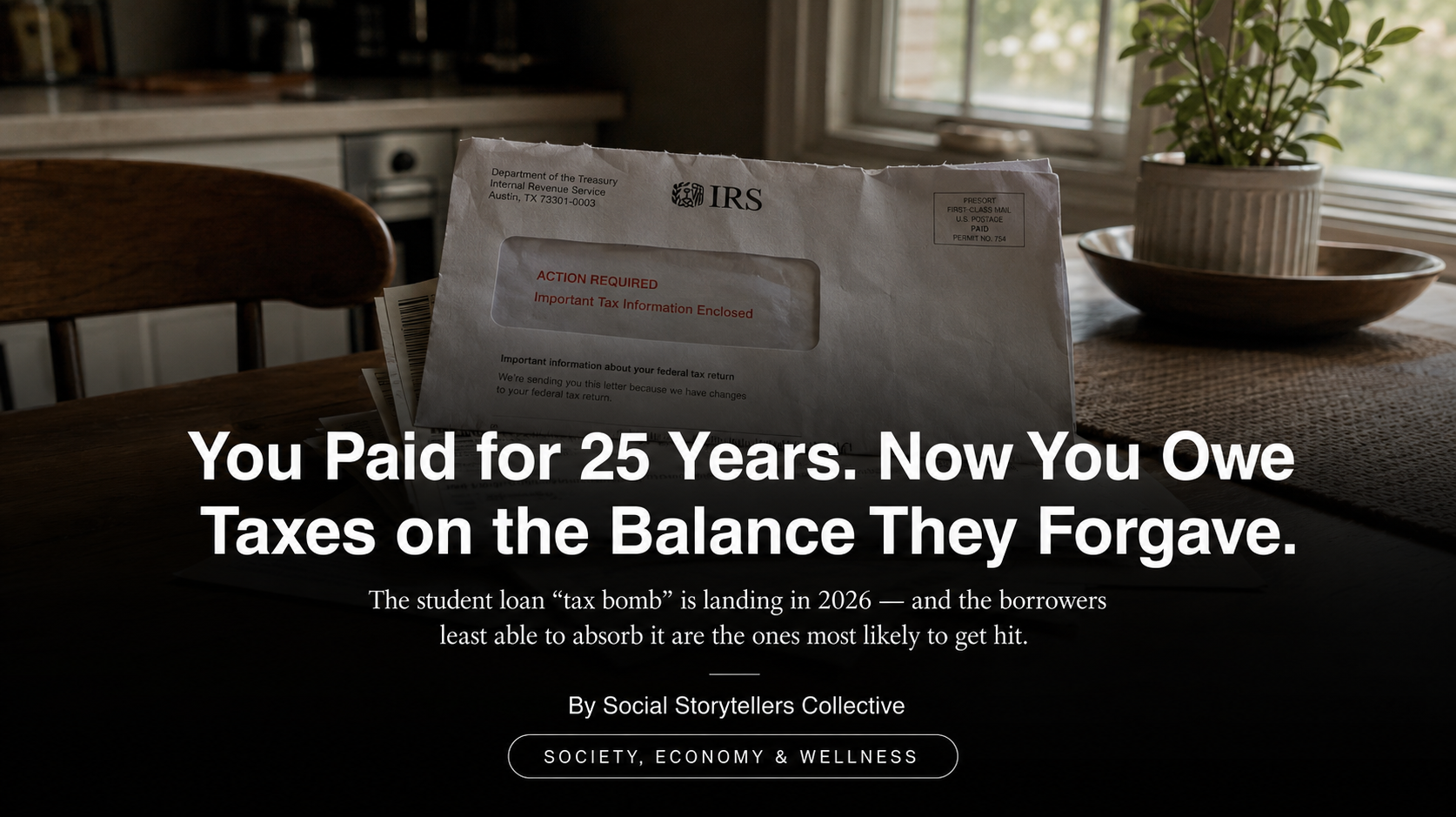
The headline this week was that the Education Department is approving another round of student loan forgiveness under income-driven repayment plans — a court-ordered development that represents real relief for borrowers who have spent decades making payments on debt that outpaced their income from the start. For people crossing the 20- or 25-year finish line, this moment should feel like resolution.
For many of them, it is about to feel like a trap.
As of January 1, 2026, federal student loan forgiveness under income-driven repayment plans is taxable again. The provision that shielded discharged debt from federal taxation — enacted as part of the American Rescue Plan Act of 2021 — expired on December 31, 2025, and Congress did not extend it. That means borrowers receiving IDR forgiveness this year will receive a Form 1099-C from the IRS treating the forgiven balance as ordinary income in the year it was discharged. The IRS does not care that the money never passed through their hands. The debt was cancelled. In the eyes of the tax code, that counts as income.
The math is punishing. A borrower earning $50,000 a year who has $40,000 discharged sees their taxable income jump to $90,000 for that year alone. Their federal tax bill goes from roughly $5,900 to nearly $14,700 — an $8,800 swing arriving with no warning at what was supposed to be the end of the road. For borrowers with average forgiven balances near $49,000, estimates put the federal tax liability between $5,800 and more than $10,000, depending on income and filing status. State income taxes, depending on where the borrower lives, can add more on top of that.
This is not a design flaw. It is a design feature. Income-driven repayment plans were structured around the premise that borrowers with limited incomes would make low monthly payments — sometimes as little as zero dollars — with interest accruing throughout. After 20 or 25 years, whatever remained would be forgiven. The problem is that the accrued interest means the forgiven balance at year 25 is often dramatically larger than the original loan. A borrower who started with $30,000 and made income-based payments for a quarter century can arrive at discharge with $60,000 or $70,000 being forgiven — and a tax bill that reflects that inflated number, not what they actually borrowed.
The borrowers most likely to be hit hardest are the ones the system was supposedly designed to help. IDR plans were built for people with high debt and low income — social workers, teachers, public sector employees, caregivers. People who borrowed to access opportunity and spent decades in fields that don’t compensate at the level their debt assumed. These are not people sitting on savings accounts they can tap for a five-figure tax payment. Many of them have spent 25 years making sacrifices premised on the promise that the balance would disappear. It is disappearing. And now they owe money on it.
There is a partial protection for some borrowers. Under a legal agreement between the American Federation of Teachers and the Education Department, borrowers who became eligible for forgiveness in 2025 — even if their discharge wasn’t formally processed until 2026 — are shielded from the new tax liability. The operative detail is documentation: borrowers in that situation need dated records confirming their eligibility was established before December 31, 2025. For everyone else, 2026 forgiveness events are fully taxable.
The broader context makes this harder. The Education Department pulled its IDR payment tracking tool from StudentAid.gov in April 2025, leaving borrowers with no independent way to verify how many qualifying payments they had accumulated or how close they were to discharge. As of this writing, the tracker has not been restored. More than 530,000 borrowers remain in the processing backlog. The administration has spent the past year fighting court orders requiring it to process discharges it had been delaying — and those court orders are the reason approvals are moving at all.
Two decades of payments. A balance that grew while they made them. A tracker that disappeared. A tax bill they didn’t know was coming. And a $1.8 billion Anti-Weaponization Fund created this same week for people who say the government treated them unfairly.
The student loan system has never operated the same way for everyone. 2026 is making that visible in the tax code.