
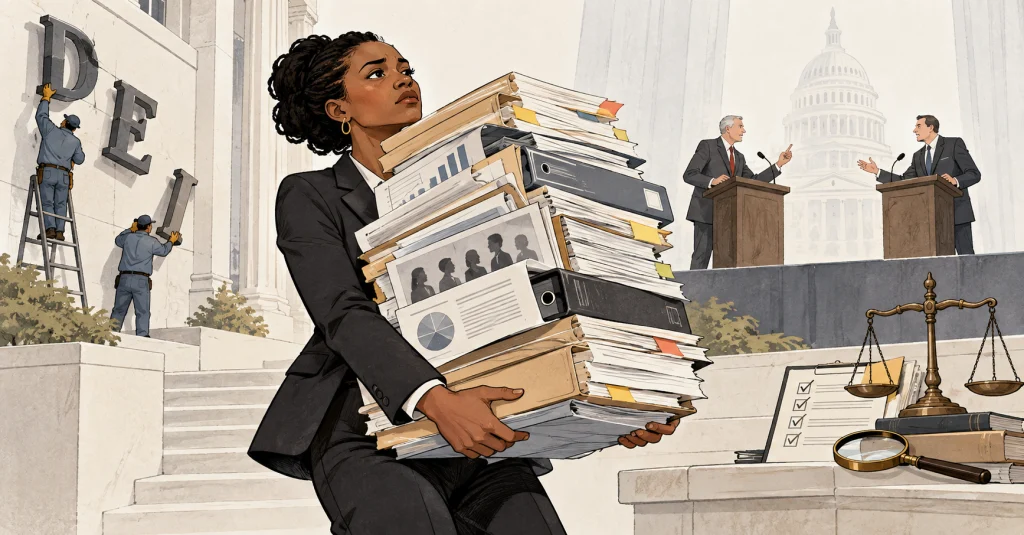
Cornell William Brooks and Kevin Roberts argued over DEI. The more important question is who has to prove discrimination still exists once the government stops looking for it.
By Will Davison Jr.
When former NAACP president Cornell William Brooks asked the Harvard Kennedy School to put him on stage with Heritage Foundation president Kevin Roberts this month, the event was billed as a debate over diversity, equity and inclusion. Roberts, widely seen as the architect of Project 2025, described DEI as a divisive totem that undermines social cohesion and argued that the country’s progress since the civil rights era is being ignored. Brooks answered that blaming DEI for division is, in his words, “like confusing aspirin with the headache,” and pointed to ongoing discrimination lawsuits and data on the disproportionate discipline of Black students as proof that inequality is not a relic. The Washington Post’s Laura Meckler moderated, and by TheGrio’s account the two men parted cordially, with Roberts calling it an honest policy disagreement.
It was an honest disagreement, but it was not the one most people think they’re watching. The argument over the acronym has become a way to avoid a harder question: once the programs are gone and the enforcement is thinned out, who bears the burden of proving that discrimination is still happening? Right now, that burden is quietly moving from institutions to individuals.
Roberts deserves a fair hearing on his strongest point. He favors diversity efforts built on geography, income and first-generation status rather than race, and there is real merit in that idea. Class-based outreach reaches students that race-conscious admissions often missed, including rural and low-income white students. It is more durable legally, and it answers a fair criticism of the corporate DEI industry, which too often produced mandatory trainings and glossy statements instead of measurable change. Brooks himself acknowledged overlap with parts of Roberts’ approach, and critics of DEI are not wrong that some of what was sold under that label was performance rather than policy.
The problem is that race-neutral tools have been tested, and the results are on record. After the Supreme Court ended race-conscious admissions in 2023, Black enrollment in MIT’s incoming class fell from roughly 13 percent to about 5 percent, and at Amherst College it dropped from 11 percent to 3 percent, according to NBC News. California offers a longer view. Economist Zachary Bleemer’s study of Proposition 209, the state’s 1996 affirmative action ban, found it pushed thousands of Black and Latino applicants into less selective schools each year and reduced their degree attainment, including in STEM. It also lowered their average early-career wages by about 5 percent a year. Income and geography are useful proxies, but they are proxies, and the data show they do not fully substitute for what they replaced. If race-neutral policy is going to carry the weight, it has to be judged by outcomes, not by intention.
That is where Roberts’ case on progress runs into trouble. He argues the country no longer faces the challenges of 1965, and in many ways that is true. But progress is a claim that can be measured, and the measuring is exactly what is being dismantled. TheGrio reports that more than two-thirds of the lawyers in the Justice Department’s Civil Rights Division have been sidelined. Meanwhile, the Equal Employment Opportunity Commission received 91,503 new discrimination charges in fiscal year 2025, up 3.4 percent from the year before, with race among the most common bases alongside disability and retaliation. People are still filing. The question is how many of those claims will be investigated by an agency with the staff and mandate to pursue them, and how many will fall to workers who have to find, fund and win their own cases.
This is the pattern SSC keeps returning to across very different stories. When a formal system steps back, the problem it addressed does not disappear. The cost moves onto the people least able to absorb it. A federal loan cap becomes a student’s crowdfunding page. A thinned enforcement office becomes an employee’s private lawsuit. Dismantling DEI programs while simultaneously weakening civil rights enforcement does not create a race-neutral playing field. It creates a system in which discrimination has to be proven one case at a time, by the person experiencing it, with fewer public allies than before.
Brooks’ sharpest point was about merit. He noted that under this administration, merit seems to come up mainly when Black and brown people are being evaluated, and he’s right that the concept is being applied selectively. Legacy admissions, donor preferences and referral-based hiring rarely draw the same scrutiny as programs designed to widen the pipeline. If merit is the standard, it should be applied to every advantage in the system, not only to the ones created to offset historic exclusion.
The way through this debate is not to defend every program that ever carried the DEI label, and it is not to accept that the label’s retirement ends the conversation. It is to insist on evidence. If the administration believes race-neutral policies can sustain opportunity, it should fund the data collection to prove it, publish enrollment and hiring outcomes, and fully staff the offices responsible for enforcing civil rights law. If those numbers hold, Roberts’ argument wins on the merits. If they don’t, the country will know exactly what was lost and who paid for it.
Roberts told the audience he wasn’t denying the country’s history of injustice. The test of that statement is whether his side is willing to keep looking for injustice in the present, with the same tools and seriousness it uses to measure progress. Brooks called the pursuit of a racially diverse democracy an everyday fight. It becomes a much harder one when the people doing the fighting are also expected to gather all the evidence themselves.
Sources: TheGrio, “Ex-NAACP president Cornell William Brooks challenges ‘Project 2025’ architect in heated debate over DEI,” by Brandon Caldwell, September 28, 2026; NBC News reporting on post-ruling enrollment at selective colleges; Zachary Bleemer, “Affirmative Action, Mismatch, and Economic Mobility After California’s Proposition 209,” UC Berkeley Center for Studies in Higher Education; EEOC fiscal year 2025 charge data as summarized by Gen Re.