
The World Cup does not arrive in Los Angeles until this summer, but the labor conversation it is generating has already begun — and as World Cup Labor Is Becoming an Immigration Story in Los Angeles makes clear, it is unfolding inside a specific pressure point. Roughly 2,000 food-service workers connected to SoFi Stadium are asking for protection from immigration enforcement during tournament operations, effectively forcing a confrontation between FIFA’s global messaging and the federal enforcement environment shaping who can safely participate in the event’s labor system. That framing is precise, but it is not contained to Los Angeles. It is the first visible expression of a broader pattern now taking shape across host cities.
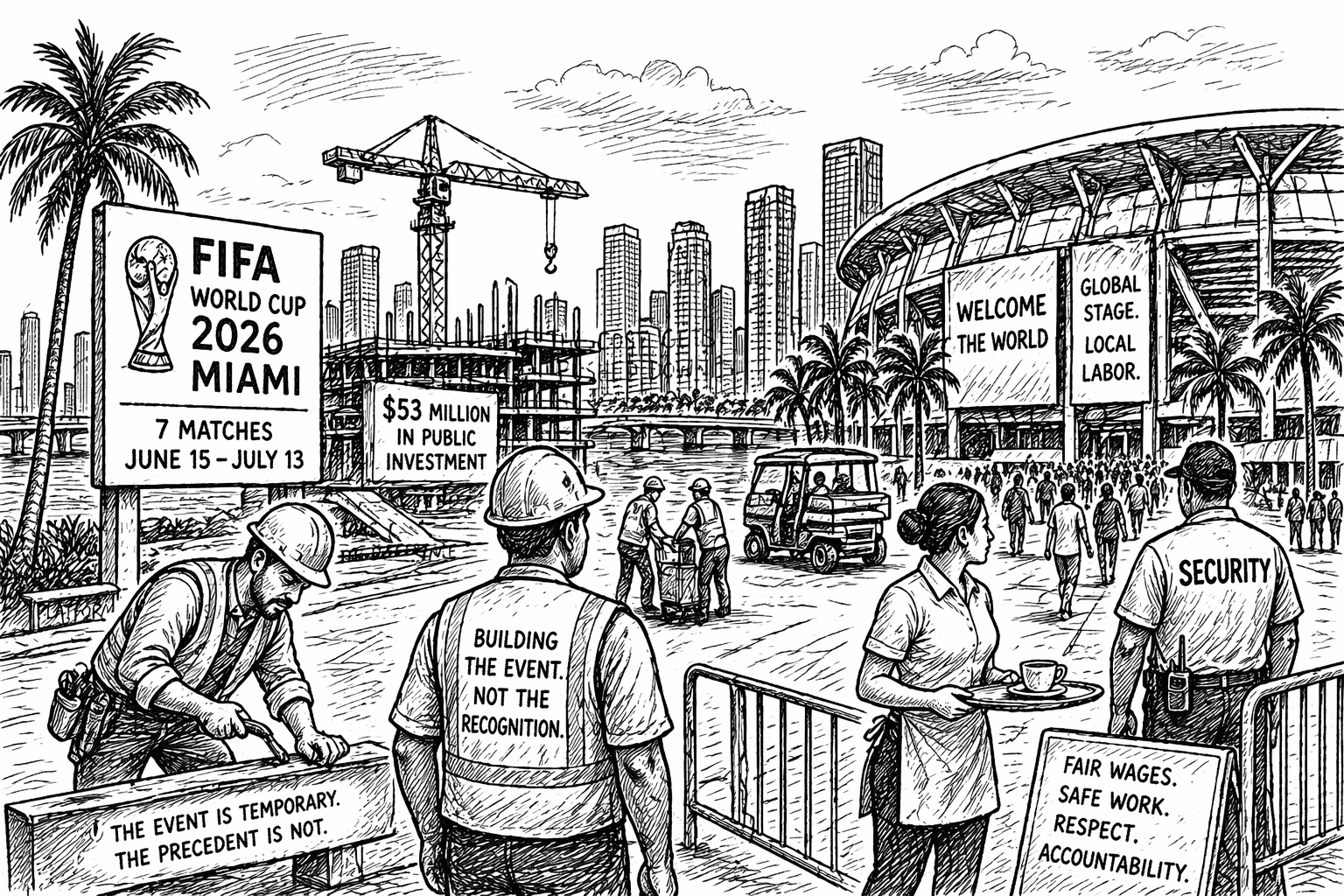
In Miami, that pattern is emerging through a different entry point but producing the same underlying question. Labor and community groups are pressing organizers and local officials for enforceable worker protections ahead of the city’s seven scheduled matches, backed by approximately $53 million in public investment. The demands are less centered on immigration explicitly and more focused on wage standards, hiring practices, and accountability mechanisms. But the structure is the same. A global event is arriving with significant economic upside, and the workers responsible for delivering that upside are negotiating the terms under which they will be allowed to participate in it.
The difference between Los Angeles and Miami is not the existence of the issue. It is the visibility of the pressure point. In Los Angeles, immigration status makes worker precarity legible immediately. In Miami, where the policy environment is different, the same precarity appears through labor standards and enforcement gaps rather than through explicit immigration confrontation. The underlying condition does not change. Workers remain central to the event’s execution and peripheral to its guarantees.
This is where the narrative of the World Cup begins to separate from its operating reality. The event is marketed through tourism, economic growth, and global unity, but those outcomes are dependent on a workforce that is often temporary, underprotected, and structurally replaceable. Whether the vulnerability is framed through immigration enforcement, as in Los Angeles, or through wage and labor protections, as in Miami, the same question persists. Who is secure enough to sustain the system, and who is expected to absorb its risk?
The automation layer connects both cities more directly than it initially appears. Stadium operations in Los Angeles and Miami have both accelerated the adoption of self-service systems and AI-driven ordering, reducing reliance on human labor over time. The World Cup provides justification for expanding those systems under the pressure of scale. For workers, this is not a separate issue from immigration or wage protections. It is part of the same negotiation over whether their labor is treated as essential infrastructure or as a temporary input that can be minimized once the event is delivered.
What emerges across these cities is not a series of isolated labor disputes. It is a distributed system of negotiation shaped by local policy environments but driven by the same structural incentives. FIFA requires operational certainty at scale. Cities require economic return on public investment. Employers require flexibility in how labor is deployed. Workers are positioned at the intersection of those requirements, carrying the responsibility of execution without equivalent guarantees of protection or stability.
The Los Angeles workers made the contradiction explicit by naming immigration enforcement directly. Miami is extending that conversation by naming the broader labor conditions that make the event possible. Together, they reveal that the World Cup is not simply a global sporting event moving from city to city. It is a system that reproduces the same labor dynamics across different policy contexts, adapting its pressure points while maintaining its underlying structure.
What this moment clarifies is that the labor story of the World Cup is not confined to one issue or one city. Immigration in Los Angeles is the most visible expression, but it is part of a larger pattern in which participation in the event’s economic system is conditional, negotiated, and unevenly protected. The question is not whether the event will proceed. It is under what terms the people sustaining it are allowed to exist within it.