
NEWS DESK | SOCIAL STORYTELLERS COLLECTIVE
Part of The Access Shift — an ongoing series examining how access is being quietly reshaped across American life.
Most people feel a gas price spike at the pump and move on. What they don’t see is where it goes next.
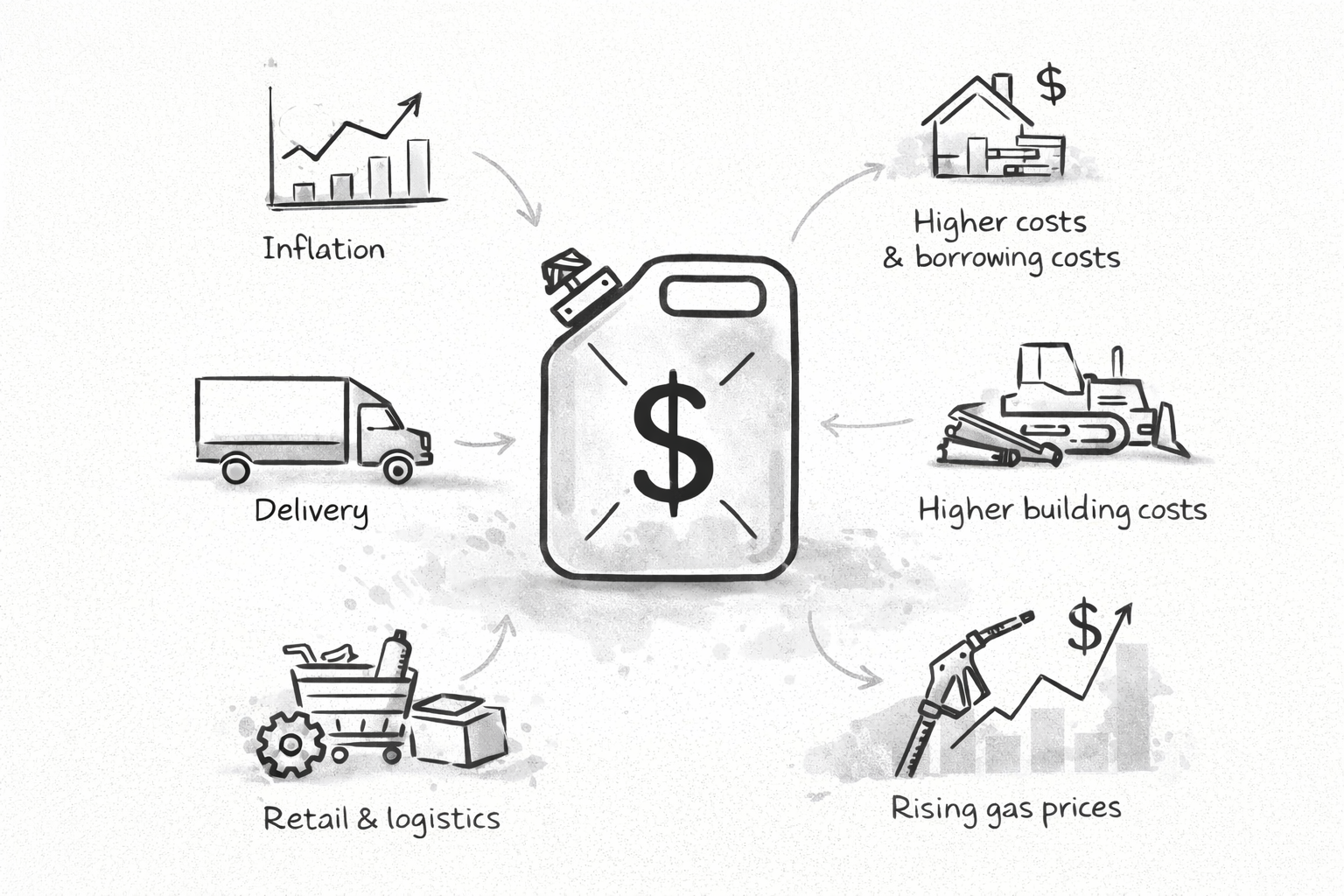
Because transportation sits at the center of how the American economy actually functions, fuel costs don’t stay contained. They travel — through supply chains, construction sites, grocery aisles, and mortgage rates — spreading in ways that rarely get traced back to their origin.
Start with freight. According to the American Trucking Associations, trucks move roughly 72 percent of all goods in the United States. When diesel gets more expensive, the cost of moving everything gets more expensive with it. Delivery companies add fuel surcharges. Retailers adjust shipping fees. Businesses absorb higher logistics costs and pass them downstream. By the time a product reaches a shelf, the price of getting it there is already baked in — quietly, invisibly, on top of whatever the item itself costs.
Housing follows a similar logic. Lumber, steel, and appliances don’t arrive at construction sites on their own — they’re transported, often long distances, by vehicles that run on fuel. The heavy equipment already on those sites runs on diesel. As operating costs rise, homebuilding gets more expensive. That cost eventually shows up in sale prices and, further down the chain, in what buyers pay to borrow.
The broadest effect is inflation — and here the transmission mechanism becomes harder to see but no less real. The U.S. Energy Information Administration identifies transportation fuel as one of the largest energy expenses for American households. When fuel prices push costs up across multiple sectors simultaneously, overall price levels rise. When inflation stays elevated, policymakers respond by keeping borrowing costs higher for longer. Mortgage rates, in that sense, are downstream of the gas pump in ways most buyers never consider.
What households tend to experience is the accumulated feeling of it — expenses rising in several places at once, without an obvious single cause. Understanding the connection doesn’t make the pressure lighter. But it does explain why a change at the gas station has a way of showing up, weeks later, in places that seem to have nothing to do with driving.
If fuel costs influence so many parts of the economy, where else might rising transportation costs quietly appear in everyday life?