
Here is what IMAX actually is, before the acquisition speculation starts. It is not a theater chain. It is the infrastructure that decides which films get the largest, most immersive commercial presentation available — and which ones don’t. That distinction is the only thing that matters about this week’s news.
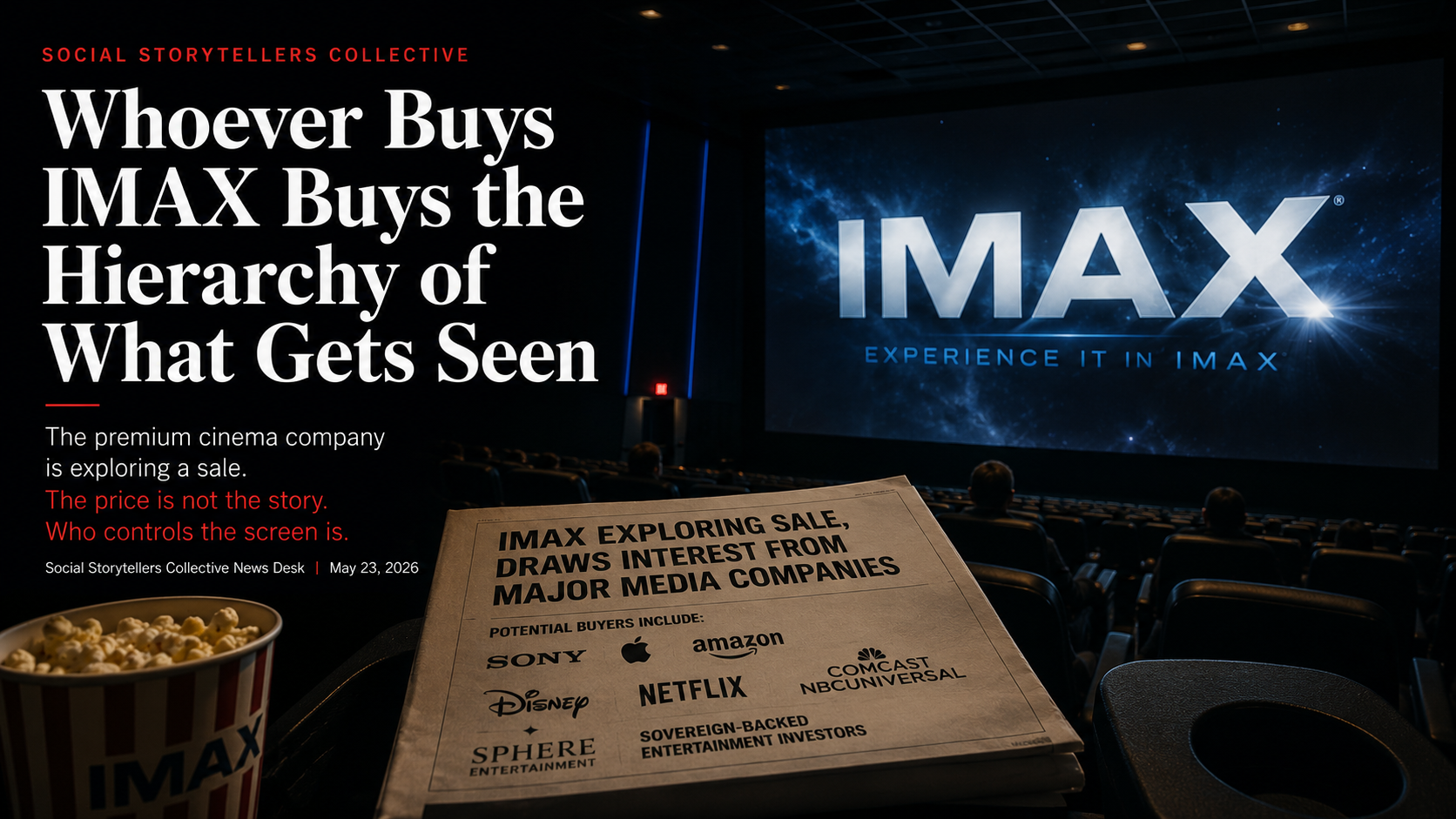
IMAX is exploring a sale. The company has approached entertainment firms as potential buyers, according to The Wall Street Journal. Shares jumped 11% in after-hours trading Thursday and continued rising, up roughly 14% by Friday. The process is early. A deal is not guaranteed. What is already guaranteed is the conversation the announcement opens — because the buyer list reads like a complete map of who currently controls the American entertainment economy. Sony. Apple. Amazon. Disney. Netflix. Comcast/NBCUniversal. Sphere Entertainment. Sovereign-backed entertainment investors. Every major player with a content library and a distribution strategy has a reason to want what IMAX has. The question is what happens to everyone else when one of them gets it.
The growth story is real. IMAX generated a record $1.28 billion at the global box office in 2025 — more than 40% above 2024 and 13% above its previous record set in 2019. Its domestic box office share rose from 3.2% in 2019 to 5.2% last year. Premium screens including IMAX now account for 16% of U.S. and Canadian ticket sales, up from 13% in 2021. Project Hail Mary has made nearly $670 million at the worldwide box office since its mid-March release in IMAX. The broader theatrical business has spent years fighting streaming for survival. IMAX has been taking share.
That growth is precisely what makes ownership consequential. Eric Wold, executive director of equity research at Texas Capital Securities, put the structural conflict plainly: a major Hollywood studio acquiring IMAX would immediately face a problem no amount of money resolves. No studio wants to share its premium release windows with competitors, and no competing studio would accept a rival controlling which films get the IMAX slate. The same logic applies to exhibitor circuits. The asset is valuable because it is neutral infrastructure. The moment it belongs to one studio, it stops being neutral.
This is not a cinema story. It is a power story. The screen is a hierarchy. It decides at scale what gets the full weight of the theatrical experience — the sound, the size, the cultural signal of being an IMAX release — and what gets everything else. For decades that hierarchy has operated as independent infrastructure. It is now on the market. Whoever buys it does not just acquire a company. They acquire the ability to decide, within the most premium segment of theatrical entertainment, whose stories get that treatment. That decision is worth more than the stock price.