
Chicago’s City Council fell four votes short of overriding Mayor Brandon Johnson’s veto, preserving a phased increase in tipped wages that will gradually move service workers closer to the standard minimum wage. The outcome keeps in place a policy that restaurant operators argue will raise costs and strain already tight margins, particularly among smaller establishments. The vote itself was narrow, but the structure it preserves is not. This is not a marginal wage adjustment. It is a direct intervention into a compensation model that has historically depended on instability to function.
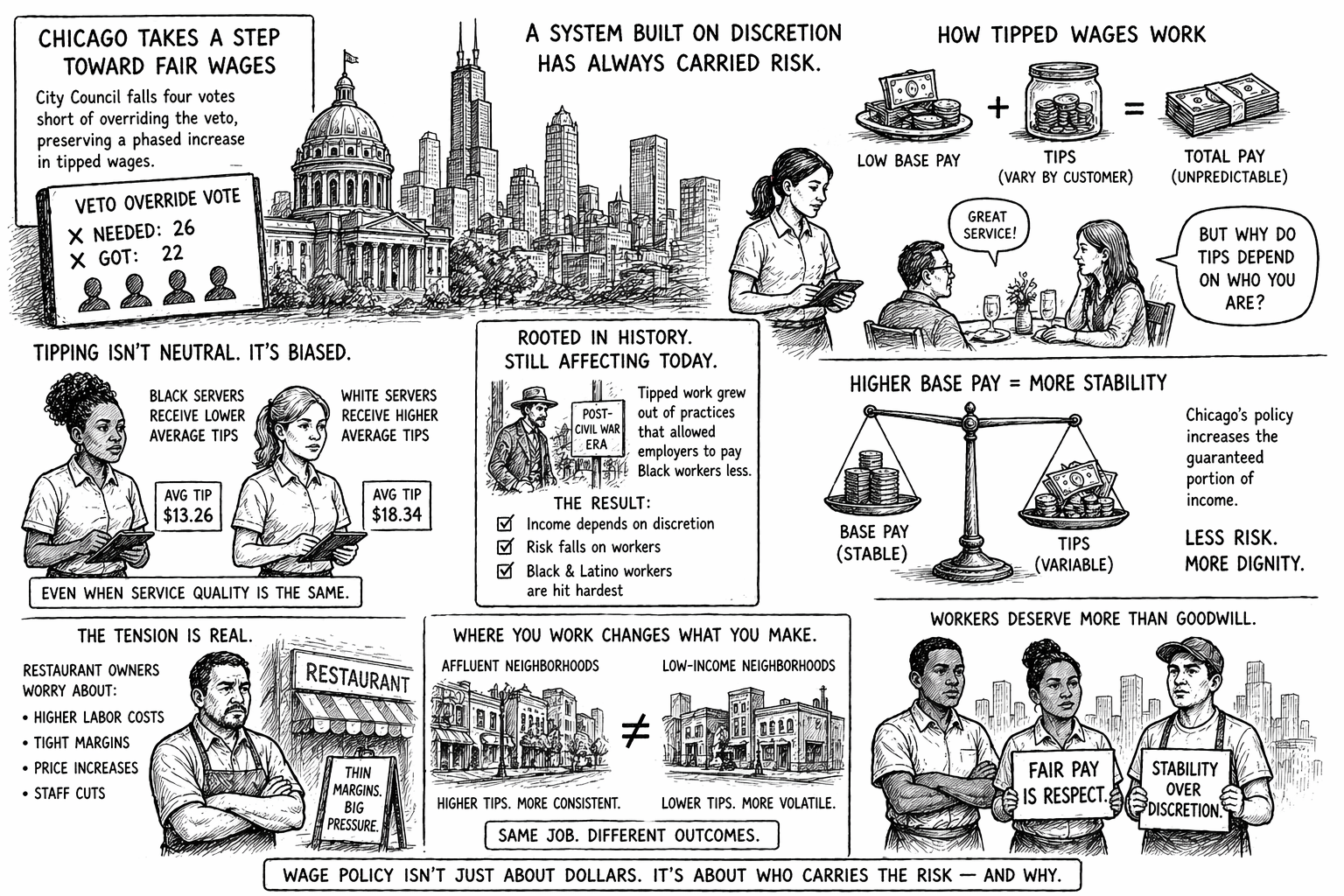
The tipped wage system has long operated as a hybrid structure in which employers pay a reduced base wage and customers effectively determine the remainder of a worker’s income. That system is often defended as flexible and performance-based, but it is also one where income varies not just by effort, but by context, clientele, and perception. Research has consistently shown that Black servers receive lower average tips than white counterparts, even when service quality is held constant. That makes tipping not just a compensation mechanism, but a site where bias can directly translate into earnings.
The racial dimension is not incidental to how the system operates. Tipped labor in the United States has roots in post-Civil War practices that allowed employers to avoid paying Black workers full wages, embedding a structure where income depended on customer discretion. While the modern system is not identical, the underlying dynamic remains. Workers carry the risk of inconsistent income, and that risk is not distributed evenly. Black and Latino workers are disproportionately represented in lower-wage service roles, meaning they are more exposed to the volatility built into the model.
Chicago’s policy shift reduces that exposure by increasing the guaranteed portion of income. It does not eliminate tipping, but it changes the balance between fixed and variable pay. That shift matters because it moves part of compensation out of a discretionary space and into a predictable one. For workers operating in environments where tipping is already inconsistent, including neighborhoods with lower average spending or less foot traffic, a higher base wage provides stability that tipping alone does not.
The tension in the policy debate reflects competing structural pressures. Restaurant owners, including many small and immigrant-owned businesses, are concerned about increased labor costs and the potential need to raise prices or reduce staff. Those concerns are not abstract. The service industry operates on thin margins, and wage increases can create immediate operational challenges. At the same time, maintaining a system that relies heavily on tipping preserves a structure where workers absorb income volatility that businesses do not.
The geographic distribution of restaurants adds another layer to the story. Higher-end establishments in more affluent, often whiter neighborhoods generate more consistent tipping income than restaurants in lower-income areas, where many Black and Brown workers are concentrated. That means the same compensation system produces different outcomes depending on location, reinforcing disparities that are not captured in average wage figures. The policy does not fully equalize those differences, but it narrows the gap by increasing the baseline.
What this moment reveals is that wage policy is not only about how much workers earn. It is about how risk is allocated within an industry. The tipped wage system places that risk on workers, making income dependent on variables they do not control, including customer bias and neighborhood economics. Chicago’s decision to move toward a higher base wage does not resolve every inequality in the system, but it shifts the structure in a way that reduces the extent to which race and perception can determine earnings in real time.