
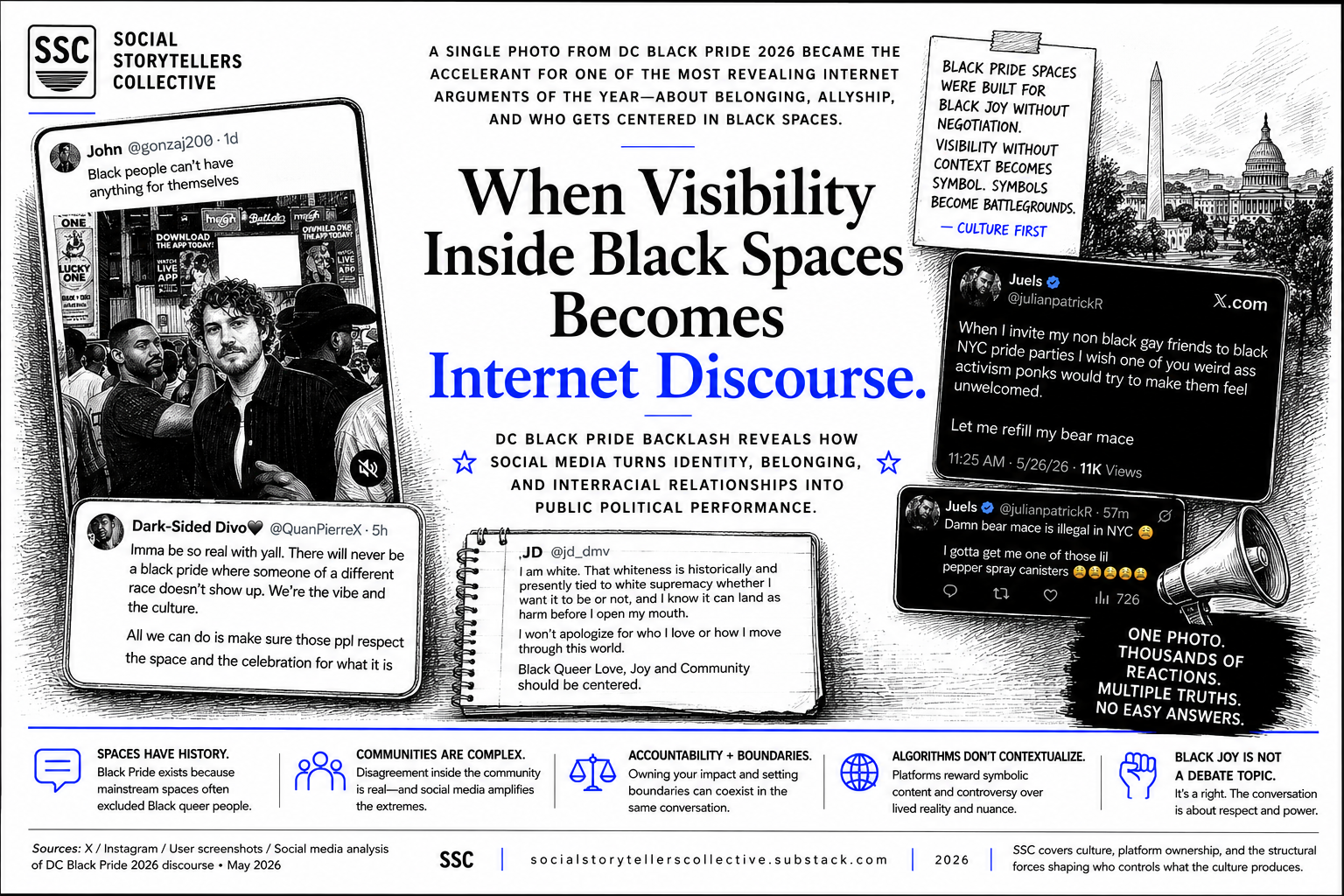
A single photo from DC Black Pride 2026 became the accelerant for one of the more revealing internet arguments of the year. White gay creator JD — Instagram handle @jd_dmv — posted images and videos from the weekend describing the event as “chosen family, good music, better people” and saying he felt “lucky to be invited.” The post moved quietly until @gonzaj200 reposted one of the images to X with the caption: “Black people can’t have anything for themselves.” That repost reached 785,000 impressions. Within hours, thousands of reactions had turned a party photo into a referendum on interracial relationships, cultural access, allyship, and who gets centered inside spaces built specifically for Black queer affirmation. The image itself hadn’t changed. What changed was the platform it landed on and the interpretive framework social media applied to it the moment it left its original context.
Black Pride spaces were not created as general LGBTQ celebrations. They emerged specifically because mainstream LGBTQ environments — predominantly white in their leadership, culture, and aesthetic — often reproduced the same racial exclusions Black queer people experienced everywhere else. DC Black Pride, one of the largest Black LGBTQ gatherings in the country, was built as an environment where Black queer joy could exist without negotiation, without being peripheral, and without performing legibility for a white gaze. That history is not incidental to the backlash. It is the entire reason visibility inside those spaces carries emotional and political weight that a photo from a rooftop bar would not. When JD‘s image circulated, it didn’t circulate as documentation of a friendship or a relationship. It circulated as a symbol — and the internet processed it accordingly.
What the piece’s original framing missed — and what the screenshots of the actual discourse reveal — is that the argument was never simply Black community versus white visitor. @julianpatrickR, a Black gay man who posts under the name Juels, responded to the backlash by writing: “When I invite my non Black gay friends to black NYC pride parties I wish one of you weird ass activism ponks would try to make them feel unwelcomed.” That post reached 88,000 views. The replies split immediately — some cosigning his position, others arguing he was minimizing a legitimate concern about space and centering. One user responded: “Imagine pepper spraying Black people for your non-Black friends.” Another wrote: “it’d be a shame to see a Black man’s life end bc of a non Black person.” The discourse had escalated from a debate about a photo to something significantly more charged — and the internal disagreement among Black users about how these spaces should function became as visible as the original controversy. That internal tension is the more structurally honest story. Black communities are not monolithic in how they think about cultural access, interracial relationships, or the politics of invitation. Social media flattens that complexity into opposing camps and rewards the most extreme positions with the most distribution.
JD‘s response across multiple Instagram Story slides was more layered than early coverage captured. He apologized for unintentionally becoming “part of the narrative” during a weekend he said should have centered “Black Queer Love, Joy and Community.” He disclosed that his romantic history and chosen family are predominantly Black, that he had dated someone with a 12-year age gap who the internet decided he was “unworthy of,” and that he had been navigating recurring harassment cycles for four years over invented narratives about his relationships. He also wrote something that the outrage cycle largely bypassed: “I am white. That whiteness is historically and presently tied to white supremacy whether I want it to be or not, and I know it can land as harm before I open my mouth.” That is not standard influencer crisis language. It is a specific acknowledgment of structural racial dynamics — and it arrived alongside his refusal to apologize for who he loves or how he moves through the world. The combination of accountability and boundary-setting is precisely what the internet’s binary framework struggled to process. He was neither fully contrite nor fully defensive, and platforms are not built to hold that middle register.
The structural tension underneath all of this is not new, but social media has made it inescapable. Black culture — and Black queer culture specifically — is among the most visible, most referenced, and most aesthetically influential forces in digital life. It shapes music, language, fashion, and the visual grammar of platforms that were not built by or for Black users. But that visibility has never translated into equivalent ownership, protection, or control over how Black cultural spaces are perceived, entered, or represented. That gap produces a specific and reasonable sensitivity around who receives attention and centering inside spaces that were built precisely because centering wasn’t guaranteed anywhere else. Algorithms compound that tension structurally: platforms are engineered to reward visual contrast, symbolic legibility, and controversy over lived context. A white creator visibly present inside a Black social environment becomes instantly readable to the algorithm — and instantly viral — in ways the relationships, history, and community that created that environment do not.
What the DC Black Pride moment signals is not simply a debate about one influencer or one weekend. It is a more fundamental shift in what community membership means when community spaces exist simultaneously as lived environments and as public-facing content ecosystems. The moment an experience is posted, it stops functioning as a personal event and becomes raw material for identity performance, political projection, and algorithmic distribution — available to anyone, interpretable by everyone, and contextualizable by no one. JD‘s final line in his response — “The virtual version is rarely the real one” — is the clearest thing anyone said across the entire discourse cycle. It is also the thing the platform is structurally designed to prevent people from believing.