
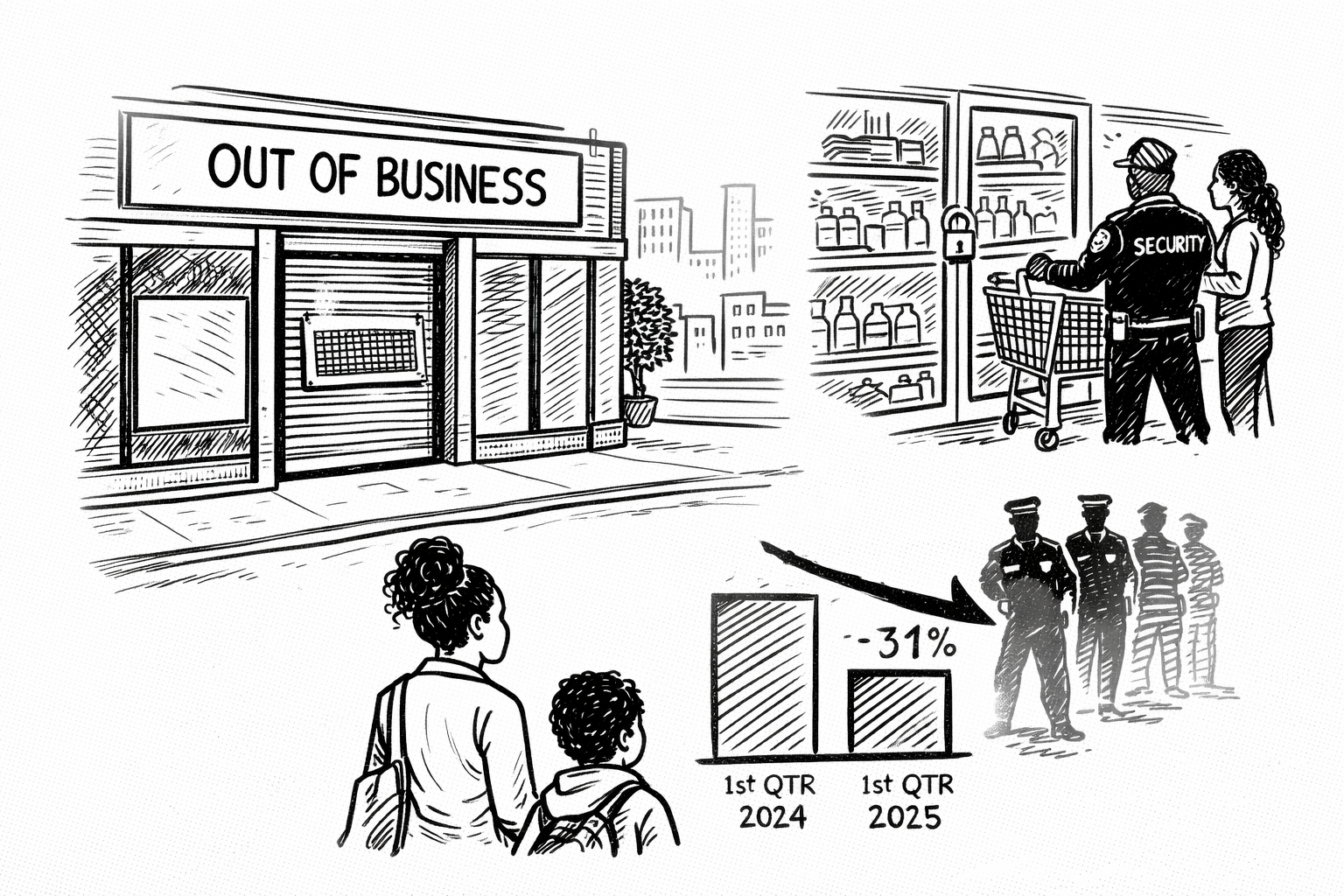
Retail theft has become one of the most reliable explanations in American retail — invoked to justify store closures, locked merchandise cases, reduced hours, and scaled-back footprints in urban neighborhoods. The problem is that in Chicago, and increasingly nationwide, the data does not fully support the story being told.
In River North, retail theft incidents declined 31% in the first quarter of 2025 compared with the prior year. Over a two-year period, Chicago law enforcement reported more than 500 felony arrests tied to organized retail crime and more than $5 million in recovered merchandise — numbers that signal active enforcement, not a system losing ground. Nationally, the Council on Criminal Justice found that shoplifting across 40 major cities dropped 10% in 2025. These declines do not make theft a non-issue. They do make a sustained, worsening retail crime crisis difficult to support as the primary explanation for what is happening to stores in urban markets.
Yet that explanation continues to circulate, and it continues to land differently depending on where you are in the city. Locked shelves, security escorts through grocery aisles, and reduced product selection have become concentrated experiences in Black and Brown neighborhoods — framed publicly as crime-response measures, but also functioning as a form of retail redlining. The message embedded in that environment is consistent regardless of intent: these customers require extra friction. That friction has a cost, in time, in dignity, and in the practical reality that a locked case requires a staff member to open it, and understaffed stores in lower-income neighborhoods are not reliably able to provide that. The result is degraded access, justified by a narrative that the data increasingly does not sustain.
What the data does sustain is a more complicated picture of why stores close and why retail footprints contract. Rising rents, escalating labor costs, e-commerce competition, and corporate restructuring decisions made at the portfolio level — not the neighborhood level — are all operating simultaneously. A major retailer closing a location in a majority-Black neighborhood may cite shrink. It may also be executing a broader consolidation strategy, or responding to a lease structure that no longer pencils out, or simply following a corporate playbook that has historically underinvested in those communities to begin with. Crime, when it is present, becomes the explanation that travels most easily in press releases and earnings calls. The other factors are harder to narrate and harder to challenge.
That asymmetry is where the policy problem lives. When closures are attributed primarily to theft, the response is more security, more surveillance, more friction applied to the customer. The structural questions — about who owns the buildings, who sets the lease rates, which communities are prioritized in site-selection decisions, and what happens to food and retail access when a store leaves — do not get asked with the same urgency. Communities losing stores are left with a story about safety in neighborhoods that are already navigating the consequences of decades of disinvestment. The narrative arrives before the remedy and forecloses the more honest conversation about why, and for whom, these places keep disappearing.