
Washington, DC now has the highest unemployment rate in the country at 6.7 percent, a figure that reflects more than a cooling labor market. It marks a contraction in a regional economy long defined by institutional stability — federal employment, government-adjacent roles, and a highly educated professional workforce. But the impact of that contraction is not landing on neutral ground. It is arriving in a city where the underlying distribution of wealth is already among the most unequal in the nation.
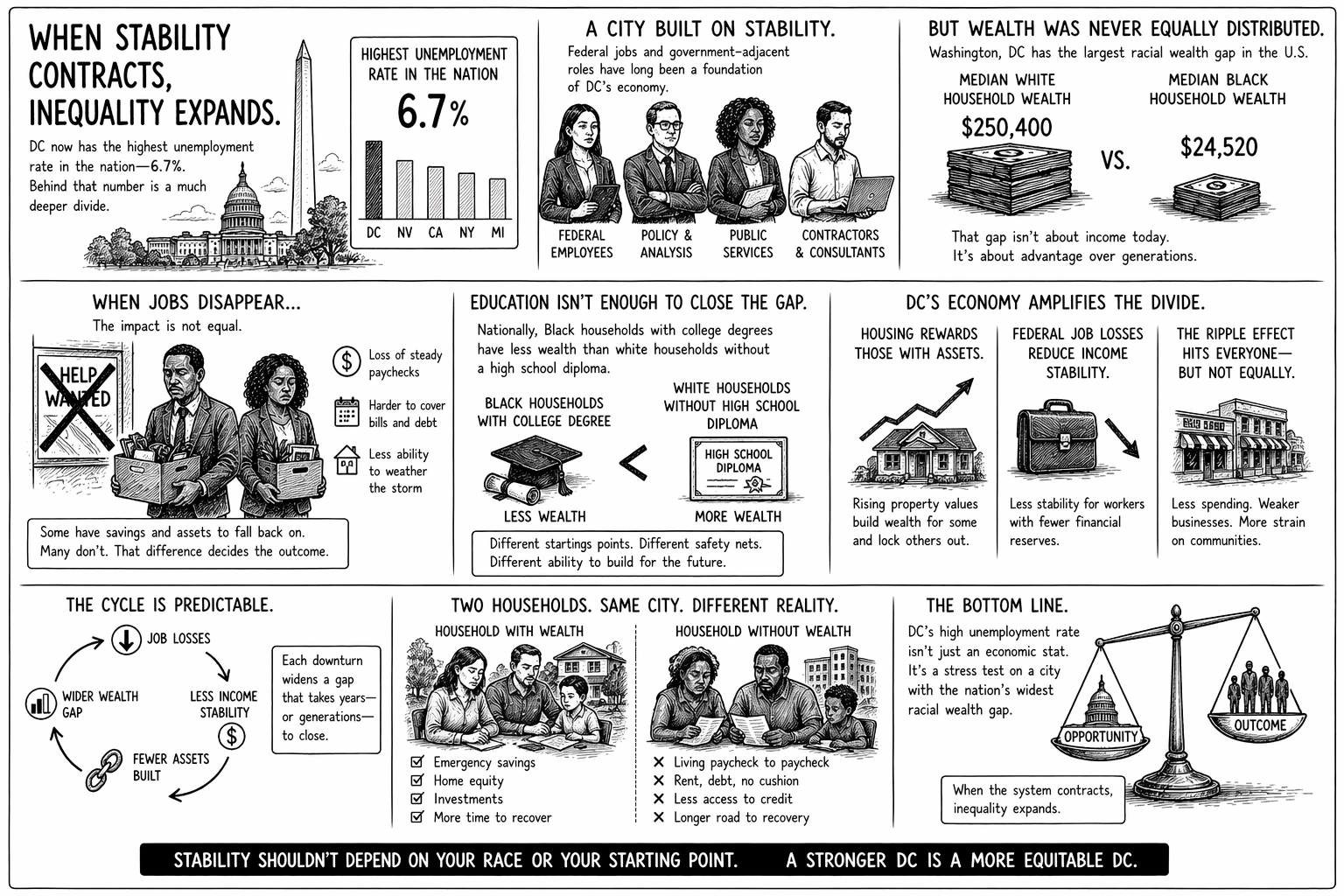
As SSC examined in DC Has The Largest Racial Wealth Gap, Washington now holds the widest racial wealth disparity in the country, with median white household wealth at $250,400 compared to $24,520 for Black households. That gap is not a reflection of income alone. It is the result of accumulated advantage over time — homeownership, inherited assets, access to capital, and the ability to convert income into long-term stability. In DC, those advantages have been distributed unevenly even as the city has grown wealthier overall.
The interaction between those two realities is where the story sharpens. The current wave of job loss is hitting a workforce that includes a significant number of Black professionals who built careers within the federal and public-sector ecosystem — one of the more reliable pathways to middle-class stability in the region. That system provided income consistency. It did not consistently translate into wealth accumulation at the same scale as white households operating within or alongside it. When those jobs contract, the difference between earning and owning becomes immediately visible.
Education does not resolve that gap. Nationally, Black households headed by college graduates hold less median wealth than white households headed by individuals without a high school diploma. That disparity reflects differences in starting position, debt burden, and access to intergenerational assets that shape outcomes long before income enters the equation. In Washington, where the workforce is highly credentialed across racial groups, the expectation that education alone produces parity is especially visible — and especially misleading. The labor market can narrow access to opportunity. It does not equalize the capacity to retain and grow what that opportunity produces.
The regional economy amplifies the effect. Washington’s housing market rewards prior ownership, with rising property values increasing wealth for those already positioned to benefit while raising barriers for those trying to enter. At the same time, the contraction in federal-adjacent employment reduces income stability for workers who were already operating with less accumulated financial cushion. The same shock produces different outcomes depending on whether a household has assets to draw from or relies primarily on income to maintain stability.
The ripple effects move outward from there. As higher-income segments of the workforce pull back, the broader local economy adjusts — reduced spending, softer real estate demand, and increased pressure on small businesses. But within that broader adjustment, the distribution of strain remains uneven. Households with limited wealth absorb shocks more quickly and recover more slowly, reinforcing patterns that predate the current downturn. What appears as a cyclical labor shift becomes a mechanism that widens structural inequality.
What this moment reveals is not simply that Washington’s job market is weakening. It is that economic stability in the region has always rested on uneven foundations. When the system expands, those differences are less visible. When it contracts, they become defining. The largest racial wealth gap in the country and the highest unemployment rate are not separate stories. They are interacting conditions, shaping how the same economic shift produces fundamentally different outcomes depending on where a household starts — and how much it has been able to accumulate before the shock arrives.