
The number on the menu is no longer the number people expect to pay. What used to feel like a straightforward exchange has become layered, conditional, and increasingly opaque. Service fees, platform fees, processing fees, and dynamic pricing models have turned everyday transactions into small negotiations — moments where the consumer must calculate, anticipate, and sometimes absorb costs that were not visible when the decision to purchase was made. The shift is subtle in any individual transaction and significant in aggregate. It is changing not just how people spend, but how they relate to the institutions asking them to.
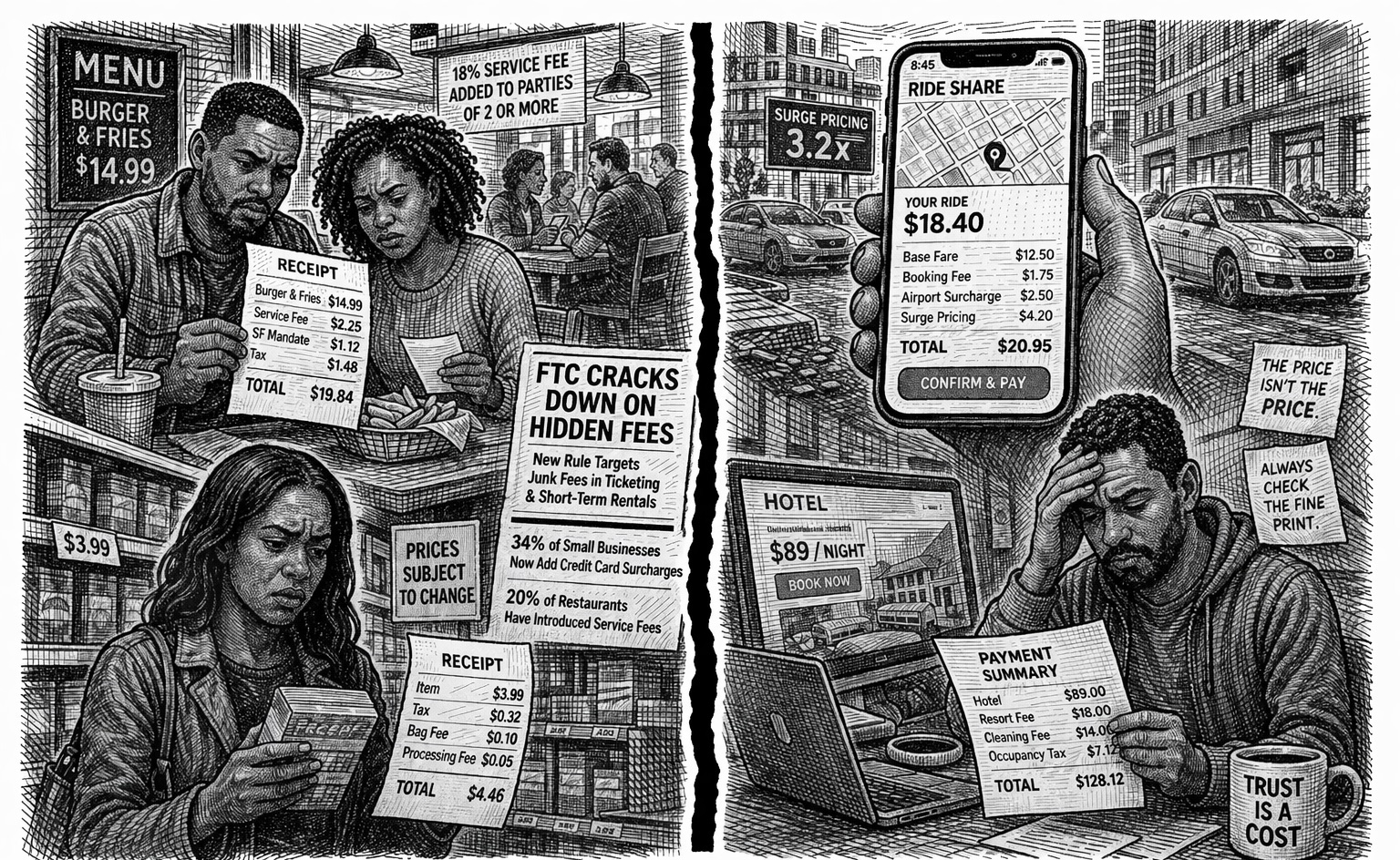
This is not just about irritation. It is about trust. When consumers assume the stated price is not the final price, they begin approaching transactions defensively. That posture extends beyond a single purchase. It reshapes expectations across sectors — from housing and travel to food and entertainment — and it creates a background level of vigilance that adds friction to exchanges that are supposed to feel routine. The transaction becomes less about exchange and more about protection. And once that defensive posture becomes habitual, it does not stay contained to the sector where it first formed.
Regulators have begun to respond in ways that signal how widespread the problem has become. The Federal Trade Commission implemented new rules in 2025 targeting deceptive or hidden fees in industries like ticketing and short-term rentals. At the same time, reporting shows that 34 percent of small businesses now add credit card surcharges and roughly 20 percent of restaurants have introduced service fees. Neither of those figures represents a fringe behavior. They represent a systemic shift in how pricing is structured and communicated — one that has normalized the gap between the price presented and the price paid.
The underlying pressure driving this is economic and real. Businesses are navigating rising costs, tighter margins, and shifting consumer expectations that make outright price increases politically difficult. Rather than raise base prices transparently, many are redistributing those costs through fees that feel smaller but accumulate quickly. For the consumer, the total price rises while the transparency declines. The experience is the same regardless of the mechanism — more money leaving the account — but the legibility of why is deliberately obscured. That obscurity is not accidental. It is a feature of pricing strategies designed to reduce the psychological resistance that transparent increases would generate.
There is also a psychological dimension to how trust erodes in this environment. Transparent price increases can be resisted, debated, negotiated, or accepted. Fragmented pricing creates a different reaction — one closer to suspicion than disagreement. It introduces a sense that the system is working against the consumer rather than with them, that the exchange is structured to extract rather than to serve. Over time that feeling compounds into a broader skepticism about fairness in everyday transactions. The credibility of the stated price becomes uncertain, and once credibility becomes uncertain, every transaction carries more weight than it should. This dynamic lands hardest on lower-income consumers who have the least margin to absorb unexpected costs and the least leverage to push back when those costs appear. That asymmetry is not limited to private transactions. As SSC reported in Cities Are Using Dynamic Pricing for Parking. Public Space Is Becoming Variable Cost., the same logic is now being applied to municipal infrastructure — parking rates that swing by more than 300 percent based on demand, imposed on workers with fixed shift schedules and small business owners who cannot budget against a floating variable. The mechanism differs. The distributional outcome is the same.
Trust erodes not through a single failure but through repeated small misalignments between expectation and reality. When people stop believing that the price presented is the price they will pay, the issue is no longer about fees. It is about credibility. And credibility, once lost at the transaction level, does not stay there. It migrates into the broader relationship between people and the institutions — commercial, civic, and financial — that depend on a baseline assumption of good faith to function.