
Houston is facing the potential loss of $114 million in state funding as Texas officials pressure the city to reverse a policy limiting compliance with certain immigration enforcement requests. A significant portion of that funding — roughly $64.7 million tied to 2026 World Cup security — is not discretionary. It is operational. The scale of the potential loss transforms what might appear to be a policy disagreement into a question of capacity, and the mechanism driving it is not legislation or court order. It is fiscal leverage — the use of funding streams to impose alignment without formally erasing the local authority being overridden. The pressure is indirect. The consequences are immediate and the precedent is the part that deserves the most attention.
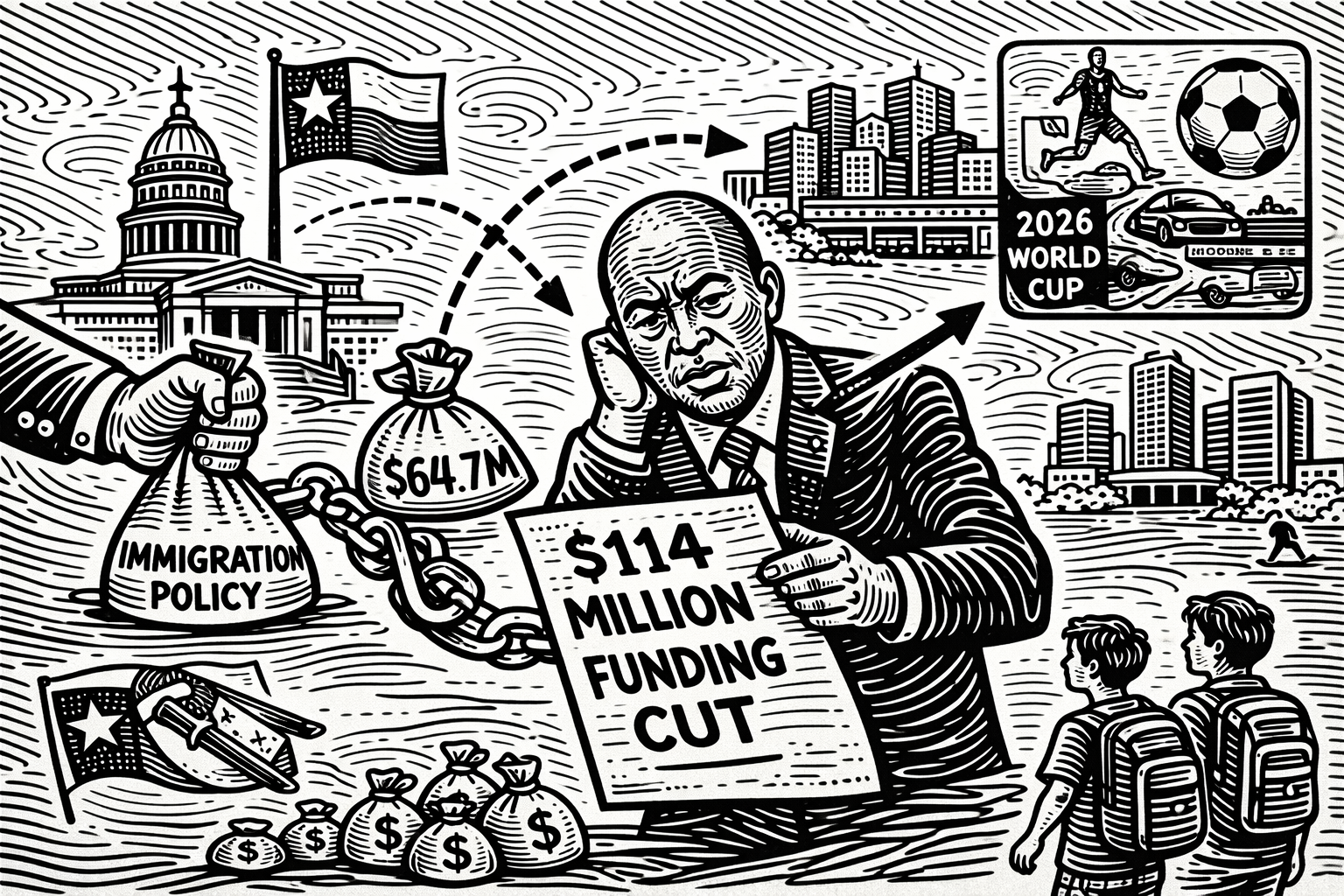
This model of enforcement has become more common across multiple policy domains — public health, education, policing, immigration — and its logic is consistent regardless of the issue it is applied to. Federal and state governments attach conditions to funding, effectively converting budgets into compliance instruments. For cities, the trade-off sharpens quickly: maintain the policy position and absorb the financial consequences, or adjust the position to preserve operational stability. Autonomy becomes a function of what a city can afford to lose rather than a function of what its residents have decided. In Houston’s case, the $114 million figure is not a number a city with a $174 million budget deficit can easily absorb — which is precisely why it was chosen. The leverage is calibrated to the vulnerability.
The stakes are amplified by Houston’s role as a 2026 World Cup host city. Large-scale international events require coordinated investments in security, infrastructure, and logistics — many of which depend on state and federal funding partnerships that cannot be easily replaced on short notice. Withholding funds tied to those preparations introduces a second layer of pressure, where global obligations intersect with local governance decisions and the cost of misalignment extends beyond internal policy debate into international visibility and contractual commitment. The World Cup deadline is not incidental to the timing of the funding threat. It is the mechanism that makes the threat most effective — a hard external clock that limits Houston’s ability to absorb the standoff and wait it out.
The broader political pattern matters beyond this specific dispute. Local governments have increasingly positioned themselves as sites of divergence on issues ranging from immigration to public safety to environmental regulation. In response, state governments have expanded the use of both preemption and conditional funding to reassert control — not by passing laws that override local decisions directly, which can be challenged in court, but by making the financial cost of local divergence prohibitive. The result is a governance landscape in which authority is less about jurisdiction and more about financial dependency. Cities can technically maintain their policy positions. They simply cannot afford to. That distinction — between formal authority and practical capacity — is where the real erosion of local governance is happening, and Houston is one of its most visible current examples.
What this moment reveals is that power is no longer exercised solely through legislation or executive action. It is increasingly exercised through the distribution and withholding of resources — a form of governance that is harder to challenge legally, harder to make visible to the public, and harder to resist without absorbing consequences that fall not on elected officials but on the residents who depend on the services those funds support. In that system, local autonomy is not a fixed principle protected by constitutional structure. It is a variable condition shaped by the ability to withstand financial pressure — and in a country where municipal budgets are structurally dependent on state and federal funding, that ability is distributed as unevenly as every other form of power.