
Across 230 feet of chain-link fencing on the National Mall, 20,000 teddy bears were arranged into a single message: “Putin abducted 20,000 Ukrainian children. Bring kids back.” Organized by Razom for Ukraine, the display transforms an object associated with comfort into one associated with absence. The scale is the point. One bear could be symbolic. Twenty thousand resists abstraction. It forces the number into physical space, where it can no longer be easily ignored.
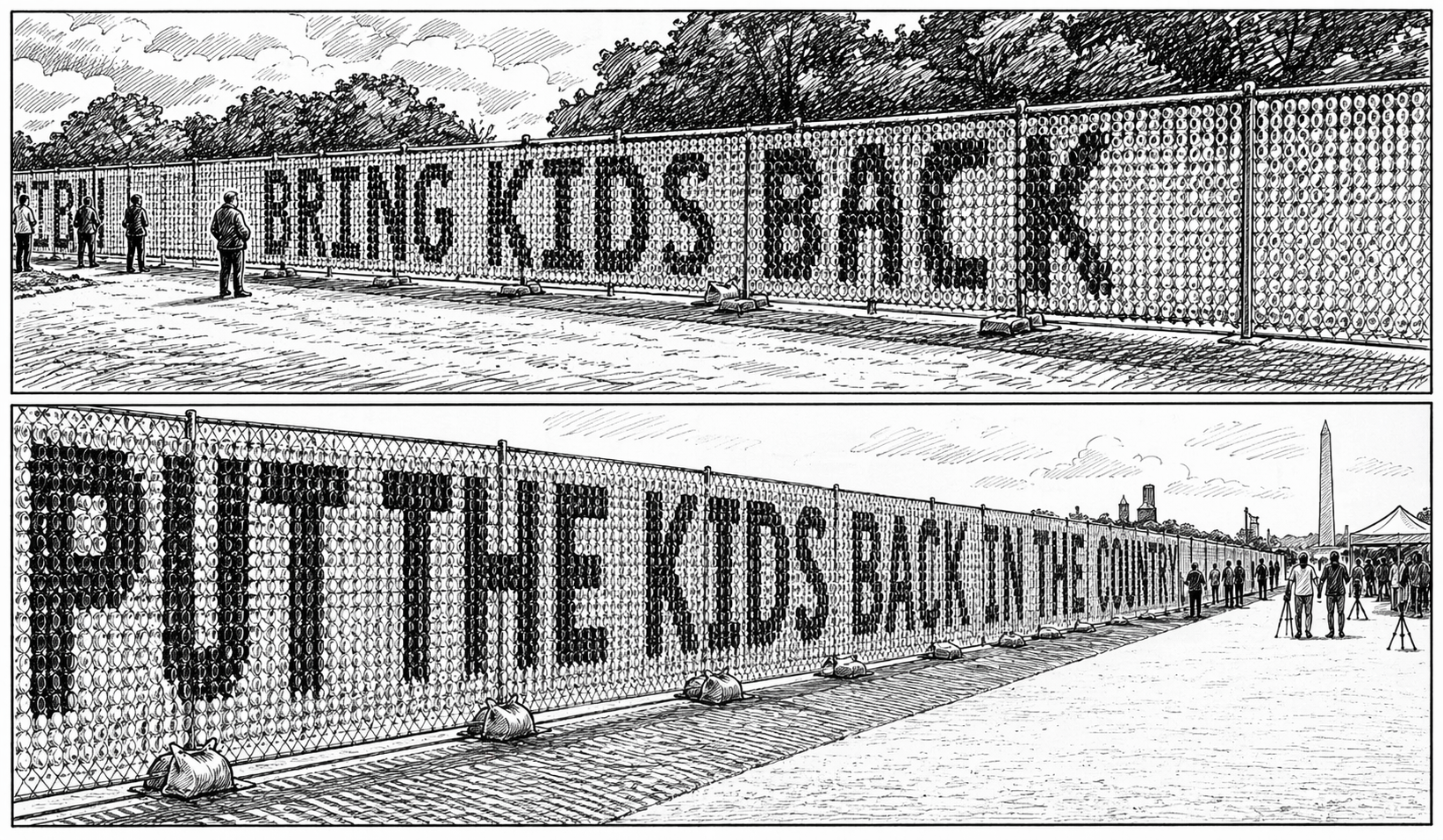
The installation does not rely on metaphor, even if it inevitably creates one. As organizer Daryna Lesniak stated, the intention was for the message to “scream.” That framing matters. Advocacy often softens reality to make it palatable. This does the opposite. It takes a statistic — allegations that thousands of Ukrainian children have been taken into Russia since the 2022 invasion — and renders it as volume, repetition, and presence. The bears are not standing in for children. They are standing in for scale.
That choice places the display within a longer tradition of protest that uses accumulation to communicate harm. Numbers alone can be dismissed or debated. Physical representation introduces friction. Visitors are not just reading about 20,000 children. They are moving alongside them, visually processing the density of what that number means. It shifts the experience from informational to spatial, from something you learn to something you encounter.
The location intensifies that encounter. The National Mall is not neutral ground. It is where national identity is performed, contested, and remembered. It is the same space where official monuments anchor history and where citizens introduce counter-narratives. By placing the installation there, Razom is not just raising awareness. It is positioning this issue within the symbolic center of American civic life — asking it to be seen alongside the country’s own defining moments and values.
There is also a strategic clarity in the message itself. It is not diffuse. It does not attempt to summarize the entire war. It isolates a single issue — the removal of children — and elevates it as non-negotiable. Lawmakers including Jamie Raskin, Amy Klobuchar, Richard Blumenthal, and Michael McCaul appeared at the site, reinforcing that this is not just an emotional appeal. It is an attempt to shape the terms of political conversation — specifically, to make the return of children central to any future negotiation.
What emerges is a different use of public space than the one typically associated with power. Where official projects often reshape space through construction, this reshapes it through accumulation. It does not alter the Mall permanently. It temporarily reorients it. For the duration of the installation, the visual field is dominated not by monuments, but by repetition — a quiet object multiplied into something overwhelming.
The installation also arrives at a moment when the National Mall is being reshaped in other ways — not through accumulation, but through redesign. Where some interventions seek to alter how the space looks through permanent or semi-permanent changes, this one operates through temporary presence. The contrast is not just aesthetic. It reflects two different approaches to influence: one that works by controlling the surface, and one that works by overwhelming it.
The teddy bears will eventually be removed. The fences will come down. But the logic of the installation lingers. It demonstrates how visibility can be constructed, how scale can be made legible, and how public space can be used to insist that certain stories remain in view. The question is not whether people understand the message in the moment. It is whether that moment translates into sustained attention once the physical reminder is gone.