
Up to 8,750 employees—roughly 7 percent of Microsoft’s U.S. workforce—could exit the company through a new voluntary buyout program targeting long-tenured staff. The structure is specific: employees whose age and years of service combine to 70 or more are eligible, creating a pathway that looks like retirement but functions as workforce reduction. The scale is notable, but the framing is more telling. This is not being presented as a layoff. It is being positioned as an option.
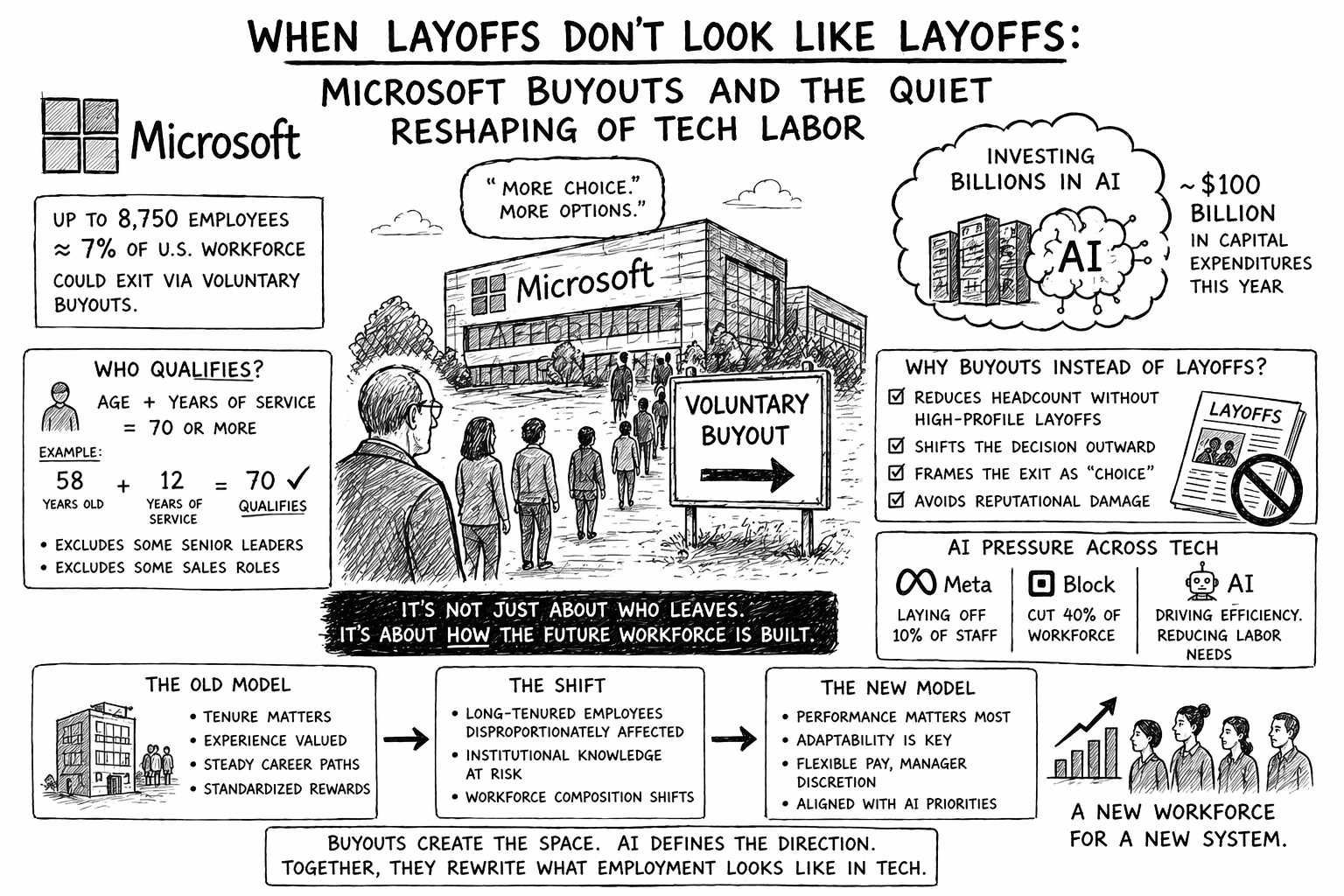
Microsoft’s internal messaging reinforces that distinction. According to reporting, the company describes the program as a way to give employees more flexibility if they are considering retirement, while avoiding the disruption and visibility of traditional layoffs. The move comes as the company continues to invest heavily in artificial intelligence, with capital expenditures projected to approach $100 billion this year. The timing is not incidental. It reflects a broader recalibration of how labor fits into a business increasingly defined by automation, infrastructure, and compute.
The use of voluntary buyouts instead of layoffs signals a shift in how companies manage workforce reductions under public scrutiny. Layoffs are immediate, visible, and often reputationally costly. Buyouts, by contrast, distribute the decision outward. They allow companies to reduce headcount while maintaining the appearance of employee agency. But that framing obscures the structural context. When incentives are offered at scale, the “choice” to leave is shaped by the conditions created by the employer, not simply individual preference.
That distinction becomes more important in the context of AI. Across the tech sector, companies are under pressure to operate more efficiently while redirecting capital toward AI development. Meta has announced plans to cut 10 percent of its workforce. Block reduced its headcount by 40 percent earlier this year, explicitly citing AI. Microsoft’s approach differs in presentation, but not in direction. The company is still reducing labor costs while increasing investment in systems designed to automate or augment that labor.
There is also a demographic dimension embedded in the structure of the buyouts. By targeting long-tenured employees, the program disproportionately affects workers with institutional knowledge—those who have accumulated experience, higher salaries, and deeper integration into the company’s operations. Replacing or redistributing that knowledge through systems, processes, or newer employees changes the internal composition of the workforce. It shifts value away from tenure and toward adaptability, performance metrics, and alignment with emerging technological priorities.
At the same time, Microsoft is restructuring its compensation model, moving away from standardized stock-based rewards toward more flexible, performance-driven incentives. On the surface, this is a shift toward recognizing high performers. In practice, it aligns compensation more closely with output in a system where expectations are being recalibrated. As AI tools increase productivity for some roles while reducing the need for others, the definition of “performance” itself begins to change.
What emerges from these overlapping moves is not just a workforce reduction strategy, but a redefinition of labor inside the company. The traditional model—where longevity, experience, and incremental advancement shape career trajectories—is being replaced by one that prioritizes efficiency, adaptability, and alignment with technological transformation. Buyouts become one mechanism within that shift, creating space for a different type of workforce to take shape.
The broader implication is that layoffs are no longer the only—or even the primary—signal of labor disruption in tech. The restructuring is happening more quietly, through incentives, compensation changes, and strategic exits that redistribute who remains inside the system. What looks like optionality at the individual level is, at scale, a coordinated adjustment to how companies allocate both capital and people.
In that sense, the story is not just about Microsoft offering buyouts. It is about how the tech industry is redefining the relationship between labor and growth. As investment flows into AI infrastructure, the role of human workers is being renegotiated—not through a single event, but through a series of decisions that, taken together, reshape what employment in the sector looks like.
And increasingly, those decisions are designed to feel voluntary.