
Canada’s labor market added jobs in March while the unemployment rate remained unchanged, suggesting a stable employment environment. Beneath that stability, the composition of job growth tells a different story. Part-time employment increased by more than 15,000 positions, while full-time employment declined slightly, producing a net gain that looks positive at the headline level. The surface narrative is one of balance. The underlying shift is toward forms of work that provide less stability, fewer benefits, and more variable income.
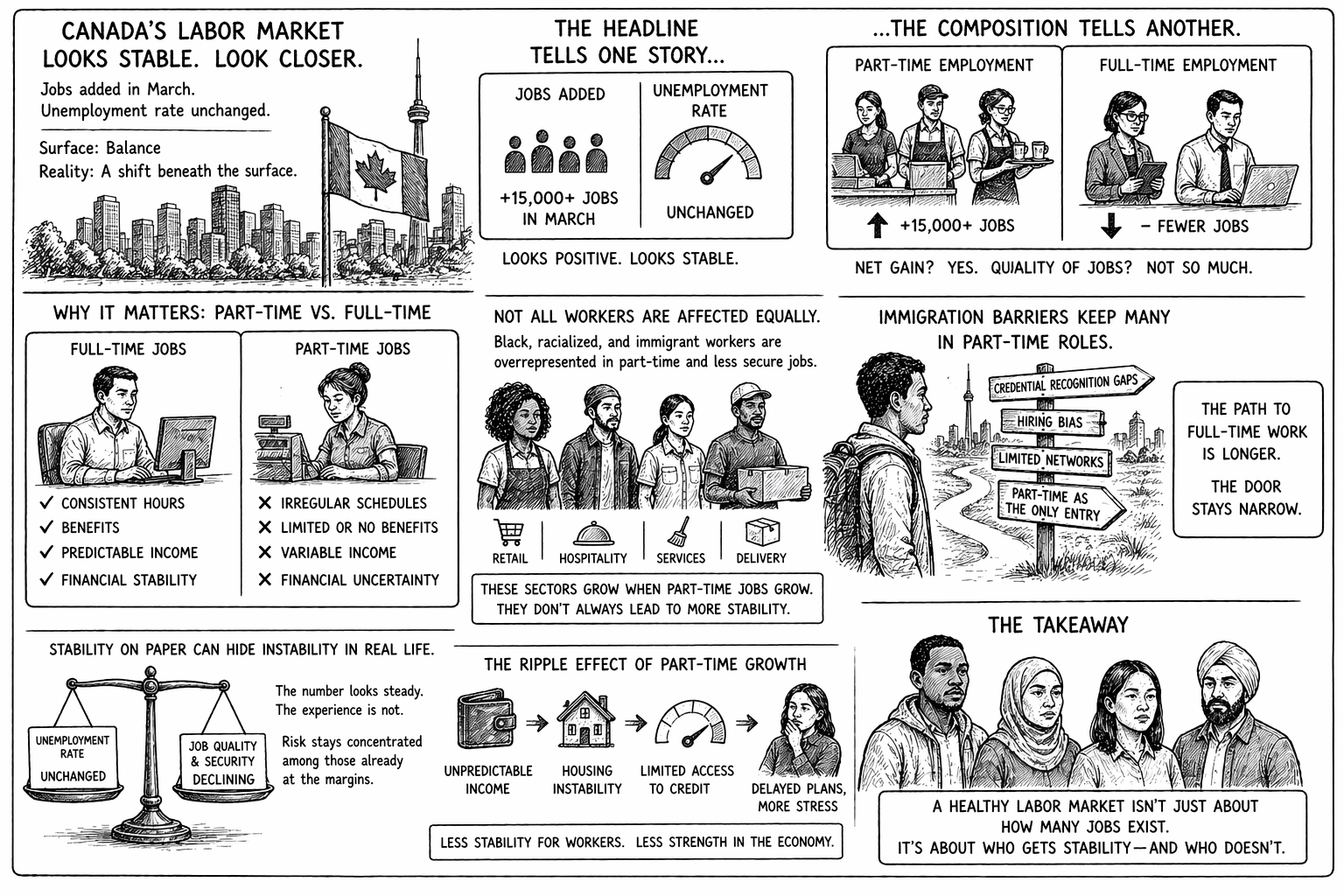
The distinction between part-time and full-time employment carries structural consequences. Full-time roles are more likely to offer consistent hours, employer-sponsored benefits, and a predictable income base that supports long-term financial planning. Part-time roles, by contrast, often involve irregular schedules, limited benefits, and greater exposure to income fluctuations. When job growth is concentrated in part-time positions, the labor market can expand numerically while becoming less secure in practice.
This shift does not affect all workers equally. Data from Statistics Canada has consistently shown that Black Canadians, recent immigrants, and other racialized groups are disproportionately represented in part-time, temporary, and lower-security employment. These workers are more likely to be concentrated in sectors such as retail, hospitality, and service industries, where part-time roles are more prevalent. When the labor market grows through these types of jobs, the expansion disproportionately includes workers who are already navigating less stable employment conditions.
The immigration dimension reinforces this pattern. Many recent immigrants, who are disproportionately non-white, face barriers to entering full-time roles that align with their qualifications. Credential recognition gaps, hiring bias, and limited professional networks often channel these workers into part-time positions as an entry point into the labor market. When full-time job growth slows while part-time roles increase, the pathway to more stable employment becomes narrower, extending the period during which workers remain in precarious positions.
The headline stability of the labor market can obscure these dynamics. An unchanged unemployment rate suggests equilibrium, but it does not capture the quality of employment or the distribution of that employment across different groups. A labor market can appear stable while shifting toward a composition that concentrates risk among those already at the margins. The aggregate number holds steady, but the experience of work becomes more uneven.
The implications extend beyond individual workers into broader economic behavior. Part-time employment affects income predictability, which in turn influences spending, housing stability, and access to credit. Workers with less stable income are more likely to delay major financial decisions, limit discretionary spending, and experience greater vulnerability to economic shocks. When a significant portion of job growth is concentrated in these roles, the effects ripple outward into the wider economy.
What this moment reveals is that labor market health cannot be fully assessed through headline indicators alone. The shift toward part-time work is not just a statistical detail. It is a structural change in how employment is distributed and experienced. For racialized workers who are already overrepresented in less stable forms of employment, that shift does not create a new inequality. It deepens an existing one, reinforcing a labor market where stability remains unevenly accessible even when overall employment appears steady.