
Part of Society, Economy & Wellness — examining how economic pressure reshapes labor, access, and everyday life.
The number reads like a cultural finding. 77% of Black Americans say they have at least one person in their lives — unrelated by birth, marriage, or law — whom they consider family, compared to 63% of non-Black adults who say the same. The play cousin who showed up at every cookout. The neighbor who kept watch from the porch. The mentor who filled gaps that schools and institutions left open. These are not symbolic relationships. They are structural ones — and the Pew Research Center study released in February 2026 begins to explain why.
These structures have roots in African kinship systems in which various relatives lived in tight communities. During the trans-Atlantic slave trade, Black family networks had to adapt when enslaved Black people were forcibly separated from their families. In response, many formed kinship bonds with other enslaved people on their plantations — networks that provided practical support when biological family members were sold away. What emerged from that rupture was not simply a broader definition of family. It was a functional architecture built to absorb what the surrounding system was designed to destroy.
That architecture has never stopped being necessary. Black adults are more likely than non-Black adults to have more than one non-relative in their family network — 58% compared to 48% — and more likely to say their non-relative family member is someone they grew up with in the same neighborhood, or someone who shares an aspect of their identity. The closeness runs deep. 73% of Black adults say they feel extremely or very close to a non-relative they consider family — nearly identical to the 77% who say the same about a spouse or partner. These are not peripheral relationships. They are load-bearing ones.
The financial dimension of that load is where the data becomes most revealing — and most connected to what SSC has been tracking across The Black Recession Is Already Here and What Doesn’t Make It Into the Cart. Nearly 59% of Black adults say they provided money to parents or other relatives in the past year, up from 39% in 2021, compared to 42% of non-Black adults. But 51% of Black adults who gave financial help say it strained their own finances, versus 35% of non-Black adults. The extended family network is not just an emotional resource. It is an economic one — and it is being drawn on at increasing rates precisely as the formal economic safety net frays. People are not expanding their definition of family because they have more. They are expanding it because the systems around them are delivering less.
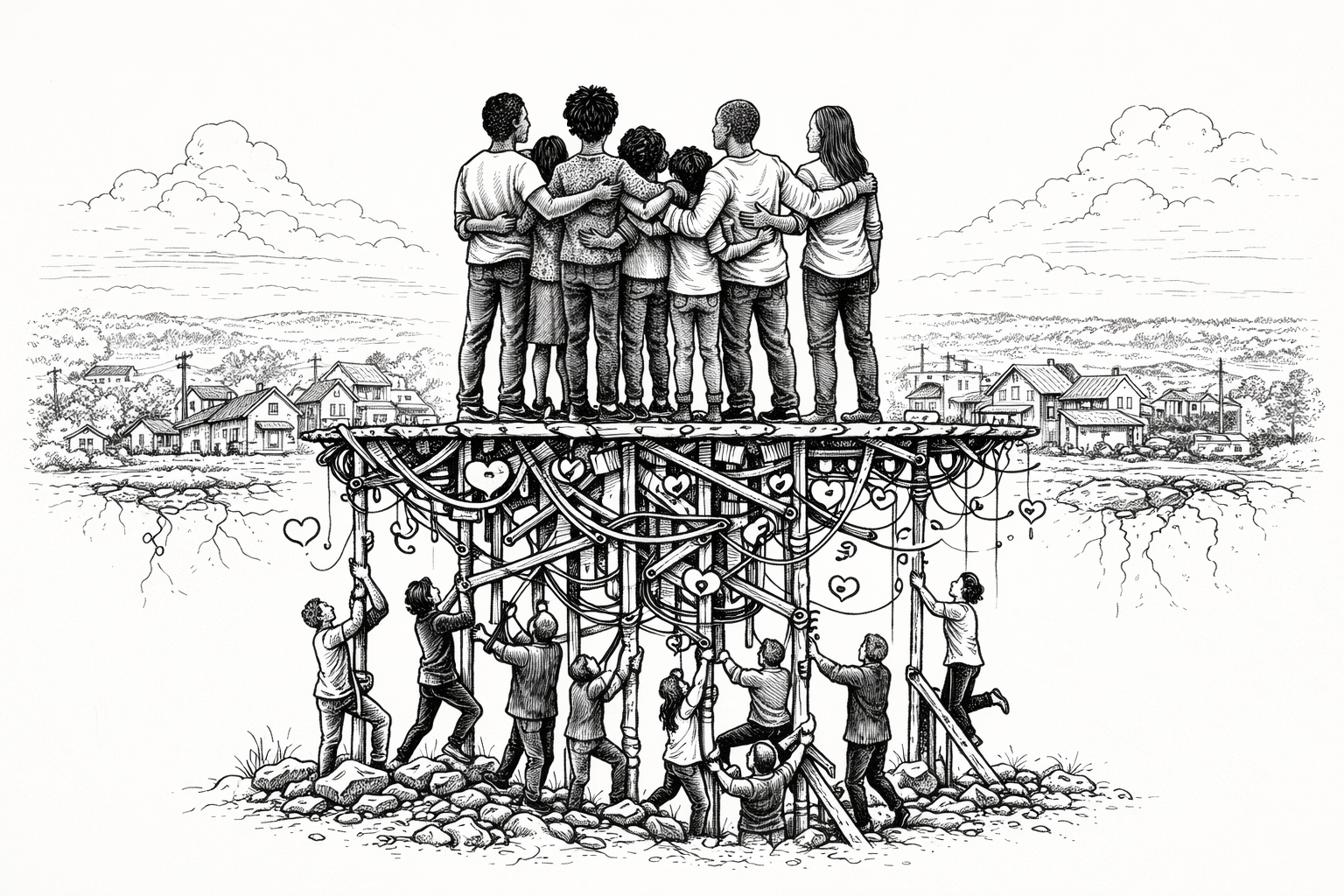
That distinction is where the concept of “chosen family” — a phrase that has been absorbed into mainstream wellness culture as something aspirational and modern — deserves a more honest accounting. For many Black Americans, what gets called chosen family is not a lifestyle preference. It is a survival infrastructure with centuries of precedent. Family networks helped Black Americans cope and survive through emancipation, Jim Crow, and persistent economic inequality — and they continue to be sources of support today, absorbing caregiving responsibilities and serving as a cultural resource despite systemic barriers. The language has softened over time. The function has not changed.
58% of Black adults say they consider other Black Americans in the U.S. to be their brothers and sisters, and nearly 80% say they feel a responsibility to look out for other Black people at least somewhat often. That sense of collective obligation is not sentimental. It is the operating logic of a community that has learned, across generations, that the institutions designed to provide stability often do not — and that the gap between what those institutions promise and what they deliver has to be filled by something. Most often, it is filled by people.
As SSC covered in The Trust Gap and Learning to Stand Where My Brother Stood, the relationship between Black communities and formal institutions — healthcare, housing, financial systems, government — has never been one of reliable reciprocity. What the Pew data quantifies is the response to that unreliability: a parallel infrastructure of care, accountability, and mutual support that functions at scale, absorbs financial risk, and holds people through the moments when the official systems either arrive too late or don’t arrive at all.
Why This Matters
Community in Black America is often described as culture — something expressive, resilient, and worthy of celebration. All of that is true. But the Pew data adds something more specific: community as compensation. A structure built in response to gaps that formal systems created and have not closed. The 77% figure is not just a measure of how broadly Black Americans define family. It is a measure of how much they have had to. The question the data raises is not whether these networks are strong — they clearly are. The question is why they have had to be — and what it would mean for the people inside them if the systems they’ve been compensating for finally held.