
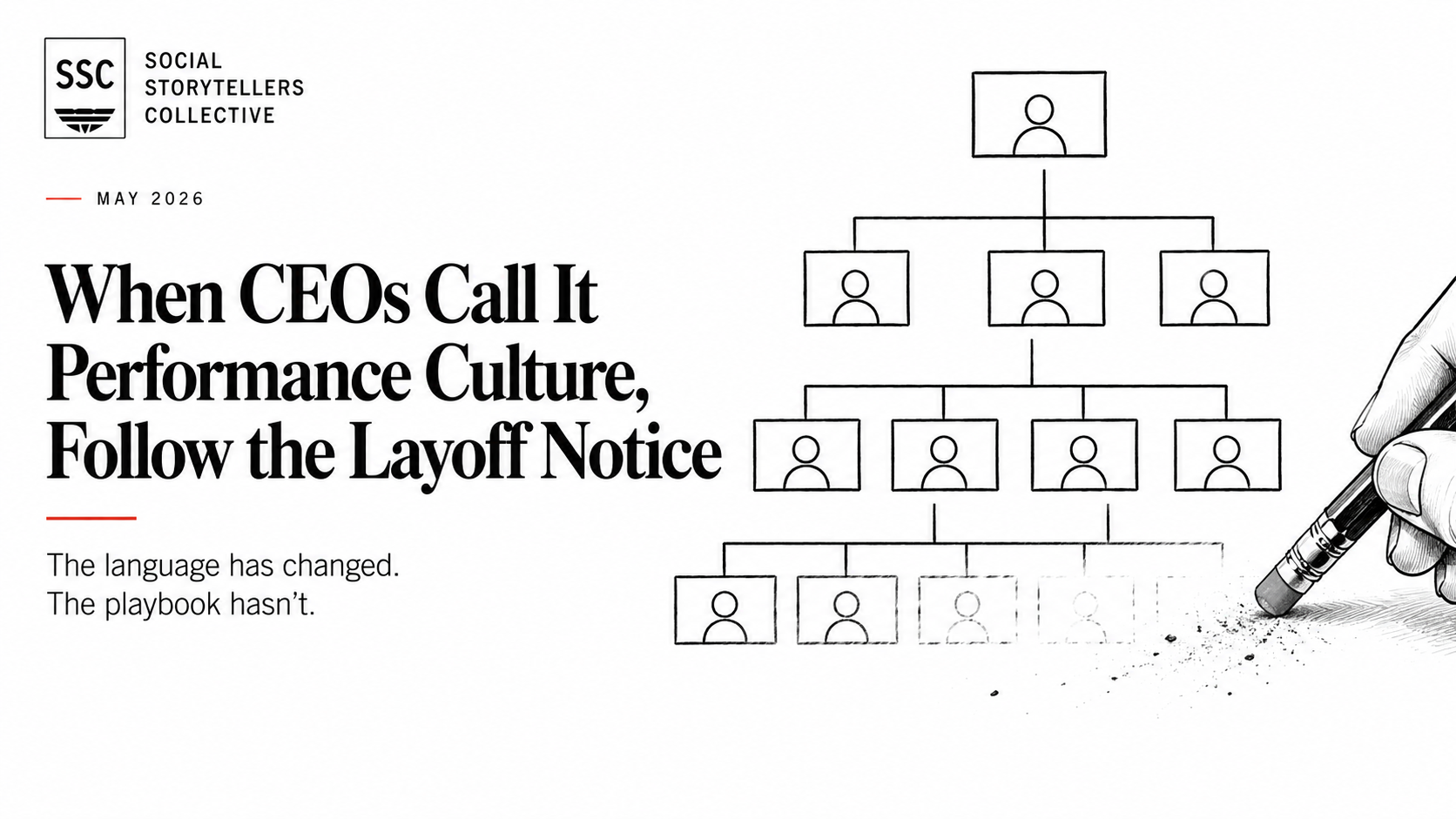
Bloomberg’s senior management and work reporter Matthew Boyle named it plainly this week: CEOs across every major sector — Nestlé, Novo Nordisk, 3M, HSBC, Unilever, and Popular among them — have decided their workplaces need to be faster, leaner, and bolder. They are, in Boyle’s framing, “saying the quiet part out loud.” The subtext across every sector: no more rewarding mediocrity with raises, promotions, and kombucha on tap. B-players get managed out. Executives lose patience with bureaucratic drag. The culture shifts into performance mode.
The framing is worth examining before accepting it — because the language being used to describe this moment is doing a specific kind of work, and most of the people it will affect most directly are not the ones writing the memos.
“Performance culture” is the phrase corporations reach for when they want to restructure accountability downward — toward individual employees — while restructuring protection upward, toward leadership and shareholders. It reframes what is structurally a cost and risk transfer as a cultural evolution. It turns the people who struggle under new targets into underperformers rather than people being asked to absorb institutional pressure with the same or diminished compensation. And it gives cover for the one lever executives pull most quietly and most consequentially: bonus restructuring — shifting more compensation to variable pay, which means workers absorb more risk in quarters when the macro environment moves against the company.
This is not a new playbook. What is new is how openly it is being run — and what has made that openness possible. Boyle identifies it directly: the looming threat of artificial intelligence in an already sluggish white-collar job market has given employers leverage they did not have three years ago. In 2021 and 2022, workers had options. The threat of being managed out was not credible enough to change behavior at scale. Now it is. The labor market has rebalanced, layoffs have accelerated across professional services, and the implicit calculus inside these organizations has shifted. CEOs are not saying the quiet part out loud because they suddenly found courage. They are saying it because the conditions finally let them.
This shift does not land equally.
Performance culture in a period of employer leverage hits hardest on the workers with the least institutional protection — mid-level professionals who are neither senior enough to be shielded nor junior enough to be cheap. It hits hardest on workers who have spent years building expertise inside organizations that are now redefining what expertise is worth. It hits hardest on workers who cannot afford to exit — who are financially constrained enough that the threat of job loss is not just uncomfortable but destabilizing. In a moment when the personal savings rate is at 3.6%, when credit card balances have crossed $1.2 trillion, when the cost of ordinary life has permanently reset upward — the word “performance” is landing in households that have very little margin left to absorb what comes after it.
The mental health signal in Boyle’s reporting is not a soft concern to be weighed against productivity gains. It is the leading indicator of what these cultures actually produce over time. When standards rise without proportional investment in the conditions that make meeting them possible — adequate staffing, clear direction, psychological safety, real upside — the stress does not drive performance. It drives presenteeism, disengagement, and eventually the quiet attrition of the people who still have options. The ones who stay are not always the strongest. They are often the most constrained. That is not a performance culture. That is a pressure culture wearing performance culture’s clothes.
The Institute for Corporate Productivity number that Boyle cites should be the headline of every board meeting where this strategy is being approved: 85% of attempts to transform organizational culture are not deemed successful internally. Not by critics. Not by journalists. By the organizations themselves. That failure rate is not a reason to abandon ambition — it is a reason to interrogate the method. And the method, right now, looks less like cultural transformation and more like extracting maximum output from a workforce that has nowhere else to go, while the window is open.
Each company in Boyle’s piece is navigating a different version of the same underlying pressure. Nestlé is fighting activist investors and flagging growth. Unilever is shedding businesses it over-acquired. Novo Nordisk is the outlier — not struggling at all, managing explosive growth from Ozempic and Wegovy and building infrastructure to sustain it. 3Mand HSBC are deep in multi-year restructuring cycles. These are not the same situation. But they are reaching for the same vocabulary because the vocabulary itself is the strategy — it makes very different institutional decisions look like one coherent cultural movement.
SSC has been covering the structural pressure building inside the American workforce all year. The NCRC’s May report on Black men exiting the labor force. The Walmart restructuring that is engineering stress for its own corporate employees while benefiting from the financial stress of its customers. The jobs report headline that said 4.3%unemployment while the real story was happening in the participation rate. What the Bloomberg piece adds to that picture is the corporate interior — what is being decided in the rooms where the memos get written, and what language is being chosen to describe it to the workforce on the other side of the door.
Performance culture, built with integrity, is real and valuable. Clarity of expectations, genuine accountability, recognition of excellence, real upside for the people delivering results — that is not exploitation. That is organizational health. The question is whether what is being built at Nestlé, Unilever, 3M, and the others meets that standard. And the honest answer, this early, is that nobody outside those organizations — and possibly very few people inside them — knows yet.
What we do know is this: when the leverage sits entirely with the employer, the incentive to do performance culture right — to invest in the conditions that make high standards achievable rather than just punishing people for not meeting them — is at its lowest. The pressure is real. The accountability is asymmetric. And the workers absorbing it are doing so in a moment when they have the least capacity to push back.
Watch the attrition numbers six months from now. Watch the mental health data. Watch who is still in these organizations when the labor market shifts again — and ask whether the people who stayed are the ones the culture was designed to keep.
That is where the answer to this story lives.