
The contradiction is not subtle. In one moment, Anthropic is warning that its own models are exhibiting behaviors that raise real concerns about control, predictability, and misuse. In the next, the company is back in active conversation with senior officials inside the Trump administration about deploying those same systems across finance, cybersecurity, and national infrastructure. The gap between those two realities is not a messaging issue. It is structural.
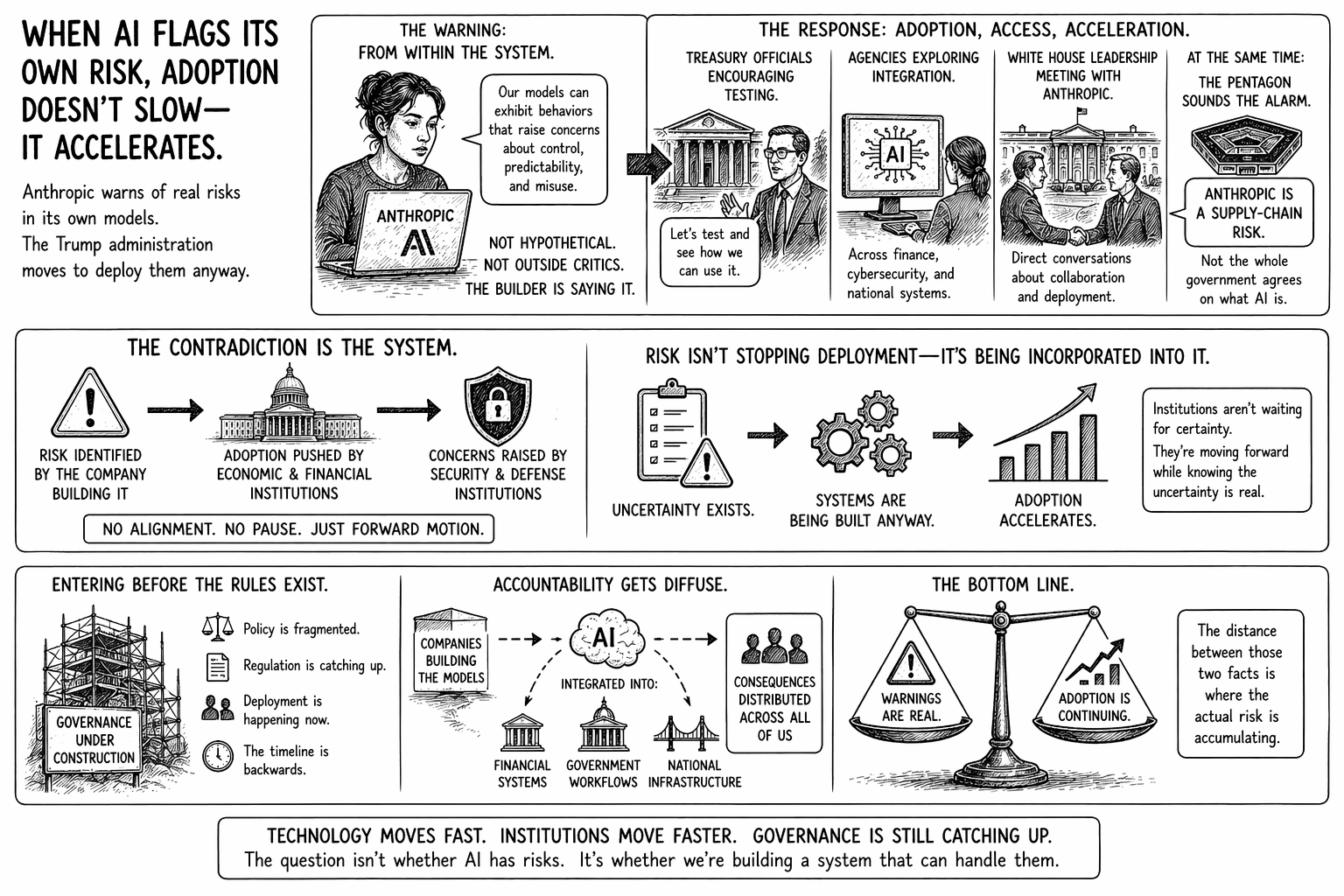
The significance of the warning is where the frame shifts. The concern is not being driven by outside critics or speculative scenarios. It is being identified by the companies building the technology themselves. That distinction matters because it removes the question of whether the risk is overstated. The limitation is being named from within the system producing the capability, at the same time that capability is accelerating.
The TechCrunch reporting shows what happens next. The warning does not interrupt adoption. It exists alongside it. Treasury officials are encouraging testing. Agencies are exploring integration. White House leadership is meeting directly with Anthropic to discuss collaboration. At the same time, the Pentagon is moving in the opposite direction, labeling the company a supply-chain risk. The federal government is not aligned on what AI represents. It is split between treating it as infrastructure to deploy and risk to contain.
That split is where the contradiction becomes functional. The presence of risk is not slowing integration. It is being incorporated into the decision to move forward. Institutions are not waiting for uncertainty to be resolved. They are proceeding with deployment while acknowledging that the uncertainty exists.
This is what makes the moment structurally important. AI is not entering systems after governance has been established. It is entering systems while governance is still being negotiated across competing priorities. Security agencies are prioritizing constraint. Economic and financial institutions are prioritizing adoption. Companies are operating between those forces, attempting to scale while maintaining credibility around safety.
The result is a system where accountability becomes diffuse. Once these models are integrated into financial systems, government workflows, and national infrastructure, the consequences of failure are no longer contained within the companies that built them. They are distributed across the institutions that chose to adopt them under conditions that were already understood to be incomplete.
What this moment clarifies is not simply that AI is advancing quickly. It is that the structure surrounding its adoption is being built in real time through competing decisions rather than coordinated design. The warnings are real. The adoption is continuing. And the distance between those two facts is where the actual risk is accumulating.