The headline out of the IoT West Africa 2026 Conference in Lagos is growth — a digital economy across the region estimated at $100 to $150 billion in annual economic activity, with fintech, e-commerce, and digital services expanding rapidly across a combined GDP of over $800 billion. The story underneath that headline is the infrastructure gap that growth is outrunning.
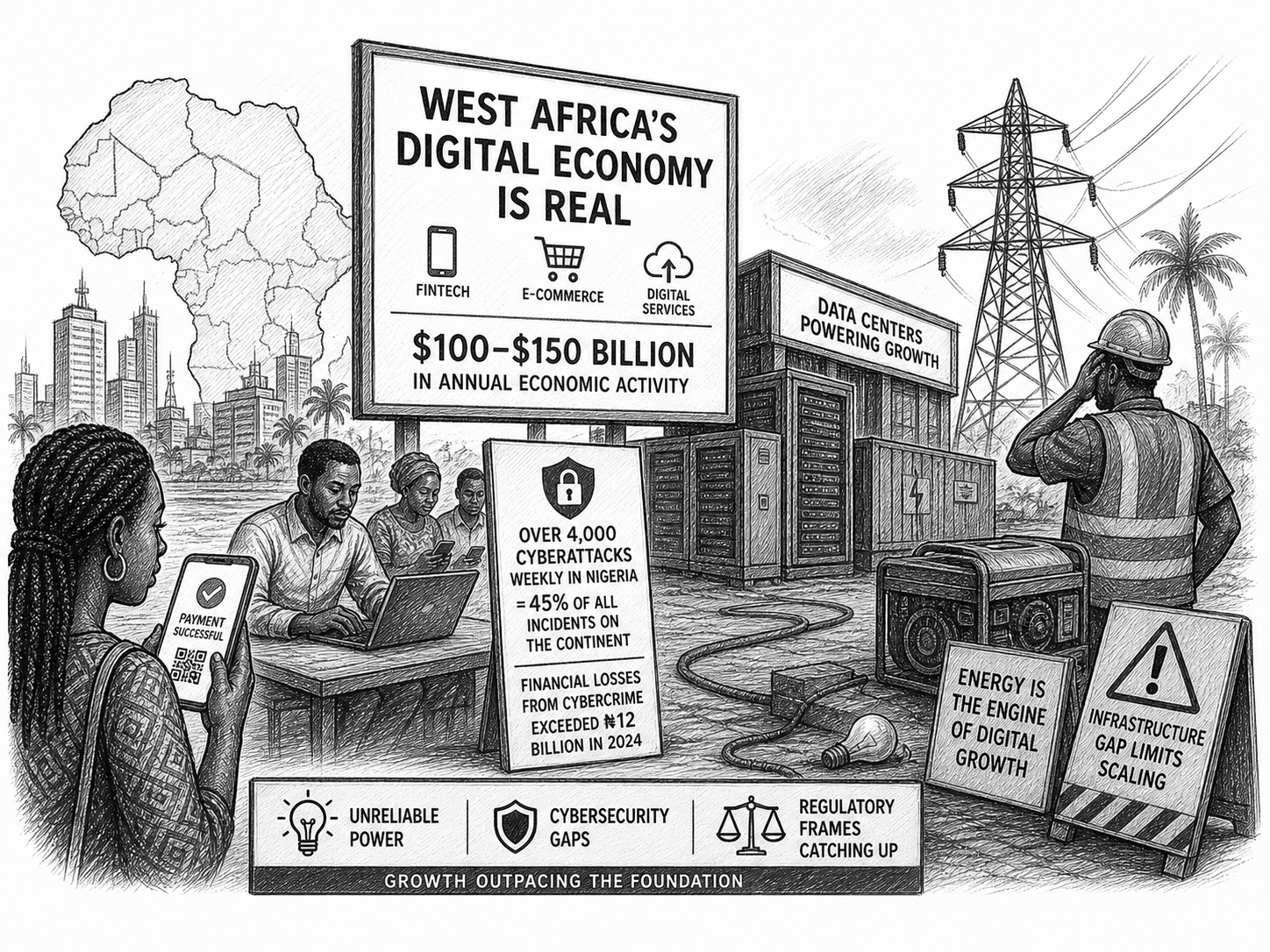
Nigeria records over 4,000 cyberattacks weekly, accounting for roughly 45 percent of all incidents on the continent. Financial losses from cybercrime exceeded ₦12 billion in 2024 alone. Globally, cybercrime costs are estimated at $10.5 trillion annually — a figure that falls disproportionately on economies that are expanding their digital footprint faster than their regulatory and security capacity can scale to match. Industry leaders at the conference were direct: energy is the machine that powers digital growth, and without fixing the power infrastructure, scaling will remain constrained regardless of investment.
This is the structural contradiction sitting underneath West Africa’s digital growth story. The countries being asked to attract foreign digital investment and build data center infrastructure at global standards are the same countries managing unreliable power grids, under-resourced cybersecurity agencies, and regulatory frameworks that are still catching up to the pace of technological change. Data centers require consistent power, cooling, and connectivity — three things that remain unevenly available across the region. Without solving those constraints, the digital economy builds on a foundation that can’t reliably hold the weight being placed on it.
What makes this an access story rather than just a tech story is who absorbs the cost when the foundation cracks. Nigeria’s digital financial infrastructure, in particular, has become a primary access point for populations that have historically been excluded from formal banking. When that infrastructure is disrupted by cyberattacks or power failures, it’s not institutional investors who lose access first — it’s the unbanked populations the fintech expansion was supposed to serve.
West Africa’s digital economy is not a future projection. It’s a present reality being built on infrastructure that needs urgent investment to match its ambition.