Seven stories. One pattern: the systems are working exactly as designed — just not for everyone inside them.
Some days don’t announce themselves. They just accumulate — story by story, sector by sector — until the shape of what’s actually happening becomes visible. Today is one of those days. Across technology, culture, labor, and identity, the same structure keeps surfacing: environments being built around behavior, credit being separated from compensation, and the people closest to the work absorbing the cost of systems optimizing for something other than them.
In technology, Uber and Expedia’s new partnership is the most visible expression of what platforms are actually building toward. Hotel booking inside a ride app is not a feature — it is a repositioning of where the trip begins, extending Uber’s reach from the last mile into the full journey. That move connects directly to the larger pattern: platforms are no longer trying to serve discrete needs. Spotify absorbing fitness, Uber absorbing travel planning — both are expressions of the same logic. The goal is continuity, an environment that anticipates the next behavior before the user decides to act on it. The structural question is not whether the integrations are convenient. It is who controls the environment once the boundaries between activities disappear — and what it costs when stepping outside it starts to feel like the inconvenient option.
In culture, the Met Gala raised $42 million last night — surpassing its previous $31 million fundraising record — and the momentum is being attributed largely to Beyoncé. That attribution is accurate as far as it goes. What it doesn’t capture is the mechanism underneath it — her presence doesn’t just attract attention, it reorganizes the system around the platform itself. Attendance patterns shift. Media coverage recalibrates. The ceiling of what an institution can produce moves. That is not a celebrity showing up. That is infrastructure activating. Pharrell’s LVERS fragrance for Louis Vuitton is being covered as a celebrity fashion moment. It is an ownership story. A Black creative not just lending his name to a luxury product but sitting at the table where the product is conceived, constructed, and positioned — that distinction, between visibility and authorship, is the one that determines whether influence translates into something durable or simply circulates until the moment passes.
In labor, Japan Airlines is testing humanoid robots at Haneda Airport. The framing is efficiency. The story is what happens when tourism grows faster than the workforce available to support it — and when that gap becomes the justification for automation rather than investment in the people already doing the work. The labor shortage did not create itself. Robots are the answer only if the question being asked is how to reduce reliance on workers rather than how to make the work sustainable.
In identity, three pieces today converged on the same underlying question — who controls the terms of how identity moves through systems. The NFL Draft red carpet remains one of the few moments where athletes author themselves before the league assigns their value, embedding family, faith, and cultural geography into their suits before the institutional frame closes around them. The emotional regulation piece lands in the same territory from a different direction — the people being asked to stay composed inside systems built for reaction are being asked to absorb a cost the system is not acknowledging. And the UK strip-search data is the sharpest version of the pattern: Black children in England and Wales are eight times more likely to be strip-searched than their white peers, accounting for 35% of all children searched despite being 6% of that age population. The overall numbers are declining. The disparity is not. Progress being used to obscure a gap that is not closing is not progress. It is reframing.
What today’s stories share is the distance between how systems describe themselves and what they are actually optimizing for — and who absorbs the weight of that distance when it goes unexamined.
Featured Story
Six Figures No Longer Signals Stability
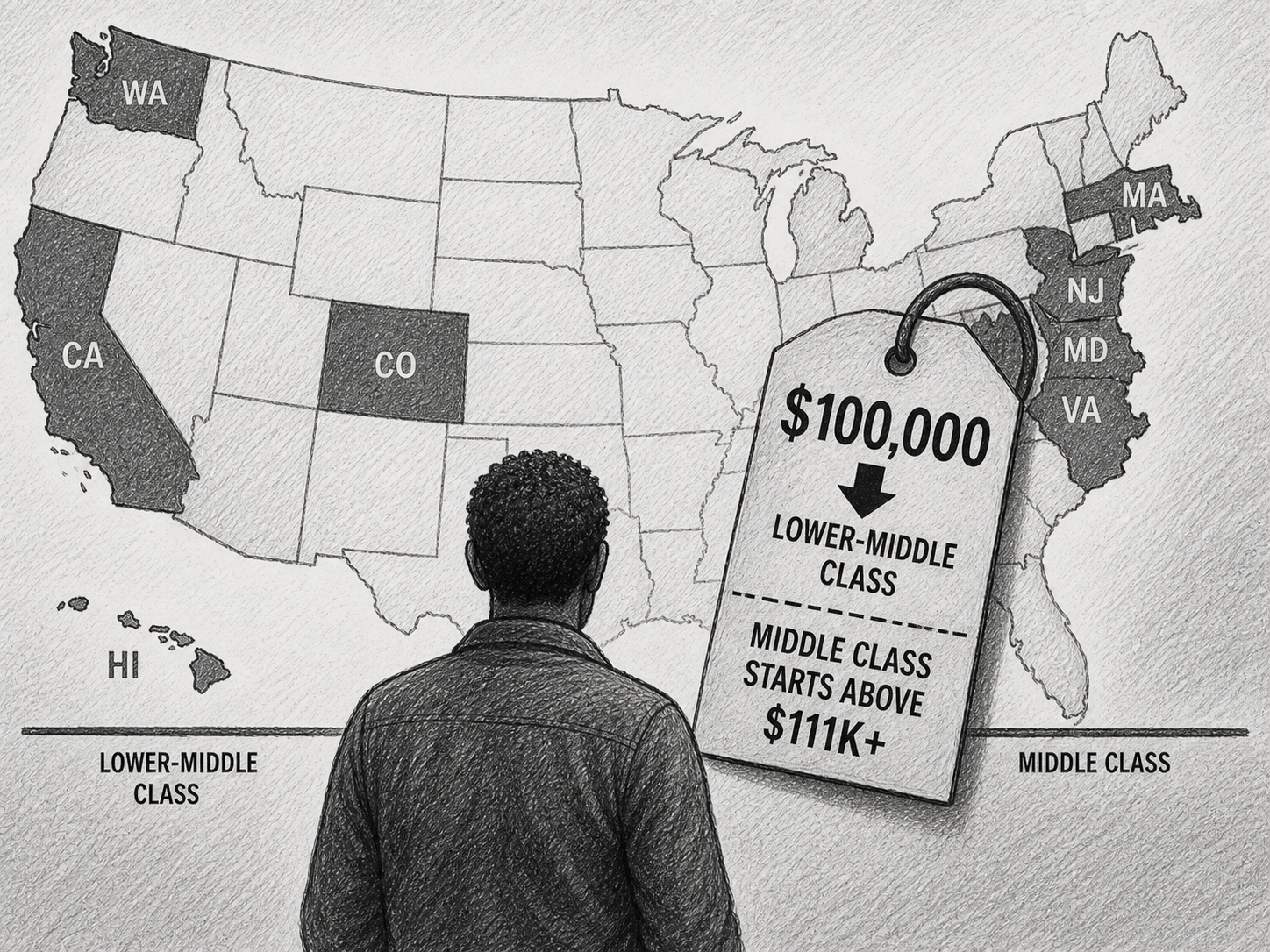
In at least 12 U.S. states, a $100,000 salary now places a household in the lower-middle class. Not by feel — by definition. Using Pew Research Center income thresholds, analysts have determined that California households need roughly $111,277 just to reach the midpoint of the middle-class range, despite a median income of about $100,149. Massachusetts sits at approximately $116,000. New Jersey at $115,000. Maryland at $114,000. Hawaii at $111,000. Washington, Colorado, and Virginia follow the same pattern. In each of these markets, the income that once signaled arrival is now positioned closer to the floor.
Read the full piece on Social Storytellers Collective.
We will be watching.