
The federal government has begun issuing refunds on up to $166 billion in tariffs collected under the Trump administration, following a February 2026 Supreme Court decision finding that the policy’s legal foundation was unlawful. The tariffs had been implemented using emergency powers under the International Emergency Economic Powers Act — a statute historically reserved for genuine national security threats rather than long-term trade policy — and the Court determined the administration exceeded its authority by using emergency powers to justify broad-based import taxes. The ruling is one of the largest retroactive financial reversals in modern U.S. trade policy. The refund process is being administered through a newly launched Consolidated Administration and Processing of Entries system, which allows businesses that paid the tariffs at the border to file claims and receive reimbursement. That last phrase is the one that matters most and is receiving the least attention: businesses that paid the tariffs at the border. Not consumers. Not households. Not the people who paid higher prices for goods throughout the tariff period. The companies.
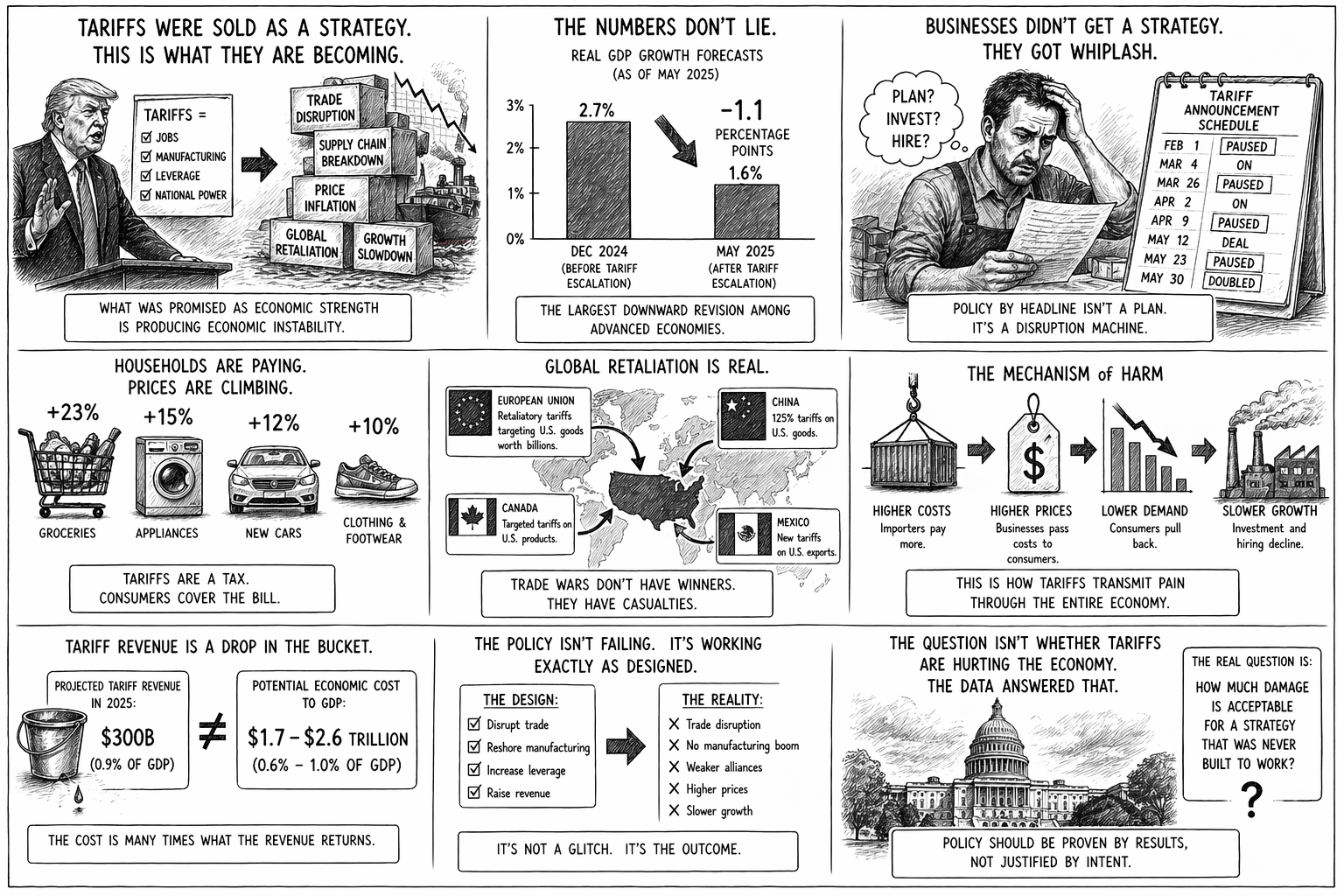
The structural asymmetry at the center of this story is not incidental — it is the story. Tariffs are frequently described in political rhetoric as taxes on foreign producers, the implication being that the cost lands on the exporting country rather than on American consumers. That description was false during the tariff period and the refund process is making it impossible to sustain. Multiple studies during the trade war period — from the Federal Reserve, from academic economists, from institutions across the political spectrum — found consistently that American businesses and households absorbed a substantial share of tariff costs. When a U.S. importer paid a tariff at the border, they did not simply absorb it as a business expense. They passed it downstream — through pricing to retailers, through retailers to consumers, through consumers to the household budgets that had to absorb the higher cost of goods ranging from electronics and appliances to clothing and food. The cost of the tariffs diffused across the economy precisely because that is how tariffs work in practice, regardless of how they are described in policy language. American consumers paid. Now the government is refunding the money — and it is refunding it to the companies that collected it from consumers, not to the consumers who paid it.
That asymmetry is not technically a flaw in the refund system. It is a reflection of how trade policy and its reversals operate in a market economy. Tariffs are collected at the border from importers. Refunds flow back to importers. The downstream distribution of costs through pricing is a market process that leaves no legal trail connecting a specific consumer to a specific tariff payment, which means there is no mechanism — legal or administrative — through which the $166 billion can be routed back to the households that absorbed it through higher prices. The CAPE system can process business claims with documented tariff payments. It cannot process a claim from a family that paid $200 more for a washing machine in 2025 because the importer passed through the tariff cost. That family will not receive a refund. The importer that passed through the cost and is now receiving a refund will recover money it did not ultimately absorb. The gap between those two outcomes is not a bureaucratic oversight. It is the designed architecture of a trade policy whose costs were distributed broadly and whose correction is being distributed narrowly — to the entities with the legal standing to file claims, which are the same entities that were best positioned to protect their margins by passing costs downstream in the first place.
The Supreme Court ruling raises a deeper question that the refund process is obscuring through its sheer scale. The Court found that the administration exceeded its authority by using IEEPA emergency powers to impose what were effectively long-term trade policy instruments — a finding that has implications well beyond the $166 billion now being returned. It signals a limit on how far executive emergency powers can be stretched to achieve economic objectives that belong constitutionally to Congress, and that limit applies not only to tariffs but to sanctions, industrial policy interventions, and any future administration’s attempt to use emergency authority as a substitute for legislative authorization. The ruling is a structural constraint on executive economic power that will shape how future administrations approach trade, investment, and economic intervention — a constitutional argument dressed in a trade policy outcome, and one whose implications extend far beyond the refund checks currently being processed.
For the communities that absorbed the tariff burden most acutely — lower-income households that spend a higher share of their income on goods, Black and Latino families that were already navigating the regressive distributional effects of a tariff regime that hit consumer goods categories hardest, small businesses that could not absorb input cost increases the way large corporations could and whose price increases did not produce sufficient margin to cushion the impact — the refund process produces no relief. The $166 billion is being returned to the economy, but it is not being returned to them. What looks on the surface like a financial correction is more precisely a financial redistribution: from the government back to the importers, from the people who paid the downstream cost to the entities that collected it from them. The policy created the burden. The Court invalidated the policy. The refund restores the money to the wrong people. That is the story the process description does not tell — and the one SSC’s coverage of who absorbs the costs of economic policy decisions requires naming directly.