
Something measurable has shifted in the architecture of American economic mobility over the past fifteen years — and it has not received the attention it deserves, in part because it does not fit cleanly into either the optimistic or pessimistic narratives that dominate economic coverage.
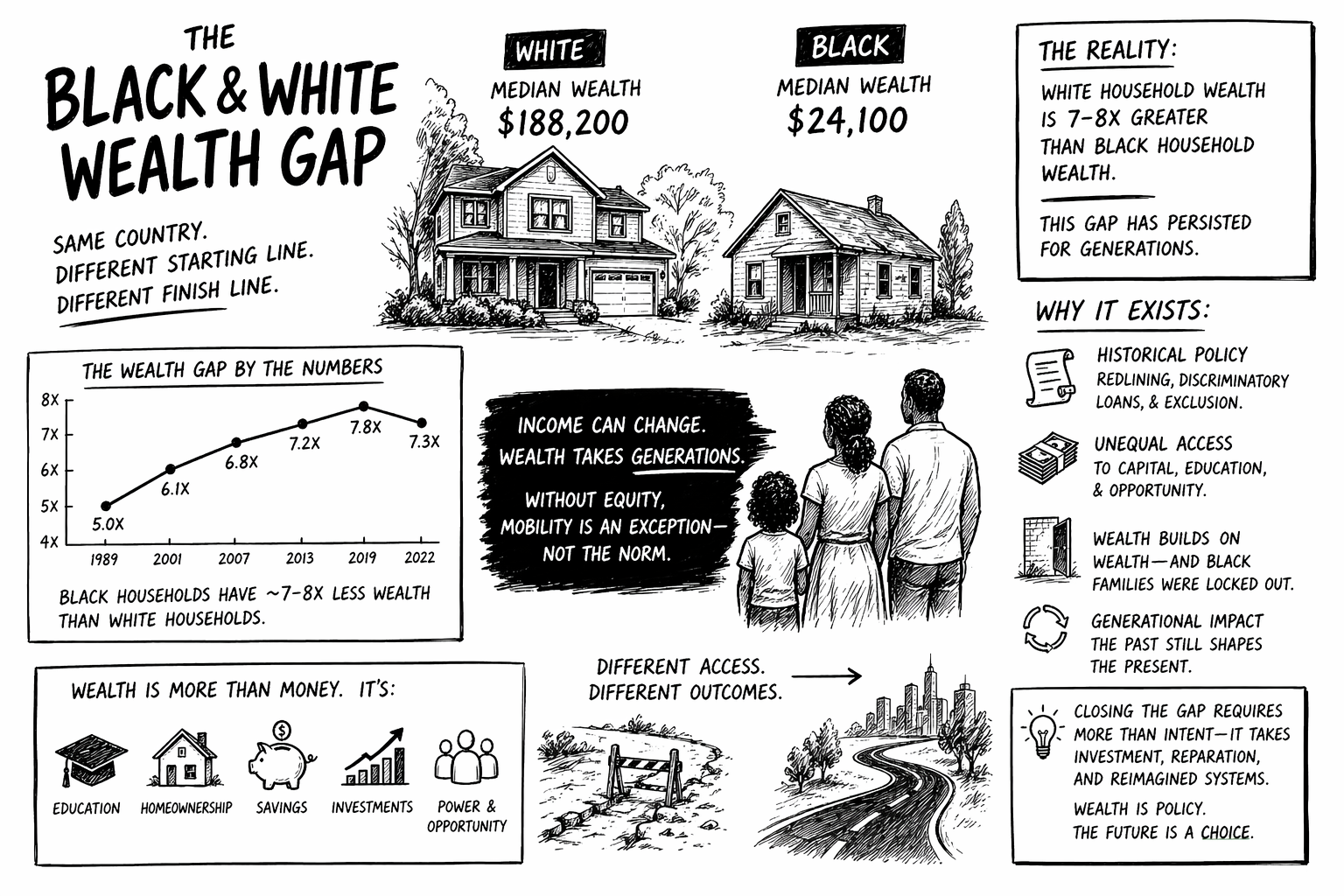
According to a 2024 research paper by Opportunity Insights, the Black-white gap in upward economic mobility shrank by 27% between 2009 and 2024 — one of the most significant improvements in cross-racial economic outcomes recorded in a generation. That is not a marginal shift. That is a structural change of the kind economists spend careers looking for and rarely find in data this clean.
And yet the headline does not tell the full story. Because the same research found that while the racial gap in economic mobility narrowed, the class gap widened. The income gap between children growing up in low- and high-income families increased by 28% over the same fifteen-year period. What that means in practice is this: children from low-income families — across racial lines — are doing meaningfully better than they were fifteen years ago relative to their white peers. Children from higher-income families are pulling further away from everyone below them. The floor rose. The ceiling also rose. And the distance between them grew.
That bifurcation is the actual story of American economic mobility in 2026, and it is more honest and more complicated than either “the system is working” or “the system is broken” can accommodate.
Understanding why the floor rose matters for anyone thinking seriously about what policy actually produces mobility. The period from 2009 to 2024 included several overlapping developments that researchers have linked to improved outcomes at the lower end of the income distribution: sustained minimum wage increases at the state and local level, expanded access to community college and vocational training, the Affordable Care Act reducing financial catastrophe from medical costs, and — critically — a prolonged tight labor market in the years immediately preceding and following the pandemic that gave lower-wage workers unusual leverage to negotiate better pay and conditions. None of those things were accidents. They were policy choices, and the mobility data reflects them.
What also rose, and is less discussed, is the role of community infrastructure in translating economic opportunity into lasting mobility. The research on what actually moves people up the income distribution over a generation consistently points to the same variables: housing stability, educational continuity, access to networks that connect young people to employment, and the presence of institutions — schools, community organizations, faith communities, local businesses — that provide structure and accountability during the transition from adolescence to adulthood. Those variables are not evenly distributed. They are concentrated in places where sustained public and private investment has produced them, and absent in places where that investment never arrived or was withdrawn.
This is why mobility gains have been so geographically uneven even within the same income bracket. A child from a low-income family in a city with strong community college infrastructure, a stable rental market, and a diversified local economy has materially different odds than a child from a family with an identical income in a city where those things are absent. The income is the same. The infrastructure is not.
The homeownership rate among younger adults continues its long structural decline, which researchers identify as one of the key drivers of the widening household wealth gap among people under 40. Mobility that does not produce asset accumulation is mobility that does not compound. A person can earn more than their parents, live in a better neighborhood, and hold a more prestigious job — and still be one medical emergency or one job loss away from sliding back. Without an asset base, upward mobility is less a ladder than a treadmill: forward motion that does not translate into position.
The policy decisions being made right now will determine whether the last fifteen years of progress hold or reverse. Housing affordability, workforce development funding, the infrastructure of community institutions — these are not separate policy questions. They are the same question asked at different levels of the system. The mobility data shows what happens when those investments are sustained. It also shows, in the widening class gap, what happens when they are not sustained equally at every level.
The question worth sitting with is not whether mobility is possible. The last fifteen years demonstrate that it is. The question is what it requires — and whether the institutions and policies that produced it are durable enough to survive the political environment that is currently trying to dismantle them.
Society & Economy | Structural Reality