
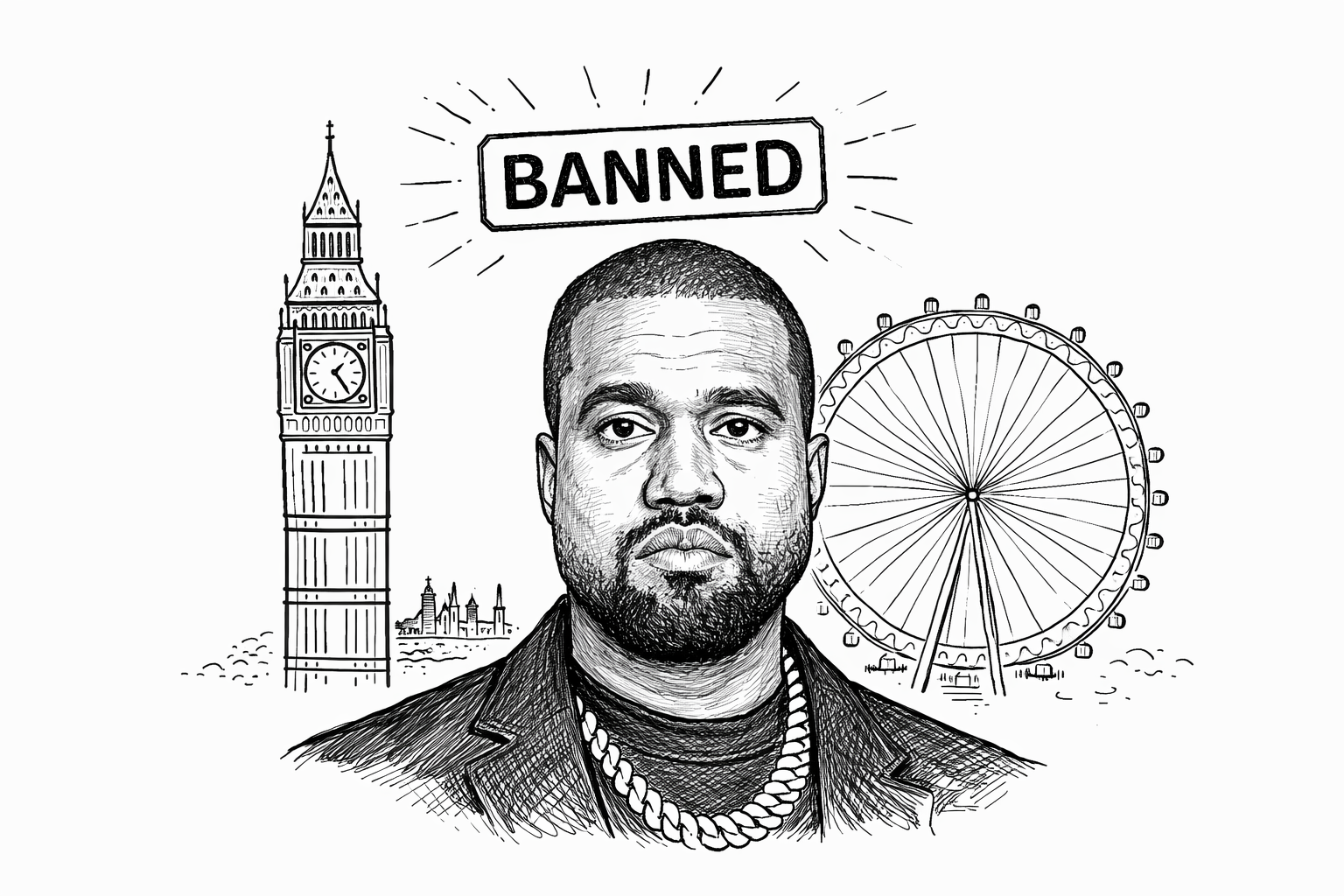
Ye is facing escalating fallout overseas after the UK government reportedly revoked his visa, effectively blocking him from entering the country. The decision follows continued backlash over antisemitic remarks and controversial public behavior, including a recent song reference that reignited criticism and scrutiny.
The consequences moved quickly from political to commercial. Major sponsors, including Pepsi, withdrew support from London’s Wireless Festival, where Ye had been slated to headline. Organizers have since canceled the festival altogether, citing the growing instability and risk tied to his involvement.
Ye recently issued a public apology through a full-page ad in The Wall Street Journal, referencing past behavior and mental health struggles. But the response has done little to restore confidence among institutional partners. If anything, it highlights a widening gap between individual expression and the threshold institutions are willing to tolerate.
That contrast matters. As we noted, behavior does not always follow belief. Consumers continue to engage when the product, price, and infrastructure make participation easy, even amid controversy. What is happening now reveals a split system: institutions are pulling back to manage risk, while consumers, in many cases, continue to lean in.
While institutional consequences are accelerating, audience behavior is telling a different story. In the same week that visa restrictions and sponsor withdrawals reshaped Ye’s ability to operate in the UK, his latest album Bully surged to the top of global streaming charts.
The project debuted at No. 1 on both Apple Music and Spotify globally, with more than 200,000 units of first-week activity in the United States and over 264 million streams on Spotify to date. His single “Father,” featuring Travis Scott, also reached the No. 1 spot on YouTube, reinforcing that attention, at scale, has not meaningfully declined.
The contrast is difficult to ignore. Governments can restrict entry. Sponsors can withdraw funding. Festivals can cancel. But streaming platforms operate on a different logic, one driven less by endorsement and more by consumption. Listening does not require public alignment. It happens privately, passively, and often without friction.
What is unfolding is not just a story about one artist’s fallout. It is a story about divergence. Institutions are drawing clearer lines around behavior and association, while audiences continue to engage on their own terms. And in a streaming economy, where participation is quiet and distributed, that gap may be where accountability becomes hardest to measure.
Why it matters: This is no longer just about reputational fallout. It is about how access is being restructured across different layers of the same ecosystem. Governments and brands can close doors quickly. Consumers can keep others open just as fast. Status may still create opportunity, but in this moment, access is being negotiated in real time, and not all gatekeepers are moving in the same direction.