
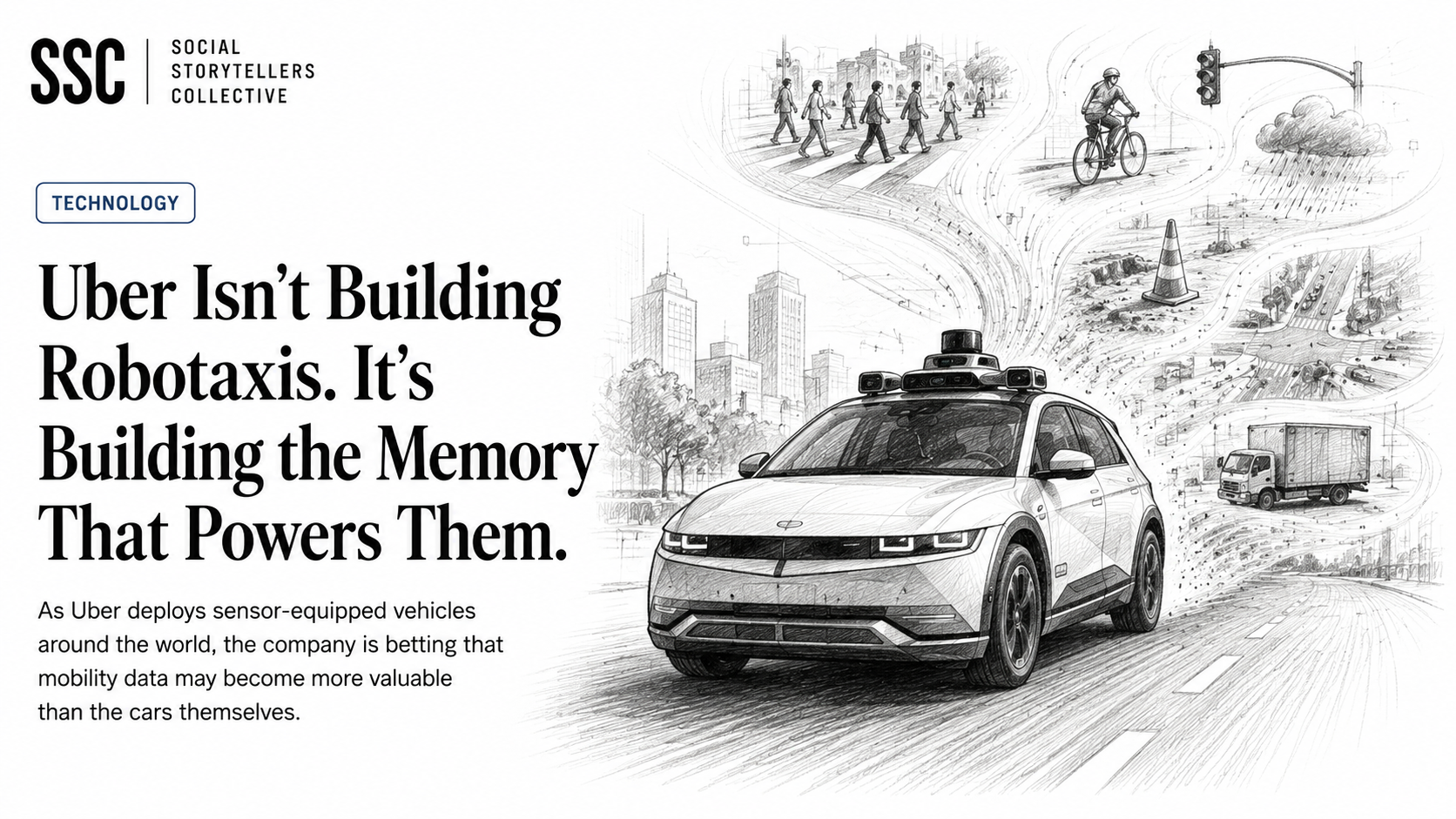
According to reporting by TechCrunch, Uber plans to deploy 500 sensor-equipped Hyundai Ioniq 5 vehicles globally this year. Each vehicle carries cameras, lidar sensors, and radar systems. Together, the fleet will generate roughly 2 million miles of driving data per month. The announcement has been framed as an autonomous vehicle story. It is not. It is a story about who controls the intelligence that autonomous vehicles run on — and why that may be a more defensible position than building the vehicles themselves.
Uber exited the autonomous vehicle development race in 2020 when it sold its self-driving division. That exit looked like a retreat. It may have been a repositioning. Rather than competing directly against Waymo, WeRide, and Avride on engineering, Uber is building what its new AV Labs division describes as one of the world’s most geographically diverse autonomous driving datasets. The objective is not to build the best autonomous vehicle. It is to become indispensable to the companies that do.
The distinction matters because artificial intelligence has changed the terms of competition. Algorithms can be improved. Computing power gets cheaper. Proprietary data does not replicate. A self-driving system becomes smarter not because it has more processing capacity, but because it has encountered more situations — unusual intersections, unexpected pedestrian behavior, construction detours, weather events, regional driving patterns. Every one of those encounters becomes part of a growing library of experience. The companies that own the richest version of that library hold an advantage that engineering alone cannot close.
Uber’s global transportation network gives it an unusually powerful position in that race. It operates simultaneously across cities, regions, and countries — each generating behavioral data that no lab-controlled environment can produce. A robotaxi trained primarily in Phoenix does not automatically understand Houston. A system optimized for California encounters entirely different variables in Europe or Asia. Uber’s scale allows it to collect those variables in parallel, across real infrastructure, in real conditions, at a volume that purpose-built AV companies cannot match without Uber’s existing footprint.
Every major technology era creates a new class of infrastructure owners. The internet era rewarded companies that controlled attention. The cloud era rewarded companies that controlled computing capacity. The autonomous era may reward companies that control mobility intelligence. The 500 vehicles TechCrunch reported on are not really cars. They are sensors attached to a data collection strategy that Uber’s autonomous vehicle partners cannot build without it.
That is what Uber is constructing. Not a robotaxi fleet. A memory. And in an economy increasingly organized around artificial intelligence, memory may prove to be the most durable asset of all.