
Part of Structural Reality — an ongoing series examining the systems, policies, and decisions that shape everyday life for Black and Brown communities in America and around the world.
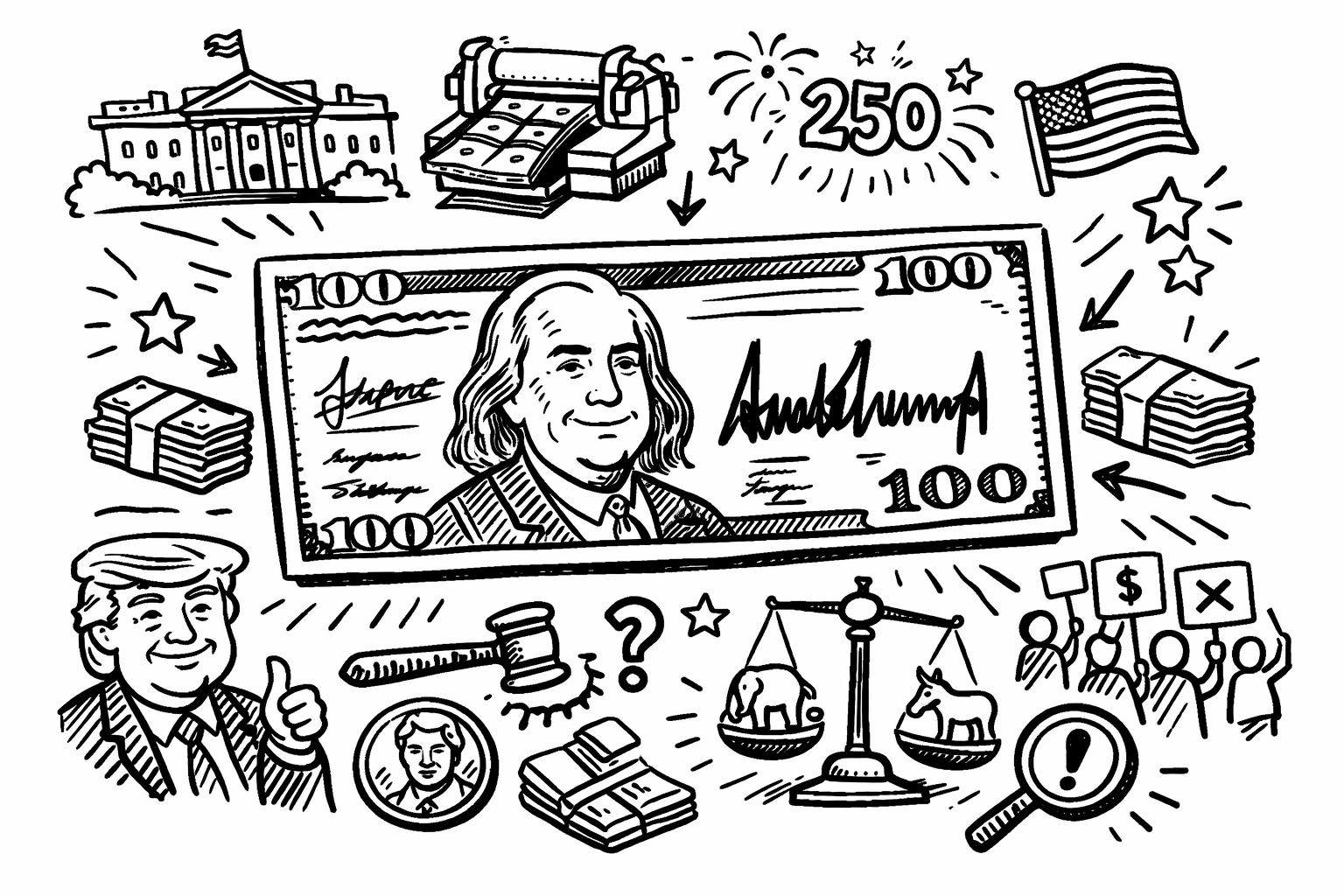
The U.S. Treasury plans to place Donald Trump’s signature on future American paper currency — the first time a sitting president’s name would appear on circulating bills. The move, tied to the nation’s 250th anniversary, breaks with the long-standing convention of only the Treasury Secretary and Treasurer signing U.S. money. The first $100 bills bearing Trump’s signature alongside Treasury Secretary Scott Bessent’s will be printed in June. The U.S. Treasurer’s signature — present on American currency for 165 years — will be removed entirely.
The proposal is drawing scrutiny. Legal experts question whether Treasury can alter the signature structure without congressional action. Critics say it politicizes a historically neutral symbol; supporters call it a fitting commemorative update. The convention itself wasn’t arbitrary. Presidential signatures were kept off currency to preserve a symbolic firewall between the executive and the money supply — a design choice rooted in deeper American anxieties about concentrated power. That the 250th anniversary is being used as justification strikes some observers as pretext; others see it as exactly the kind of milestone that warrants departing from precedent.
The Harriet Tubman $20 — announced in 2016, delayed, and still unissued — is a reminder that currency decisions are never purely aesthetic. They attract political friction, legal challenge, and institutional resistance in roughly equal measure. The Trump administration pushed back on a set of quarters originally designed to honor the abolition of slavery and women’s suffrage. A 24-karat gold commemorative coin bearing Trump’s image has already been approved by a federal arts commission. Democrats in Congress have introduced legislation to prohibit a living president’s image on currency — it has not advanced.
This announcement arrived the same week the U.S. voted no on the UN reparations resolution, the same week the gender wage gap widened for the second consecutive year, and the same week Voice of America was restructured under federal control. None of those are coincidences in the editorial sense — they are part of a documented pattern of institutional rebranding. As Voice of America Is Back — And the Fight Over Who Controls the Story Isn’t Over examined, the infrastructure of public institutions is not neutral, and when it is systematically rebranded around a single figure, the question is not aesthetic. It is about who the systems of public life are designed to center — and whose history gets quietly moved to the margins to make room. As The Cycle of Panic in Public Education documented, the contests over representation in public institutions — in curricula, in monuments, on currency — are never incidental. They are the argument.
The deeper debate is not whether institutional symbols should remain fixed. They never have been. It is whether the changes being made reflect the full breadth of the country they are supposed to represent — or only the version of it that currently holds power.