
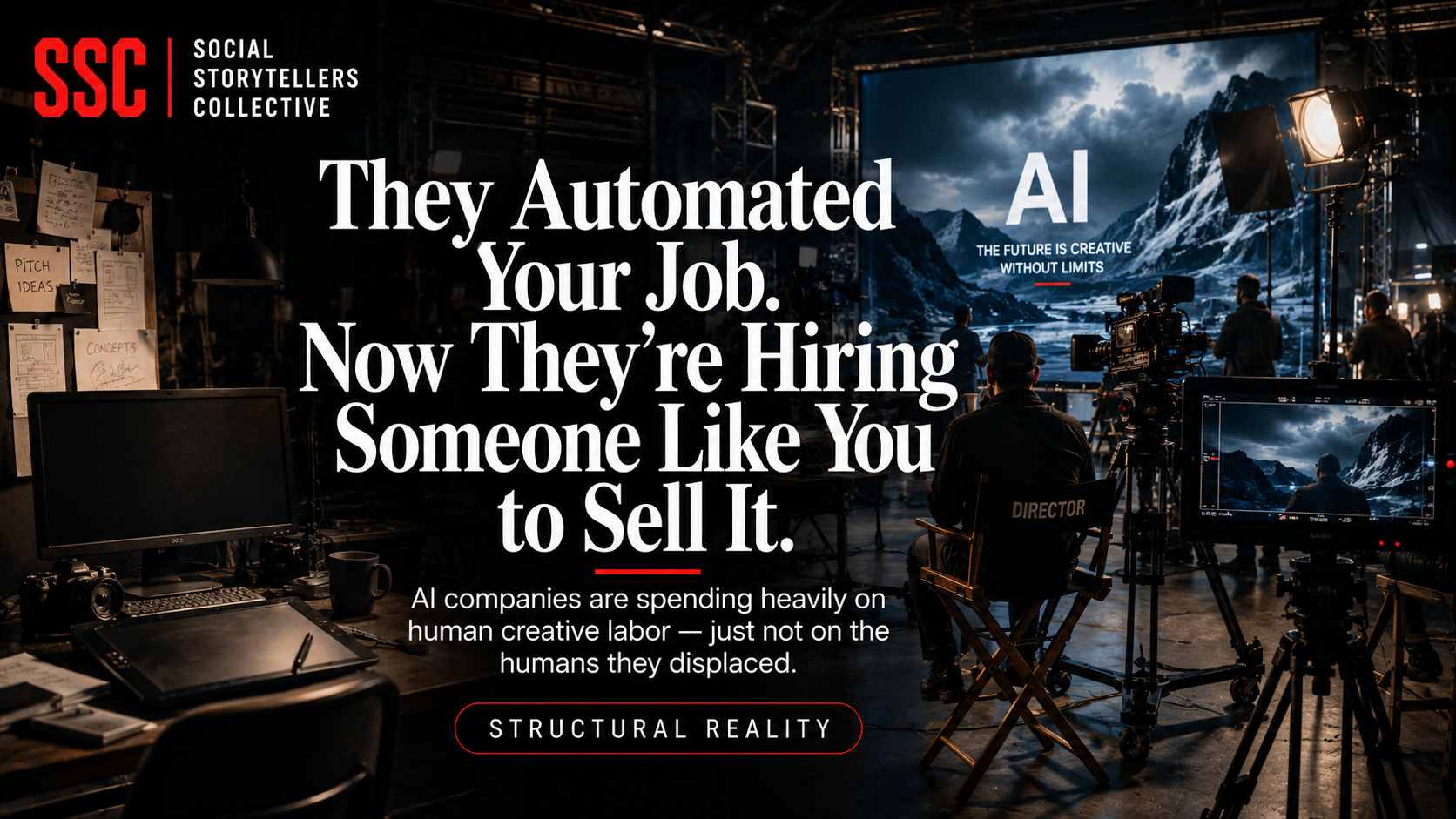
Here is what the AI disruption of creative work actually looks like in practice. The illustrators, junior copywriters, stock photographers, and entry-level content producers who absorbed the first wave of displacement are still absorbing it — their rate cards down, their client rosters thinner, their industries restructured around tools that produce output at a fraction of what human labor once cost. That story has not changed. What changed this week is that The New York Times reported what the companies building those tools are spending their venture capital on: film crews, professional lighting directors, and high-production promotional videos — because their own technology cannot make them look credible enough to recruit the engineers they need to keep building it.
The argument these companies have made publicly is that AI-generated creative work is good enough, getting better, and inevitable. The argument their spending is making privately is different. When 50 startups are working on the same AI product and the differentiator comes down to marketing, they are not reaching for the tools they sell. They are reaching for human judgment, human craft, and the cultural signal that comes from having invested in something made by people. A professionally shot production reads as serious, funded, and worth joining. An AI-generated video reads as what it is. The companies know the difference. They are paying the premium to avoid it — while continuing to sell the tools that eliminated that premium for everyone else.
This is a power story, not an irony story. The creative workers being hired for these Silicon Valley productions are not the ones who lost ground when AI image generators and automated copywriting tools hit the market. They are established professionals with existing networks, premium rate cards, and client relationships that predate the disruption. The workers who absorbed the cost of the AI creative economy — the ones who saw their stock photo libraries devalued overnight, whose junior copywriting contracts evaporated, whose illustration commissions dried up as generative tools improved — are not the beneficiaries of this particular spending decision. The industry is buying human creativity at the top of the market while having systematically collapsed its value at the bottom. Both are happening simultaneously. Neither cancels the other out.
What the film crew spending reveals is a gap the automation pitch has always papered over: the difference between output and signal. AI tools produce output efficiently. What they cannot yet produce is the signal that comes from human investment — the legibility that tells a recruit, an investor, or a client that something real was made here, by people who chose to make it that way. The startups spending on film crews are not paying for content. They are paying for credibility. And the fact that they need to buy it from human workers rather than generate it from their own platforms is the clearest evidence available that the technology has not actually replaced what it claimed to replace. It has just made the bottom of the market uninhabitable while leaving the top intact.
As SSC documented in The Correction Nobody Asked For, the people who made the loudest predictions about AI creative displacement quietly walked them back this year on a timeline that served their IPO roadshows. The workers who reorganized their careers around those predictions did not get a correction. They got a promotional video — shot by someone else, funded by the same capital that disrupted their industry, designed to recruit the next generation of engineers who will build the next wave of tools. The argument was never that AI would replace everything. It was that AI would replace the parts of creative work that did not require premium signal. What the film crew spending confirms is that the boundary between those two categories is drawn exactly where power already sits.