I was a graphic designer. Not in theory — in practice, with clients, deliverables, and a role that I had built real expertise around. Then the company I worked for made a decision that is becoming increasingly common: they folded my position into the social media manager’s role and handed her an AI tool to cover the gap. The work didn’t disappear. The job did. That distinction is what most of the conversation about AI and employment gets wrong — and it’s why students searching for an “AI-proof” major are asking a real question that has no clean answer.
As The Associated Press reports, the search for AI-proof majors is accelerating, with students attempting to map their education to a labor market that is actively being reshaped in real time. The premise feels logical — choose a field that cannot be replaced — but the conclusion collapses under its own uncertainty. No one, including the institutions guiding those decisions, can clearly define what “AI-proof” actually means. That ambiguity is not a failure of information. It is a reflection of how quickly the underlying system is shifting.
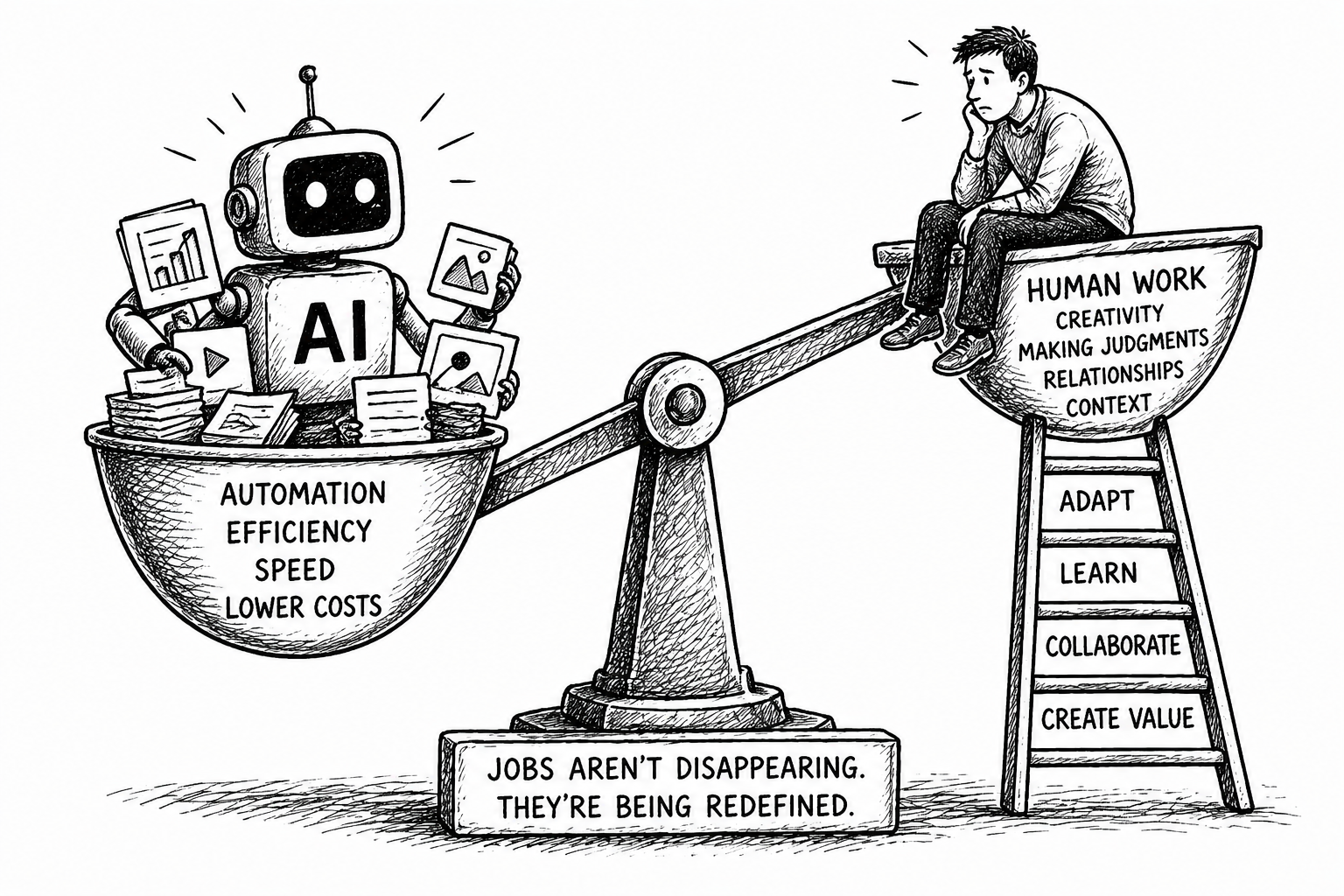
Artificial intelligence is not replacing entire professions in a single sweep. It is fragmenting them. Tasks that once required specialized training are being automated, augmented, or redistributed — often unevenly across industries. This creates a moving target where parts of a job become obsolete while others become more valuable. A major, by contrast, is static. It is designed to signal preparation for a category of work that may no longer exist in the same form by the time a student graduates. My role as a graphic designer was not eliminated because design stopped mattering. It was eliminated because one function of design became cheap enough to reassign. That is the distinction institutions are not yet equipped to teach students how to navigate.
The result is a growing mismatch between how education is structured and how work is evolving. Universities still organize knowledge into defined disciplines, each with a presumed pathway to employment. But employers are increasingly valuing adaptability, tool fluency, and the ability to work alongside emerging technologies. This is why the instinct to switch majors — from computer science to marketing, or from liberal arts to data science — feels reactive rather than strategic. It assumes that safety can be found in category selection, when the categories themselves are becoming unstable.
What students are responding to, more than anything, is the disappearance of predictability. For decades, higher education offered a relatively clear exchange: choose a field, develop expertise, enter a corresponding profession. That contract is weakening. The introduction of AI has accelerated a shift that was already underway — where careers are less linear, roles are more fluid, and skills depreciate faster than the programs designed to build them. In that environment, the idea of a safe major becomes less about actual protection and more about managing anxiety in the face of structural change.
This is where much of the public conversation goes wrong. The focus remains on which jobs will disappear, rather than how work itself is being reorganized. Automation does not eliminate the need for human labor as much as it redefines where that labor sits. Creative work becomes iterative. Analytical work becomes assisted. Entry-level roles, historically used for training and access, are compressed or removed altogether. The pressure is not evenly distributed and it does not align neatly with academic disciplines. It operates at the level of tasks, workflows, and systems — which is exactly why a job title can vanish while the underlying need it served remains fully intact.
The responses emerging online reflect this confusion. Some argue that students should avoid AI entirely, while others insist that the only viable path is to fully embrace it. Both positions oversimplify the reality. Avoidance is not protection, but neither is proximity. The advantage is not in choosing a major that resists AI — it is in developing the ability to navigate a landscape where AI is embedded across functions. That includes understanding how tools work, where they fail, and where human judgment remains not just useful but necessary inside automated systems.
What this moment ultimately reveals is a deeper shift in how stability is defined. It is no longer anchored in a specific field or credential. It is tied to the capacity to move across contexts as those contexts change. Education systems have not fully adjusted to that reality, and students are left trying to solve for it individually, often with incomplete information. The search for an AI-proof major is not misguided because students are wrong to be concerned. It is misguided because the form of the solution no longer matches the structure of the problem. The labor market is not asking for protection from change. It is demanding alignment with it. Until institutions begin to reflect that shift, students will continue searching for certainty in places that can no longer provide it.