
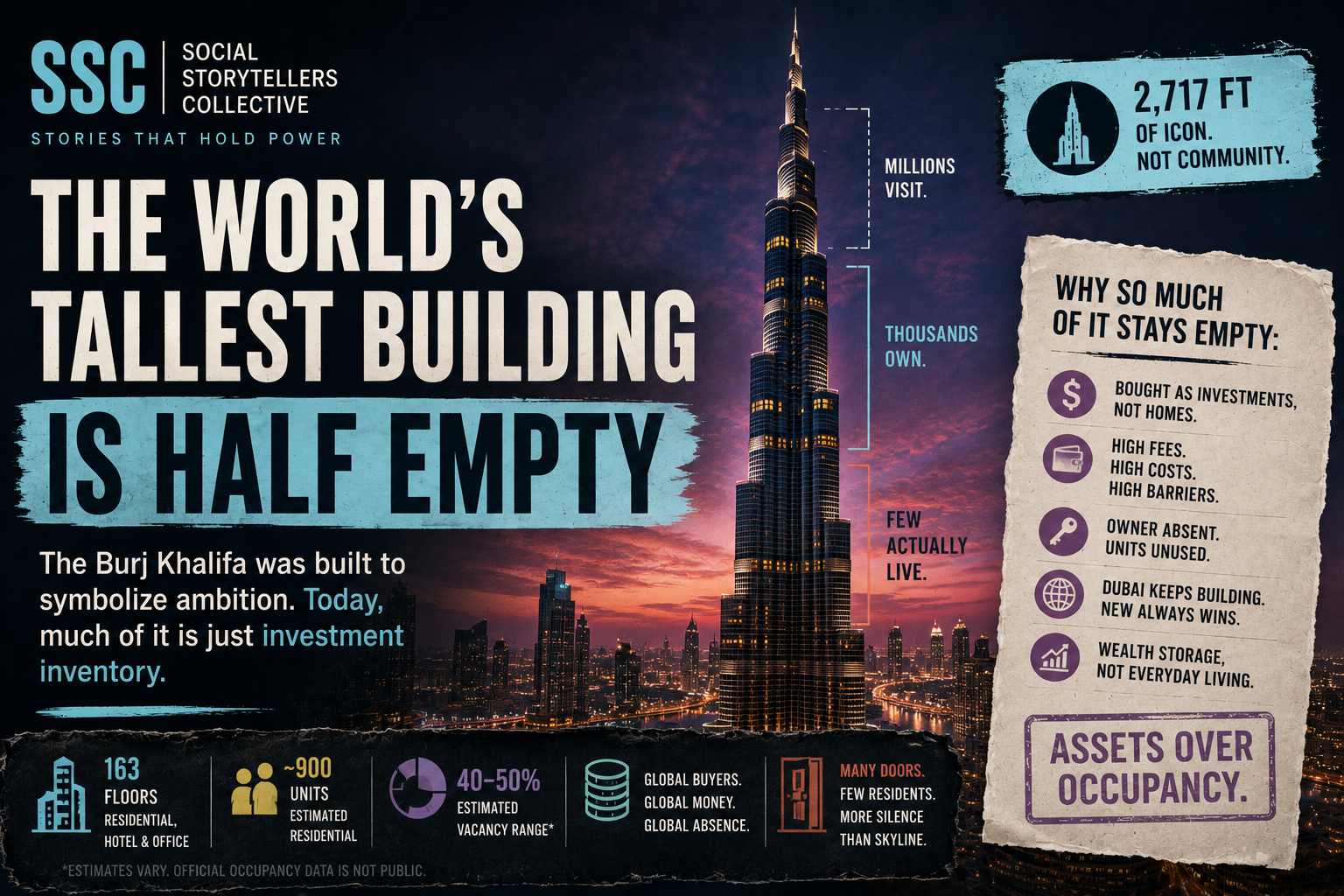
When the Burj Khalifa opened in 2010, it was designed to accomplish something larger than becoming the tallest building in the world. At 2,717 feet, the tower was meant to announce Dubai’s arrival as a global capital of finance, tourism, luxury, and engineered spectacle. It became an instant branding device for the city itself — appearing in films, tourism campaigns, New Year’s Eve broadcasts, influencer content, and global business presentations. But behind the postcard imagery, a quieter reality has persisted: significant portions of the tower remain only partially occupied, with many units functioning less as homes and more as financial assets held by global investors. The world’s tallest building succeeded culturally long before it fully succeeded residentially — and the gap between those two things reveals something worth understanding about how modern cities actually work.
Part of the misunderstanding comes from how people imagine skyscrapers operating. The Burj Khalifa was never structured like a traditional apartment building filled with permanent residents. It was built around mixed-use prestige economics — luxury residences, corporate suites, Armani hotel space, observation decks, restaurants, and investment-owned units purchased by international buyers. Many apartments were acquired during Dubai’s explosive pre-2008 real estate boom, when global investors treated property in the emirate as both speculative opportunity and status symbol. After the global financial crisis hit, Dubai’s market collapsed sharply, construction debt spiraled, and the tower became tied to a bailout from neighboring Abu Dhabi. The building’s original name — Burj Dubai — was changed to Burj Khalifa in honor of Abu Dhabi ruler Sheikh Khalifa bin Zayed Al Nahyan following the rescue package. The name on the building is itself a record of what it cost to keep the building standing.
Even after Dubai’s real estate recovery, occupancy inside the tower remained uneven because many units were never purchased for habitation in the first place. Luxury supertalls increasingly operate as wealth storage systems rather than dense residential communities. Apartments sit empty for months or years while still appreciating in value or serving as offshore holdings inside global capital networks. Some owners visit occasionally. Others rent through hospitality channels rather than occupying units directly. In hyper-luxury real estate markets, vacancy does not signal failure in the traditional sense. The building can remain financially valuable even while physically underused — which is a distinction that most cities built around housing shortages cannot afford to make.
The economics attached to living inside the tower create their own barriers. Maintenance fees inside the Burj Khalifa are among the highest in the region because operating the world’s tallest building carries enormous infrastructure costs — elevators, cooling systems, water pressure engineering, security, façade maintenance, energy consumption. Moving water to upper floors requires complex pumping systems. Elevator logistics become increasingly difficult at extreme height. Residents have periodically reported plumbing issues, outages, noise, traffic congestion, and the practical inconveniences of living inside a global tourist attraction visited by millions annually. The fantasy of vertical luxury collides regularly with the operational reality of maintaining a megastructure functioning simultaneously as residence, tourist site, and international icon.
Dubai’s broader development strategy compounds the phenomenon. The city continuously produces new luxury inventory at enormous scale — waterfront towers, artificial island developments, branded residences, ultra-luxury villas, mixed-use megaprojects all competing for wealthy global buyers. In that environment, prestige has a short shelf life because the next project is always arriving. The Burj Khalifa remains iconic, but it no longer monopolizes the luxury imagination inside Dubai the way it once did. Buildings function increasingly as part of an endless visibility economy where novelty itself becomes economically necessary. What was extraordinary in 2010 is context by 2026.
The tower’s partial emptiness reveals something larger about modern global cities. Many landmark skyscrapers are no longer built primarily to solve housing shortages or maximize dense urban living. They operate as financial instruments, branding mechanisms, tourism engines, and geopolitical statements. Their success is measured less by how many lights are on at night than by how effectively they attract capital, attention, and international prestige. The Burj Khalifa accomplished that mission almost immediately. It transformed Dubai’s global identity permanently — and the city would not be the city it is today without the image the tower made possible.
That may be why partially dark floors inside the world’s tallest building feel so psychologically striking. Skyscrapers traditionally symbolize density, momentum, and concentrated human activity. Modern luxury towers increasingly symbolize something different: the separation of ownership from occupancy. The building still dominates the skyline exactly as intended. Parts of it remain suspended in a condition between asset and community, investment and habitation, spectacle and stillness. It is a vertical monument to an era in which visibility became economically valuable even when the rooms inside stayed quiet — and a mirror, held up at 2,717 feet, of what cities become when capital and people stop moving in the same direction.
SSC | Culture & Society — May 17, 2026 — Social Storytellers Collective News Desk