
The April jobs report arrived with the kind of numbers policymakers usually celebrate. The United States added 115,000 jobs last month — nearly double what economists had forecast. Unemployment held steady at 4.3%. Wage growth continues to outpace inflation. On paper, the labor market appears resilient, maybe even strengthening.
But the emotional reality inside the workforce tells a far more complicated story.
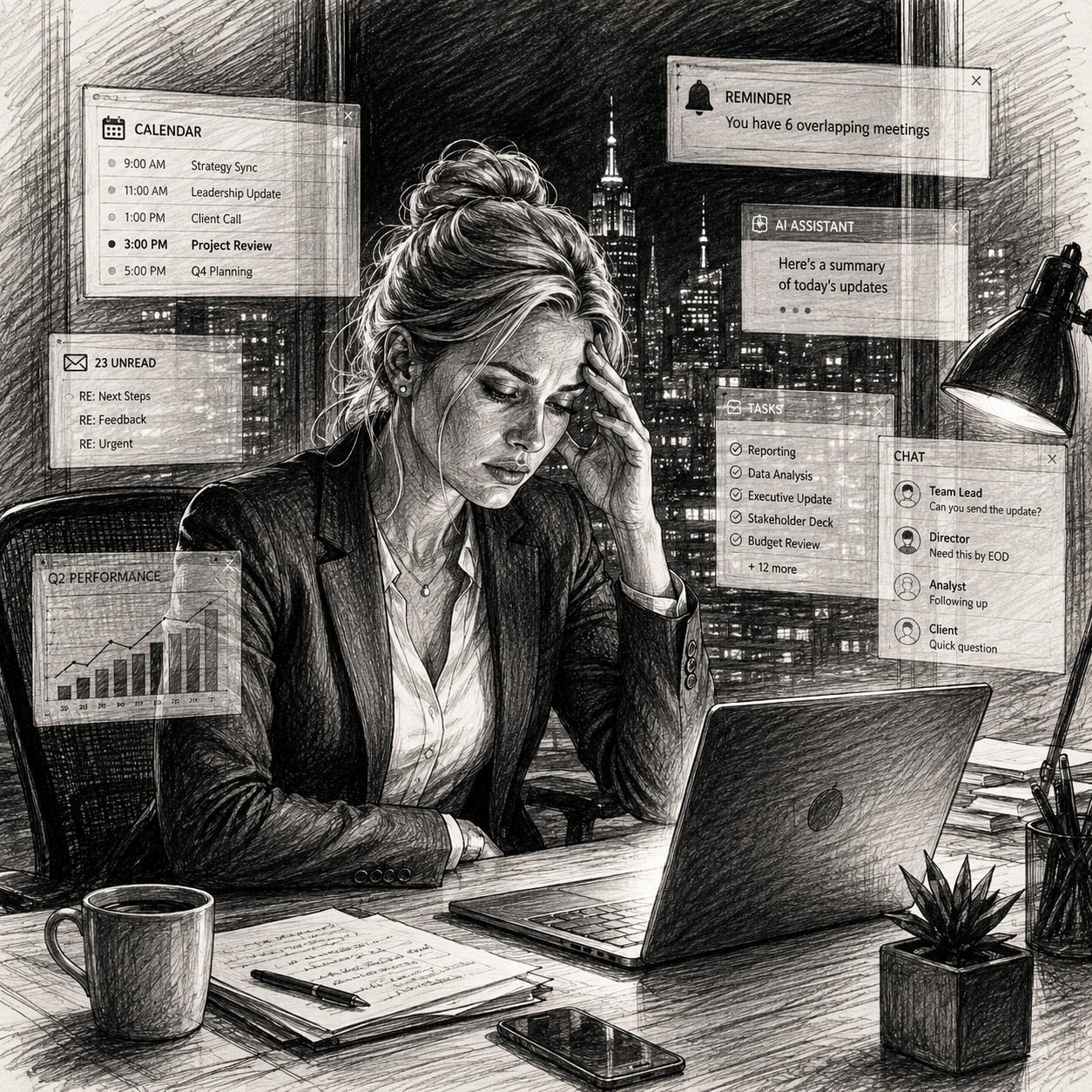
Across industries, workers increasingly describe themselves as exhausted, anxious, emotionally detached, and permanently “on.” The contradiction is becoming harder to ignore. The economy may be stabilizing statistically while deteriorating psychologically. The modern workplace is producing a growing disconnect between what employment data measures and what workers are actually experiencing day to day.
That tension shows up clearly in recent workplace research. Gallup’s State of the Global Workplace report found that 41% of employees globally experience “a lot of stress” during the workday, keeping workplace stress levels near historic highs even after pandemic-era disruption eased. Meanwhile, the American Psychological Association’s Work in America survey found workers reporting chronic stress tied to workload, low staffing levels, job insecurity, and expectations to remain constantly available. Deloitte’s workforce studies have similarly shown younger professionals reporting especially high levels of burnout, financial strain, and emotional fatigue connected to unstable economic conditions and rising performance expectations.
What makes the current moment distinct is that worker stress is no longer being driven by a single event. Employees are now absorbing multiple overlapping pressures simultaneously. Inflation may be cooling compared to its peak, but affordability pressure remains high across housing, healthcare, transportation, childcare, and debt repayment. Layoffs continue across technology, media, higher education, and consulting even while national employment figures remain relatively strong. And now artificial intelligence is introducing a new layer of uncertainty into professional identity itself.
For many white-collar workers, AI is no longer being discussed as a future possibility. It is becoming an active workplace expectation. Companies increasingly expect employees to integrate AI tools into daily workflows, improve productivity metrics, and adapt to changing operational structures in real time. Some firms are already internally benchmarking employee AI adoption rates, treating usage not as optional experimentation but as a measurable performance behavior.
That shift changes the emotional structure of work.
Employees are no longer simply being evaluated on competence, experience, or output. Increasingly, they are being evaluated on adaptability. Workers are expected to learn new systems continuously while maintaining productivity under conditions of constant technological change. The result is a labor environment where many professionals feel simultaneously employed and insecure — technically stable, but psychologically unsettled.
The pressure becomes even more intense because modern work increasingly extends beyond the office itself. Slack notifications, email culture, performance dashboards, AI assistants, and remote collaboration tools have collapsed many of the boundaries that once separated labor from personal life. Workers are reachable everywhere. Availability has become normalized. Rest increasingly feels conditional.
That emotional strain is often hardest to identify in professional environments precisely because the external indicators still appear functional. Meetings happen. Deadlines get met. Teams remain operational. The modern workplace still looks polished on the surface. But underneath that surface, many employees describe operating in a constant state of low-level depletion.
The disconnect is particularly visible among younger professionals navigating careers during an unusually unstable economic era. Many entered adulthood during the financial crisis, began careers during pandemic disruption, and are now trying to establish long-term stability inside an economy increasingly shaped by automation anxiety, housing unaffordability, and shifting labor expectations. Traditional career promises — loyalty, upward mobility, predictable progression, retirement stability — feel less certain than they did for previous generations.
And yet productivity expectations continue rising.
The modern worker is now expected to be responsive, emotionally intelligent, technologically adaptable, creatively productive, and continuously available while also managing personal financial pressure and maintaining the appearance of professional stability. Burnout is often discussed like an individual wellness issue. Increasingly, it looks more like a structural condition.
That distinction matters because the current workforce conversation often remains trapped between two misleading narratives. One narrative insists the labor market is collapsing entirely. The other insists everything is fundamentally healthy because unemployment remains relatively low. The truth may be more complicated. Many workers are still employed. But employment alone is no longer functioning as a reliable indicator of security, emotional well-being, or long-term stability.
The workforce is not simply asking whether jobs exist. Increasingly, workers are asking what modern employment is demanding from them psychologically in exchange.
That question may define the next phase of the labor economy more than the unemployment rate itself.
Because beneath the strong headline numbers, a quieter reality is emerging: the workforce is still functioning. But many workers no longer feel well inside the system keeping it running.