
A new executive order requiring standardized anti-DEI contract language across the federal contracting system is the latest mechanism in a coordinated effort to remove equity infrastructure from the institutions closest to public resources.
Donald Trump signed an executive order titled “Addressing DEI Discrimination by Federal Contractors” directing federal agencies to add standardized contract language prohibiting government contractors from engaging in diversity, equity, and inclusion programming — with a 30-day compliance window from enactment. The Congressional Black Caucus, led by Chair Yvette D. Clarke, responded with a formal statement denouncing the order as an attack on economic mobility and a continuation of what the CBC has characterized as a coordinated effort to remove equity infrastructure from the federal government and the institutions that depend on its contracts. The order does not target a single agency or program. It targets the contracting system itself — the network of private employers, nonprofits, and institutions whose work is funded through federal dollars and whose internal practices are now being made a condition of that funding.
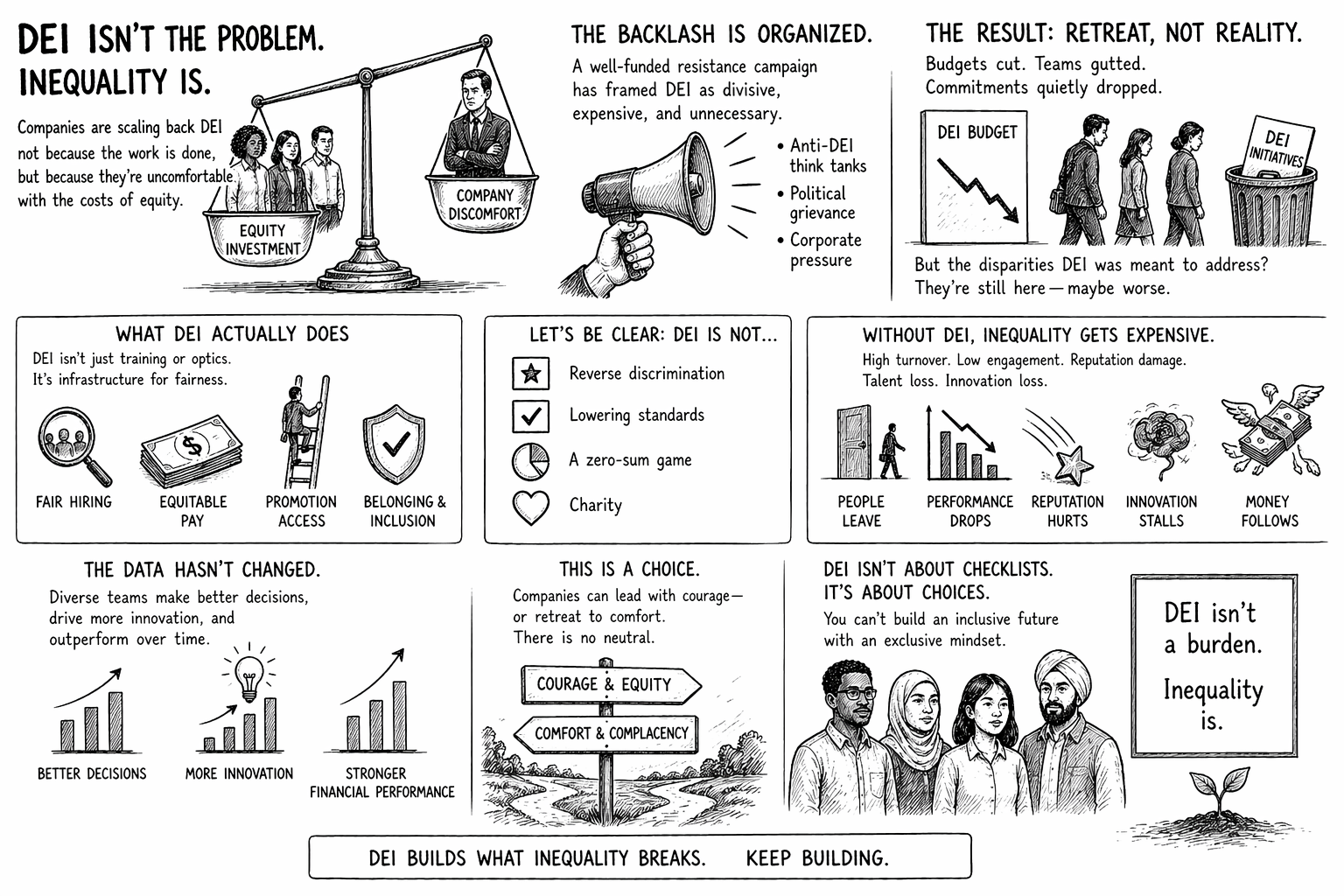
The mechanism matters as much as the stated intent. Federal contracting touches virtually every sector of the American economy — defense, healthcare, technology, construction, research, and social services among them. When the federal government attaches anti-DEI compliance requirements to contract language, it is not simply expressing a policy preference. It is using the financial leverage of federal dollars to reshape employment and organizational practices across the private sector in ways that reach far beyond what any single legislative act could accomplish. The same architecture SSC has covered in the context of Houston’s ICE funding standoff — funding conditionality as a governance mechanism — is operating here at national scale, directed not at immigration policy but at the internal diversity practices of the companies and institutions that do business with the federal government. The instrument is the same. The target is different. The structural logic is identical.
The CBC’s statement frames the order as an attack on economic mobility — a framing that requires unpacking to make the structural argument precise. DEI programs in federal contracting have historically functioned as one of the primary mechanisms through which Black professionals, women, and other underrepresented groups have gained access to the federal contracting economy — a sector that distributes billions of dollars annually in employment, subcontracting, and business development opportunities. As SSC reported in The Federal Government Has Officially Reframed DEI as Risk, the State of the Dream 2026 report estimates cumulative DEI rollbacks have already created an estimated $10 to $15 billion annual gap in federal contracting opportunities for Black-owned firms. The April order does not exist in isolation — it is an escalation of a rollback that was already producing measurable economic consequences before this compliance mandate arrived. Eliminating the practices that created and sustained that access does not produce a neutral outcome. It produces a reversion toward the demographic distribution that existed before those practices were implemented.
The 30-day compliance window is the provision that signals how the order is designed to function in practice. Standardized contract language that prohibits DEI programming, attached to every federal contract within thirty days, does not give contractors time to litigate, negotiate, or develop alternative compliance frameworks. It gives them time to comply or lose the contract. For large contractors with sophisticated legal teams, that window is manageable. For smaller minority-owned businesses, nonprofits serving underrepresented communities, and institutions whose DEI commitments are embedded in their organizational structure, thirty days is not a transition period. It is a deadline designed to produce rapid capitulation rather than considered policy adjustment. Legal experts are already raising questions about whether participating in a career fair at an HBCU would now constitute a violation under the order’s broad language — a question whose ambiguity is itself a compliance mechanism, since institutions uncertain about the line are more likely to abandon programs altogether than risk a finding.
What the executive order represents in the context of the current administration’s full policy posture is the completion of a circuit. Federal workforce DEI programs have been eliminated. Federal agency civil rights enforcement has been weakened. Federal education funding has been conditioned on the removal of equity-oriented curriculum. And now the federal contracting system — one of the primary remaining mechanisms through which federal resources flow toward equity-oriented employment and business practices — is being brought into alignment with the same framework. The CBC’s characterization of this as an attempt to whitewash the federal government is not rhetorical excess. It is a description of the directional pattern that emerges when you read these executive actions as a coordinated system rather than as isolated policy decisions. Each one is individually contestable. Together they describe a federal government being restructured around a specific and explicit vision of whose interests it serves.