
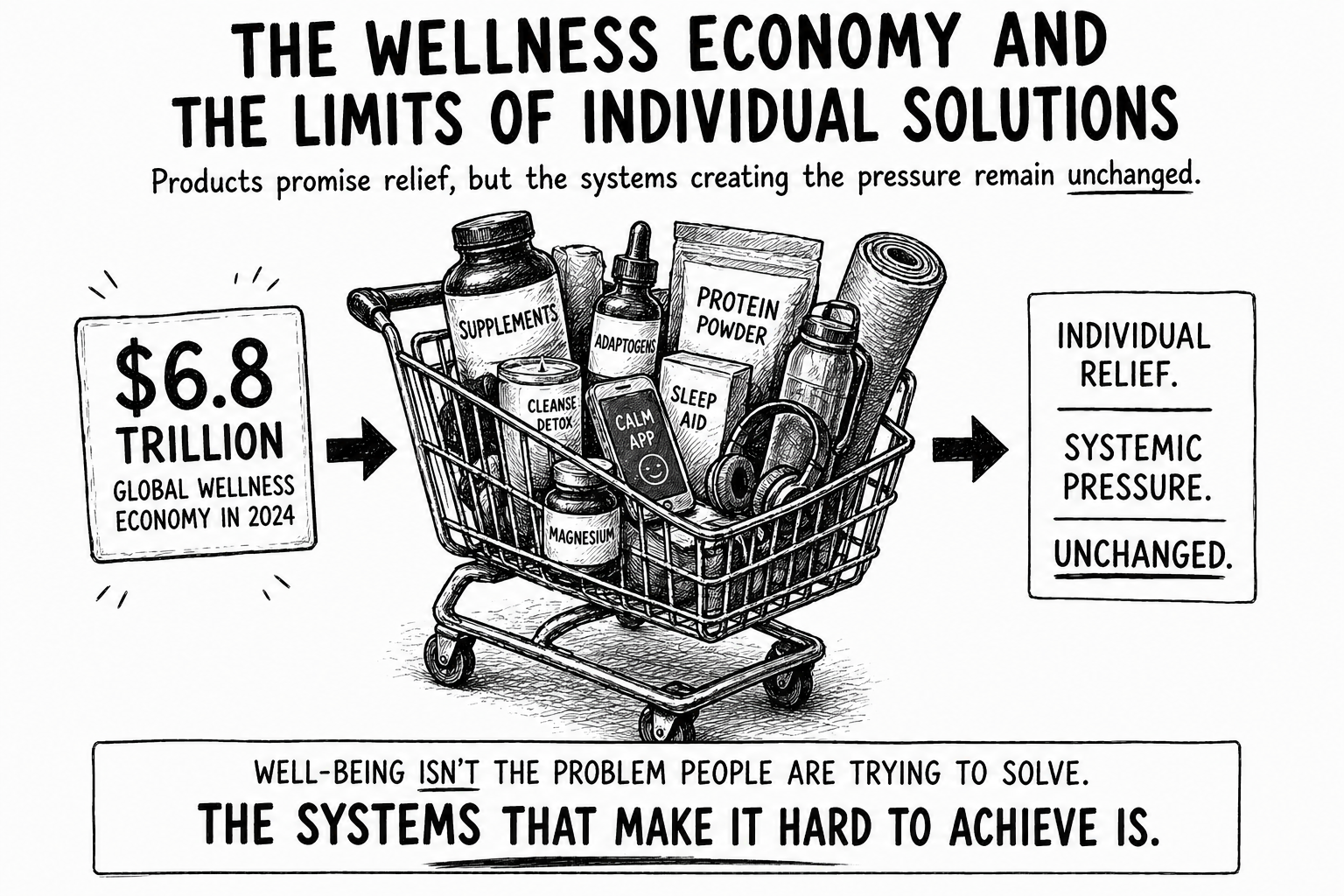
The global wellness economy reached $6.8 trillion in 2024 — nearly four times the size of the pharmaceutical industry — and is projected to approach $10 trillion by 2029. It has doubled since 2013, growing at twice the rate of global GDP over that period. In the United States alone, wellness represents more than $500 billion in annual consumer spending. Those numbers describe an industry. They also describe a pressure system. The scale of what people are spending to feel better is a signal about how much worse the baseline has gotten.
The demand is rooted in measurable conditions. Forty percent of Gen Z Americans report feeling almost always stressed — nearly double the 23 percent rate across the general adult population. Nearly 30 percent of Gen Z and millennial consumers say they are prioritizing wellness significantly more than they were a year ago, a rate higher than any older demographic. Work, financial pressure, and digital connectivity are consistently cited as the leading drivers. Average work hours have remained elevated while the boundary between professional and personal time has effectively collapsed in remote and hybrid environments. The conditions generating stress are not episodic. They are structural — and the industry selling relief has organized itself around that permanence.
The fastest-growing segment of the wellness economy is mental wellness, expanding at 12.4% annually since 2019. The one sector that declined was workplace wellness — where global spending shrank between 2023 and 2024, as employers moved away from programmatic support and remote work left more employees without access to any employer-provided wellness benefits. That divergence is worth sitting with. The segment of the wellness economy most directly tied to institutional responsibility contracted. The segment most dependent on individual purchasing grew. The burden of care shifted, and the market followed it.
The system behind the wellness economy is structured around individual intervention. Supplements, recovery tools, mental health apps, fitness programs — these are products designed to help people manage how they feel without altering the conditions that produce those feelings. The peptide market alone — and the parallel supply chain that has grown around it — is one of the clearest examples of how quickly consumer enthusiasm can outpace clinical evidence when the underlying demand for relief is urgent enough. The focus is optimization at the individual level, even when the cause is structural.
This creates a tension between cause and solution. The same systems generating stress — work expectations, economic uncertainty, constant digital input — remain intact while individuals are encouraged to adapt to them through purchases. Relief becomes something that is bought and maintained rather than built into the environment itself. Consumers say that in the event of an economic downturn they are less likely to cut wellness spending than spending on clothing, entertainment, or home decor — which means the industry has successfully repositioned what was once discretionary as essential. The market did not respond to a crisis. It absorbed one.
Other sectors reflect the same logic. In personal finance, individuals are given budgeting tools to manage debt within systems that generate it. In healthcare, lifestyle adjustment is emphasized alongside structural gaps in access and coverage. The responsibility for adaptation sits at the individual level even when the problem is systemic. Wellness follows that pattern precisely — and has monetized it at a scale no other consumer category has matched.
The broader implication is that well-being, in this economy, is managed rather than secured. The wellness industry does not eliminate pressure. It creates a market around helping people live with it — and the growth projections suggest that market will keep expanding as long as the pressure does. What gets lost in the trillion-dollar figure is the question it raises: if the conditions driving the demand were actually improving, the market would be shrinking. It is not.