
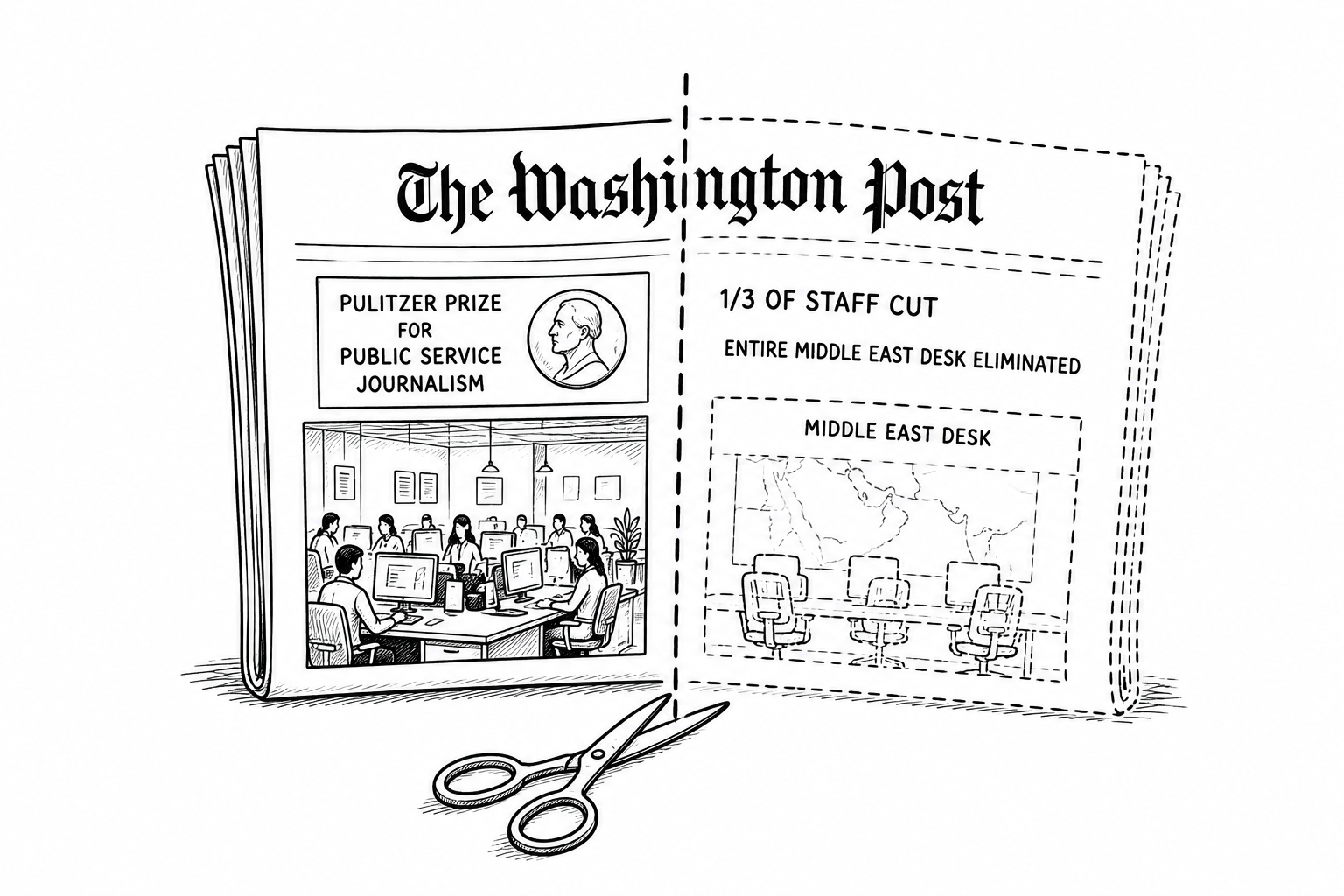
The Washington Post cut more than 300 journalists on February 4, 2026 — roughly a third of its 800-person newsroom — in what executive editor Matt Murray called a “strategic reset” for the AI era. Sports, books, the international desk, the Post Reports podcast, and the ArcXP tech arm were all gutted in a single morning. Staffers were told to stay home, join a Zoom call, and wait for an email telling them whether they still had jobs. Will Lewis, the paper’s publisher and CEO, did not participate in the discussion with staff. SSC covered the mechanism behind that decision when it first emerged — alongside the Associated Press offering buyouts to more than 100 union members the same season — in Associated Press Offers Buyouts as Print Journalism Continues to Contract.
The justification Murray offered at the time was precise: organic search had fallen by nearly half in three years, and AI-generated content was reshaping user experiences faster than the Post’s traditional reporting infrastructure could respond. The argument was that the organization needed to restructure around AI-driven distribution. Experienced journalists absorbed the cost of that argument.
Four months later, the strategy has not produced a recovery — and the contradictions Murray named as the rationale for the cuts have not resolved. The Post won a 2026 Pulitzer Prize for public service journalism in the same year it eliminated the staff that produces public service journalism. Lewis has centered his recovery plan on subscriptions, events, and AI tools — but the paper lost $177 million over the two years preceding the cuts, and no public accounting of post-restructuring performance has emerged. Daily circulation stands at 97,000, down from 250,000 at peak. The Post is no longer a mass-circulation newspaper. It is a prestige brand operating at a fraction of its former reach.
The Post’s situation is not isolated. Press Gazette’s 2026 layoff tracker documents a contraction running across the entire industry simultaneously. The BBC plans to cut approximately 2,000 jobs — roughly one in ten staff members. The APreduced its editorial staff by 60 people through a combination of buyouts and layoffs. The Minnesota Star Tribune announced a 15 percent workforce reduction this week, citing readers turning to social media and non-traditional information sources. CBS News Radio, which served roughly 700 affiliate radio stations for nearly a century, has closed. The pattern SSC identified in May — newsrooms offering buyouts, citing technology transitions, and eliminating institutional knowledge that takes years to build — has not slowed. It has accelerated.
What the Washington Post case confirms, four months on, is what the AP workers guild argued when it first objected to that organization’s buyouts: newsrooms do not actually know what they need until after they have eliminated the people who were providing it. The Post quietly reached out to laid-off staff in the weeks following the February cuts, asking some to return. At least three were rehired full-time. Fifteen more were placed in a holding pattern pending summer openings. The reversal did not produce a correction to the strategy that caused it. It confirmed that the cuts were not precision — they were panic wearing the language of transformation.
The industry is now hiring for what it eliminated. Nieman Lab documented sixteen new journalism roles published this week — senior AI engineers, editorial AI directors, newsroom engineering leads — at outlets including The Economist and the Philadelphia Inquirer. The new roles are designed to integrate AI into editorial workflows. The experienced journalists who understood what those workflows were producing are largely gone. The institutions rebuilding around AI are doing so without the institutional knowledge that made the original reporting worth automating in the first place.
Murray told staff in February that the goal was to make the Post “nimbler.” What the 2026 Pulitzer, the circulation numbers, and the quiet rehiring suggest is that nimble and credible are not the same destination — and the restructuring assumed they were.