
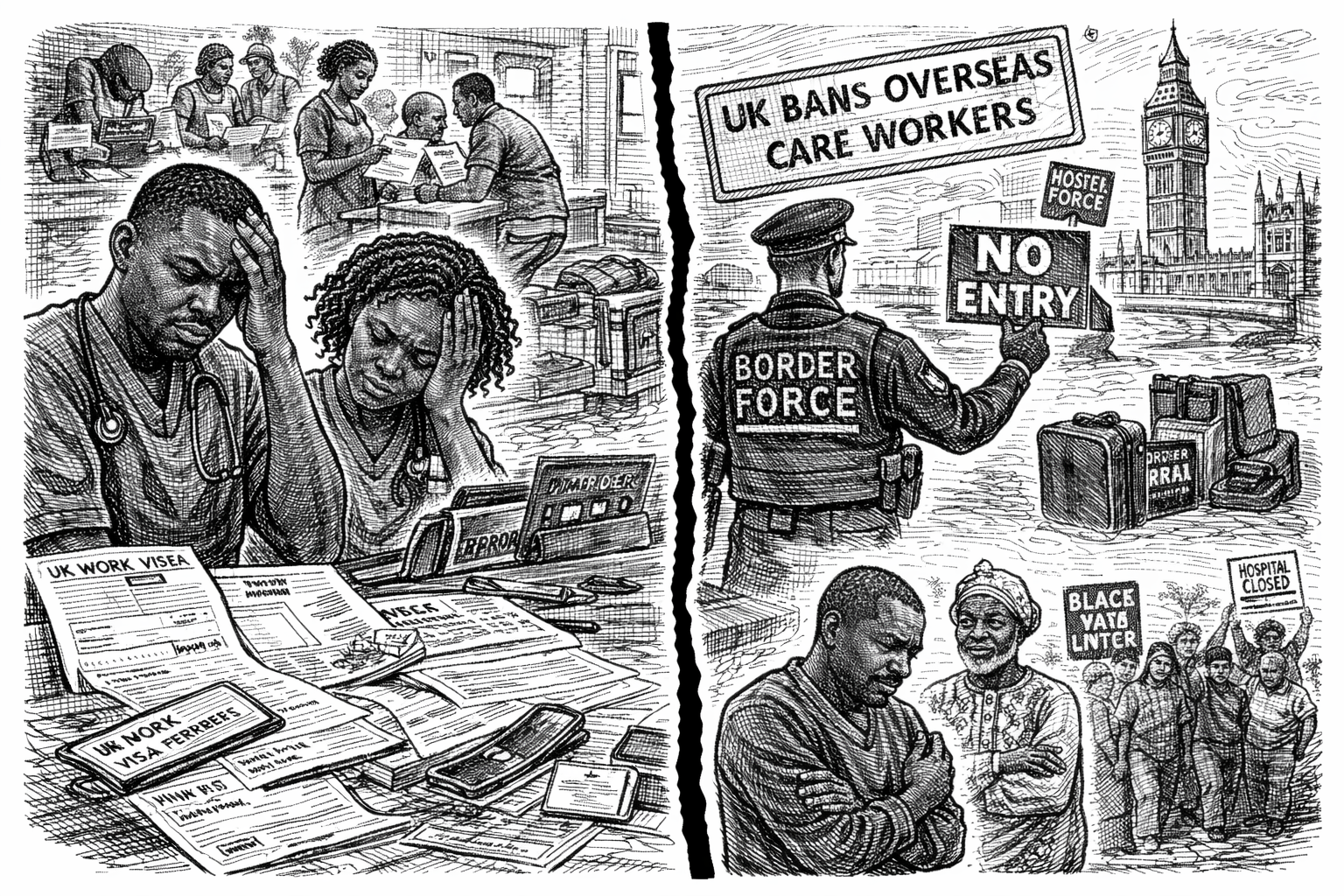
The United Kingdom did not develop a sudden philosophical objection to overseas care worker recruitment. It developed a political problem — immigration numbers that had become electorally inconvenient — and the care sector, which had become structurally dependent on workers from Nigeria, Zimbabwe, Ghana, and other African nations, became the policy solution. The announcement that Britain would halt recruitment of overseas care workers and place Nigeria and other high-sending nations on a restricted list arrived while thousands of workers were mid-process — having paid for tuberculosis tests, police clearances, nursing aide certifications, and English language examinations, having signed with agents who promised sponsorship, having restructured their lives around a pathway that was abruptly closed. The financial and emotional cost of that closure was borne entirely by the workers and their families. The British care sector, meanwhile, expressed concern about staffing gaps.
The scale of the disruption reflects the scale of the dependency that had been allowed to develop. An estimated 13,418 Nigerian care workers received UK visas in 2023 and 2024 alone, representing 19 percent of all care sector visas issued in those years. Nigeria currently has 11,055 Nigerian-trained doctors working in the United Kingdom — the third-largest national group in British medicine after India and Pakistan. The broader health workforce exodus from Nigeria has reached levels that the country’s own health system cannot sustain. According to the Nursing and Midwifery Council of Nigeria, 42,000 nurses left Nigeria in the last three years. Sixteen thousand doctors have emigrated, leaving 55,000 licensed physicians for a population of 220 million — a health workforce ratio that falls far below the WHO minimum recommendation of 4.45 skilled health workers per 1,000 people.
The system that produced this outcome was not accidental. Britain, like the United States, Canada, and other wealthy nations, built its health and care workforce infrastructure around the assumption that international recruitment from the Global South would remain available as a pressure valve — a way to staff essential services without making the domestic investments in training, wages, and working conditions that would have made those services sustainable from within. When political conditions changed and that valve was closed, the countries that had been depleted by the recruitment had no recourse. For workers already inside the UK system, the terms are tightening from the other direction. As SSC reported in its coverage of NHS workforce dependence, effective April 8 the UK raised fees across all Health and Care visa categories while simultaneously fast-tracking deportation agreements with Nigeria — a policy posture that wants Nigerian healthcare labor but on increasingly constrained terms. Nigeria is attempting to address the crisis through a National Health Workforce Migration Policy approved in 2024, which aims to improve retention through incentives, salary reform, and diaspora return programs. The goals are laudable. The funding mechanisms remain uncertain, and Nigeria has still not met the 15 percent of annual budget dedicated to healthcare that it committed to in the Abuja Declaration of 2001.
What this moment reveals is the extractive logic at the center of Global North health workforce strategy — a logic that treats the educational investments of poorer nations as a resource to be accessed when convenient and restricted when politically inconvenient, with no mechanism for compensation, accountability, or reciprocity. The workers who built their lives around UK sponsorship and are now navigating that door being closed are not abstractions. They are the most educated cohort that countries like Nigeria and Ghana are producing, choosing to leave because domestic systems cannot match the wages, conditions, and stability that overseas positions offered. When those positions disappear through policy change, the workers do not return to Nigeria and Ghana with their skills intact and their ambitions redirected. They find other routes — to Canada, to the Gulf states, to other European systems still recruiting. The depletion continues. The bill stays in Lagos and Accra. And the wealthy nations that created the dependency continue to manage their political problems on someone else’s tab.