
The Trump administration’s expanded travel ban is being framed as a border policy, but its most immediate impact is unfolding inside the United States, where the government has paused processing immigration applications for people already living and working here legally. Nationals from 39 countries—including Nigeria, Myanmar, Senegal, and Venezuela—are now caught in a system that has not denied their applications, but has stopped moving them forward. According to NPR, nearly 12 million immigration applications are awaiting a decision from U.S. Citizenship and Immigration Services, including hundreds of thousands that have not yet been opened. These are not new arrivals attempting entry. They are residents navigating renewals, work authorization, and citizenship pathways, now watching their legal status erode through delay rather than formal action.
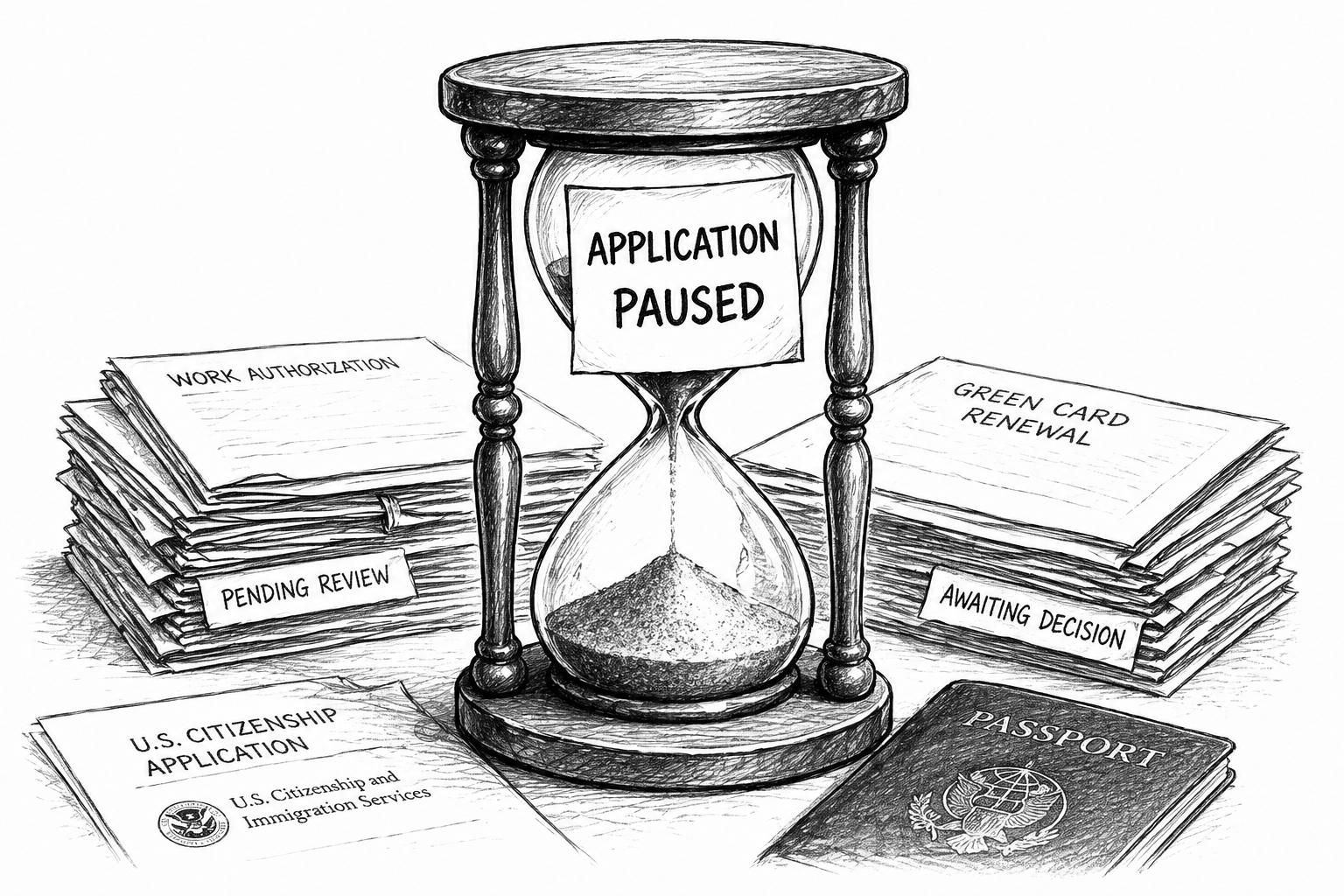
The policy builds on an earlier version of the ban that covered 19 countries and was expanded in December 2025 to include 39 following an attack in Washington involving an Afghan national. That expansion more than doubled the number of affected countries and broadened the rationale beyond national security concerns to include factors such as visa overstay rates. While some countries face only partial restrictions, those distinctions offer little protection to people already inside the United States whose applications have been frozen in place. In practice, individuals who followed established legal pathways are being subjected to the same absence of processing as new applicants, creating a condition where compliance no longer guarantees continuity.
The economic implications complicate the administration’s stated priorities. Workers from affected countries are employed across oil and gas, technology, and healthcare—sectors already facing labor shortages and long-term capacity constraints. A federal judge in California, in considering a preliminary injunction, warned that indefinitely holding employment authorization applications would deter skilled workers and leave applicants in immigration limbo without any timeline for resolution. The policy is effectively constraining labor supply in industries the administration has identified as essential to U.S. competitiveness.
The human cost is immediate and specific. Individuals are exhausting savings while waiting for decisions that may not come, and families are being forced into difficult calculations about how to preserve stability under conditions of uncertainty. Some are preparing to sell homes, while others are separating across borders to avoid lapsing status, with employment tied to authorizations that are neither approved nor denied. Immigration attorneys describe clients who followed every requirement placed before them and are now navigating a system that offers no clear way to remain compliant because the process itself has stalled.
What is being produced is not enforcement in the traditional sense, but administrative pressure that operates without formal resolution. There are no deportation orders to challenge and no explicit denials to appeal, leaving affected individuals without a clear legal action to contest. Delay becomes the mechanism, and uncertainty becomes the outcome.
Framing this solely as an immigration restriction story misses the deeper shift. The more precise interpretation is that this is a workforce and governance issue being carried out through administrative inaction, where the lack of processing functions as policy. The consequences are being distributed across countries, industries, and families who built their lives around the expectation that following legal pathways would provide stability. That assumption is now being tested by a system that has stopped moving without formally closing the door.