
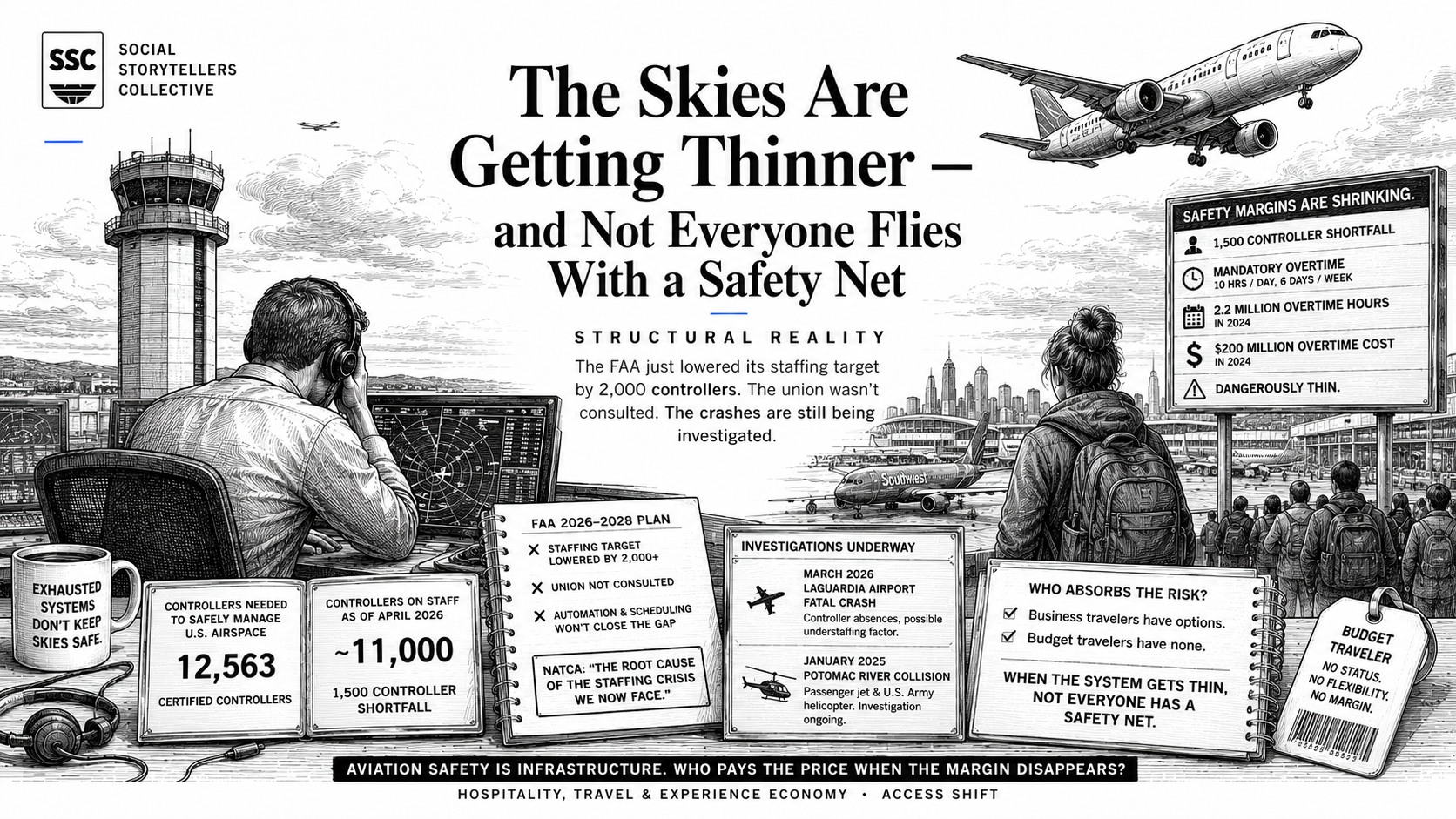
The FAA needs 12,563 certified air traffic controllers to safely manage U.S. airspace. As of April 2026, it has approximately 11,000. That 1,500-controller shortfall is being managed through mandatory overtime — controllers working 10 hours a day, six days a week in some facilities. Overtime costs hit 2.2 million hours and $200 million in 2024 alone. The system is running on exhaustion.
Last week, the FAA released its 2026–2028 Air Traffic Controller Workforce Plan — and quietly lowered its own staffing target by more than 2,000 positions from the previous benchmark. The agency says automation and smarter scheduling can close the gap. The National Air Traffic Controllers Association — the union representing more than 14,000 controllers — was not consulted in developing the plan and immediately challenged it. NATCA said the new model is “the root cause of the staffing crisis we now face.” FAA Administrator Bryan Bedford told Congress in December: “The system is designed to be chronically understaffed. We’ll never catch up.”
That admission belongs in the lead of every aviation story being written right now. The agency responsible for keeping U.S. airspace safe told lawmakers — on the record — that the system cannot reach full staffing under its current structure. Then it released a plan that lowers what full staffing means.
The safety record is already showing the strain. The National Transportation Safety Board is investigating whether controller absences at LaGuardia Airport contributed to a fatal crash in March 2026 — specifically whether understaffing caused controllers to manage multiple duties simultaneously. That investigation follows the January 2025collision between a passenger jet and a U.S. Army helicopter over the Potomac River near Washington, D.C. Both incidents are still under active review. Both occurred at facilities operating below recommended staffing levels.
The EasyJet diversion to Rome this week — triggered by a passenger leaving a power bank charging in their checked luggage — is a reminder of how quickly a routine flight becomes a managed emergency. The aviation system depends on controllers, crews, and protocols all functioning at full capacity simultaneously. When any layer gets thin, the margin shrinks. Right now, the controller layer is the thinnest it has been in years — and the FAA just officially decided to accept that as the new normal.
The SSC angle is not the staffing number. It is who absorbs the risk when the system gets thin.
Business travelers on major carriers with hub connections, lounge access, and the flexibility to rebook have options when delays cascade. The price-sensitive traveler on a budget carrier — the demographic that Spirit Airlines’ bankruptcy and Southwest’s route cuts most directly affected — does not. Ground stops, extended holds, and diversions hit budget travelers hardest because they have the fewest alternatives and the least financial cushion to absorb the disruption.
The FAA’s own workforce plan acknowledges that hours of operation at some facilities will be reviewed to match “periods of high traffic demand.” In plain terms: some towers may operate shorter hours. The routes that serve smaller cities, regional airports, and budget-carrier hubs are the most exposed to those reductions. The people flying those routes are not the ones with status upgrades and travel insurance.
Aviation safety is not an abstract public good. It is infrastructure — and like every other infrastructure story SSC has covered this week, the question is not whether the system is under pressure. It is who absorbs the cost of that pressure when the margin disappears.
SSC covers travel, access, and the structural forces shaping how people move through the world
.