
The federal shutdown has entered a phase where its effects are no longer confined to policy discussions or budget negotiations. It is now showing up in daily systems that rely on consistent participation to function. The shift is not always immediately visible, but it is increasingly difficult to ignore. The underlying issue is labor.
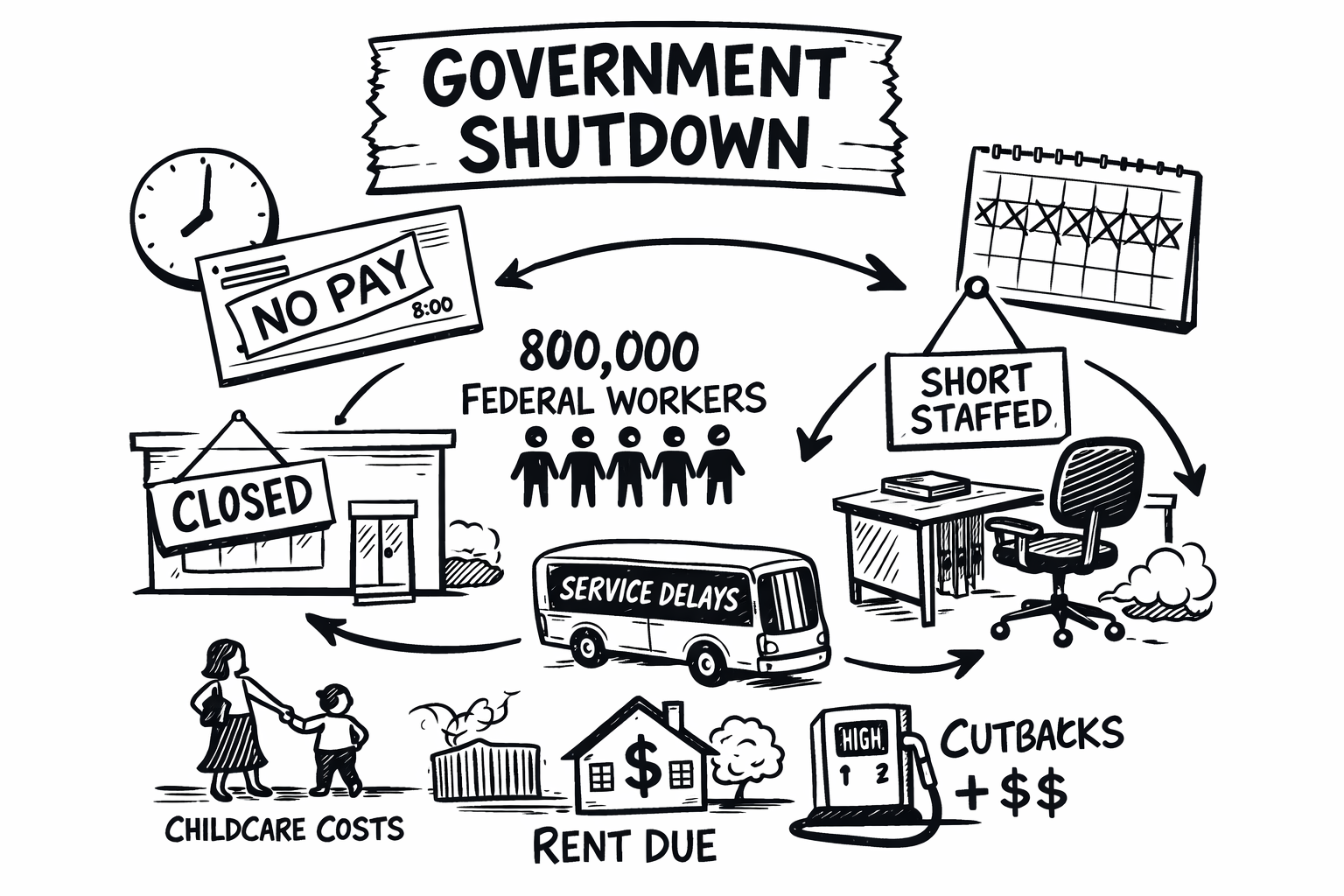
Roughly 800,000 federal workers have been affected by the shutdown, many of whom have now missed multiple pay periods. For employees earning salaries that often fall in the $40,000 to $60,000 range, the disruption is not abstract. It is immediate—covering rent, childcare, transportation, and daily costs without income. When pay stops, participation becomes conditional.
This creates a shift in how systems operate. Roles that are typically stable become unreliable, not because the work has changed, but because the conditions supporting that work have been disrupted. Systems designed around steady staffing begin to absorb inconsistency, and over time, that inconsistency becomes visible to the public.
What makes this moment distinct is not the existence of disruption, but where it appears. Government shutdowns have historically been discussed in terms of political impact, but their operational effects are now unfolding in real time across services people interact with daily. The distance between policy and experience is narrowing.
This is not a collapse. The system continues to function. But it is doing so under altered conditions, where participation is no longer guaranteed. That shift changes how stability is experienced, even if headline indicators suggest continuity.
What is becoming visible is not just the impact of a shutdown, but the reliance of essential systems on consistent, compensated labor. When that condition is removed, even temporarily, the effects extend beyond the workforce itself.