
On May 5, 2026, PayPal’s new CEO Enrique Lores announced that the company would eliminate 4,760 positions — 20 percent of its global workforce — phased over the next two to three years. The stated rationale was AI transformation. The stated target was $1.5 billion in annual run-rate savings. The stated vision was a PayPal that is, in Lores’ own words, “becoming a technology company again.”
That framing deserves a closer look. PayPal was founded in 1998. It has been a technology company for twenty-eight years. What Lores means, translated from executive communications into plain language, is this: PayPal is becoming a company whose technology requires fewer humans to operate. The jobs being eliminated are not going to be refilled by AI engineers or machine learning specialists. They are going away. The $1.5 billion is not being reinvested in the workforce. It is being recaptured as margin.
The Company That Needed a Turnaround
To understand what is happening at PayPal in 2026, it is necessary to understand how the company got here — and why the board decided to bring in a hardware executive to run a fintech platform.
Lores is not a payments person. He is a manufacturing and hardware executive who spent 37 years at Hewlett-Packard, the last seven as CEO of HP Inc. His track record at HP is real: he stabilized a PC and printing business that most analysts had written off, expanded HP into subscription services, and delivered consistent shareholder returns in a market that was structurally declining. He knows how to run a cost discipline playbook. That is precisely why PayPal’s board recruited him.
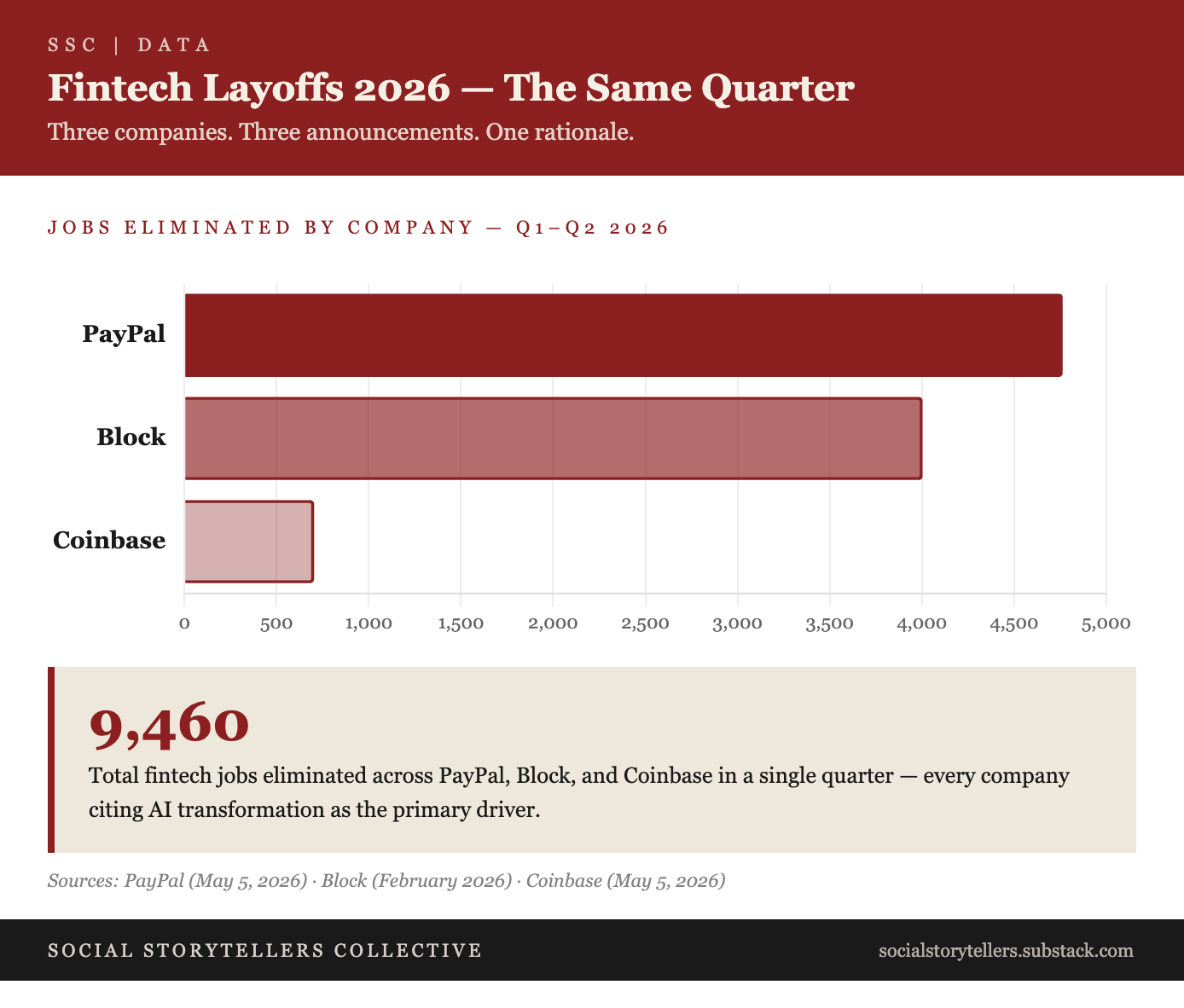
PayPal’s previous CEO, Alex Chriss, was shown the door in early 2026 after the board concluded that “the pace of change and execution was not in line with the Board’s expectations.” The metrics behind that assessment were unambiguous. PayPal’s Q4 2025 revenue came in at $8.67 billion, missing analyst forecasts. More critically, its branded checkout business — the product line responsible for half the company’s profits — grew just 1 percent in Q4 2025, down from 5 percent the quarter before. The trajectory was moving in the wrong direction.
The underlying competitive problem is structural. PayPal built its dominance in an era when digital payment infrastructure was scarce and trust in online transactions was fragile. It was the answer to a question millions of people had: how do I pay for things online without giving every merchant my credit card number? That question has been answered by five other companies now. Apple Pay. Google Pay. Shop Pay. Stripe. Venmo — which PayPal owns but which increasingly operates as a competitor to its parent’s core product. PayPal’s checkout market share has been declining steadily against this field. The company did not lose because it stopped innovating. It lost because the thing it invented became infrastructure, and infrastructure commoditizes.
Lores was brought in to arrest that slide. His approach — restructure around AI, eliminate redundancy, capture savings — is the same playbook he ran at HP. It is rational from a shareholder perspective. It is also, for the workers involved, a layoff.
The Anatomy of an AI Pivot
PayPal’s restructuring is being executed in three simultaneous moves.
The first is organizational. The company has been reorganized into three distinct business units: Checkout Solutions & PayPal, Consumer Financial Services & Venmo, and Payment Services & Crypto. Each unit is intended to have its own P&L accountability and resource allocation. The reorganization is designed to eliminate the cross-functional redundancy that accumulates in large companies over time — duplicated roles, parallel teams, management layers that exist to coordinate other management layers.
The second is technological. Lores has formed a new internal team called “AI transformation and simplification” — a name that functions simultaneously as a mission statement and a roadmap for which functions are being automated. The roles targeted are not random. Customer service and support operations are the first wave. Risk management and fraud detection are the second. Basic coding and software testing are the third. These are the functions where AI has demonstrated measurable capability in production environments. They are also, not coincidentally, among the highest-headcount functions in a company of PayPal’s size.
The third move is financial. The $1.5 billion in run-rate savings is the number the board approved and the number Wall Street is tracking. It represents the annualized cost of the positions being eliminated plus the infrastructure associated with running them. PayPal’s stock responded to the announcement with a predictable rally. The math is not complicated: fewer employees, similar revenue, better margins. For shareholders, the AI transformation thesis is incidental. The savings are the point.
The Pattern Behind the Announcement
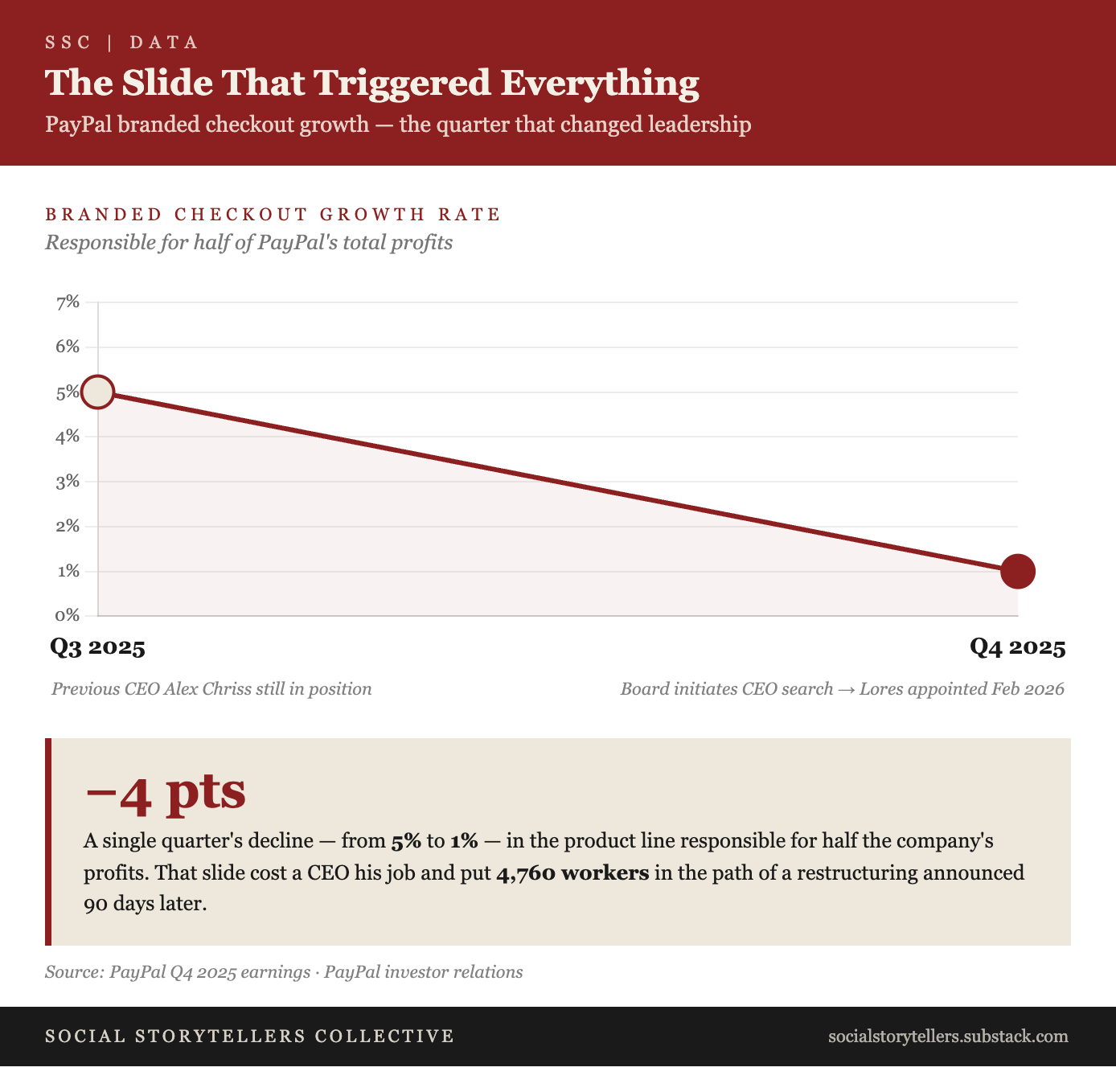
PayPal’s announcement did not arrive in isolation. It arrived as the third major fintech workforce reduction in the first five months of 2026, following Block’s elimination of 4,000 positions in February and Coinbase’s cut of 700 roles on the same day PayPal made its announcement — May 5. Every reduction in this sequence has cited AI as a primary driver. The language is almost identical across the three companies: efficiency, transformation, becoming a more focused organization. The job titles being eliminated are also nearly identical: customer support specialists, operations analysts, compliance coordinators, data entry roles, and mid-level product managers whose function was to translate between technical teams and business stakeholders.
This convergence is not coincidental. What is happening across fintech in 2026 is the systematic reclassification of a category of work. The roles being eliminated were created at a specific moment in the industry’s development — when digital financial services were new enough that human judgment, human oversight, and human customer contact were considered essential. That moment is being declared over. The AI systems handling fraud detection, customer queries, and compliance review are not perfect. They are good enough, and good enough at $1.5 billion less per year is the calculation these boards are making.
Across the sector, the workers absorbing this transition are concentrated in a specific demographic band: mid-career professionals, disproportionately women, disproportionately people of color, who entered the workforce during the fintech expansion of the 2010s and built careers in the support and operations infrastructure those companies needed at scale. They are not being reabsorbed into AI engineering roles. The AI transformation teams being formed at PayPal, Block, and Coinbase employ dozens of people, not thousands. The math of displacement does not resolve in the workers’ favor.
What Lores Said and What He Meant
When Enrique Lores told analysts and investors that PayPal is “becoming a technology company again,” he was making a claim about identity. The implicit argument is that PayPal had drifted — had accumulated human overhead that obscured its essential nature as a technology platform — and that he is restoring what the company was supposed to be.
That framing is worth examining. PayPal’s workforce did not expand randomly. The 4,760 positions being eliminated were created because customers called with problems, because fraud required human review, because markets required compliance, because software required testing, because product decisions required coordination. Those needs did not disappear because AI can now address some of them. The needs remain. What changes is the question of whether a human being gets paid to address them.
The honest version of what Lores announced is this: PayPal has found a way to do more with fewer people, and it intends to capture the savings from that efficiency rather than reinvest them in its workforce. That is a legitimate business decision. It is not a technology transformation. It is a workforce reduction with a technological rationale.
The 4,760 workers in the path of that reduction have names, tenure, and mortgages. They were recruited by a company that told them they were building something. They are being separated by a company that has decided the thing they were building can now be built without them.
That is not a critique of AI. That is an accurate description of how its value is currently being distributed.
What Comes Next
The two-to-three year timeline of PayPal’s restructuring is designed to minimize the visibility of the displacement. There will be no single WARN Act filing. There will be no mass layoff event that generates a news cycle. There will be quarterly reductions, voluntary separation packages, hiring freezes that accomplish through attrition what a single announcement would accomplish through cuts. By the time the 4,760 is complete, the news environment will have moved on.
What will not have moved on is the labor market those workers are entering. The fintech sector that was absorbing displaced workers five years ago is now producing them. The tech sector that might have been an adjacent landing zone has eliminated 128,270 positions in 2026 alone. The federal government — historically a fallback employer for operations and compliance professionals — is contracting. The options available to the PayPal worker being separated in Q3 2027 are meaningfully narrower than the options available to the PayPal worker who was hired in Q3 2019.
Enrique Lores is not responsible for designing a social safety net. That is not the job he was hired to do. But the companies executing these transitions, and the policymakers watching them happen at scale across every major sector simultaneously, bear some accountability for the aggregate consequence of decisions that are rational in isolation and destabilizing in aggregate.
4,760 jobs. $1.5 billion in savings. The technology is the story they are telling. The workers are the story that doesn’t have a press release.