
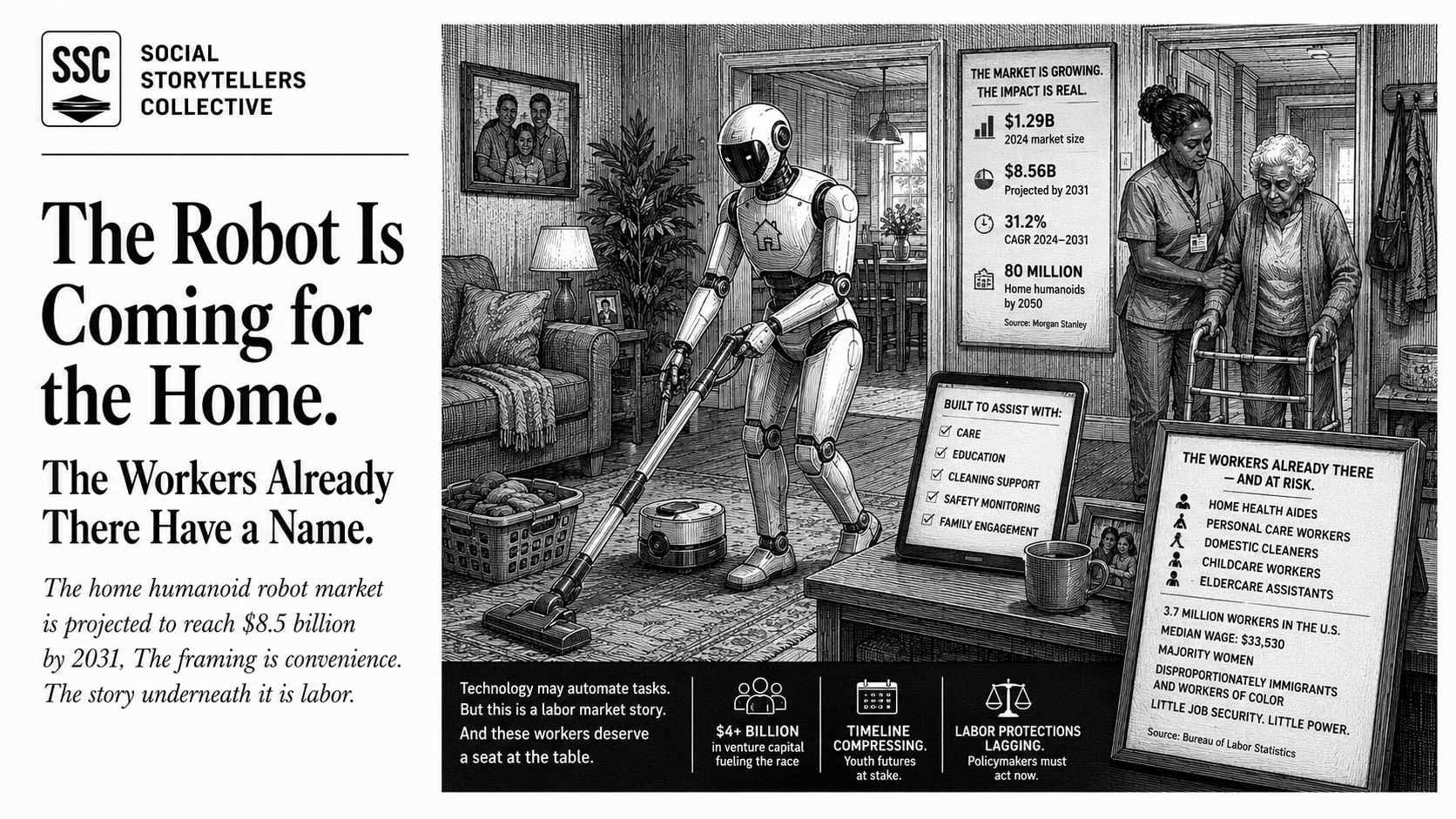
The home humanoid robot market was valued at $1.29 billion in 2024. By 2031, it is projected to reach $8.56 billion — a 31.2% compound annual growth rate over seven years. Morgan Stanley projects nearly 1 billion humanoid robots globally by 2050, with 80 million in homes. Goldman Sachs puts the total addressable market at $38 billion by 2035. The capital is moving. The timeline is compressing. And the framing across nearly every market report is the same: robots that handle “daily routines,” “reduce repetitive domestic work,” assist with “care, education, cleaning support, safety monitoring, and family engagement.”
That framing is accurate. It is also incomplete. The domestic work being automated has a workforce already doing it — and that workforce is among the most vulnerable in the American labor market.
Home health aides. Personal care workers. Domestic cleaners. Childcare workers. Eldercare assistants. The Bureau of Labor Statistics counts approximately 3.7 million home health and personal care aides in the United States — one of the largest and fastest-growing occupational categories in the country, projected to add more jobs than almost any other sector through 2032. The median annual wage is $33,530. The majority are women. A disproportionate share are immigrants and workers of color. Most have no union, no pension, and no employer-provided health insurance. Their work is essential, physically demanding, and chronically underpaid — in part because it has historically been invisible, performed inside private homes where labor protections are weaker and organizing is harder.
The home humanoid robot market is being built around the exact task set these workers perform.
The market reports are careful about their language. Robots are positioned as supplements to human care, not replacements — handling the repetitive and physical tasks so human workers can focus on the “higher-value” relational dimensions. That framing has appeared before, in every wave of automation, and it has consistently proven to be a transitional description rather than a permanent one. The robots begin by supplementing. The headcount is reduced. The supplementary position becomes the primary one. The workers who were doing the supplemented tasks are no longer needed at the same scale.
The timeline is the part that matters. Morgan Stanley’s household adoption forecast is conservative relative to industrial deployment — 80 million home humanoids by 2050 against 930 million industrial units. But 2050 is the same horizon against which today’s 16-to-19-year-old workers will be in the middle of their careers. The youth joblessness data the UIC Great Cities Institute released this month — 81.9% of Black youth ages 16 to 19 in Chicago jobless, the labor market designed to exclude young people without credentials and networks — describes a generation entering a workforce that is being redesigned around them before they have had a chance to build a foothold inside it.
The home humanoid robot market is not a technology story. It is a labor market story about who does the work of care in America, what that work is worth, and what happens to the people doing it when a $8.5 billion market decides their tasks are more efficiently handled by a machine. Those workers were not consulted in the design of the market. They are not represented in the venture capital flows exceeding $4 billion that are accelerating the timeline. And the labor protections that would give them leverage in that transition — the kind Governor Newsom is still studying while the No Robo Bosses Act sits on his desk — have not yet arrived.
The robot is coming for the home. The workers already there have names, addresses, and families. That part of the story belongs in the market report.
SSC covers technology, labor, and the structural forces shaping how people work and live.