
Part of Society, Economy & Wellness — examining how economic pressure reshapes labor, access, and everyday life.
For the past year, the language around returning to the office has been remarkably consistent. Leaders talk about collaboration. They talk about culture. They talk about innovation happening faster when people are physically together. But the scale and rigidity of recent mandates — from Amazon requiring five days a week to JPMorgan Chase enforcing full-time in-office attendance with little exception — suggest something deeper than a renewed belief in in-person work. What’s emerging isn’t a workplace preference. It’s a structural reset of power.
During the height of remote work, employees experienced a level of autonomy that had rarely existed at scale. Work moved from a place to an output. Time became more flexible. Geography became less relevant. For many workers, especially knowledge workers, this wasn’t just a logistical shift. It was a redefinition of what work could be. And once that shift happened, expectations didn’t fully revert. Even as offices reopened, the idea that productivity required physical presence had already been disrupted. Employees had built lives around the new model — childcare arrangements, housing decisions, second jobs, caregiving responsibilities. The reversion being demanded now is not just about where people sit. It is about who absorbs the cost of a preference that organizations are framing as a necessity.
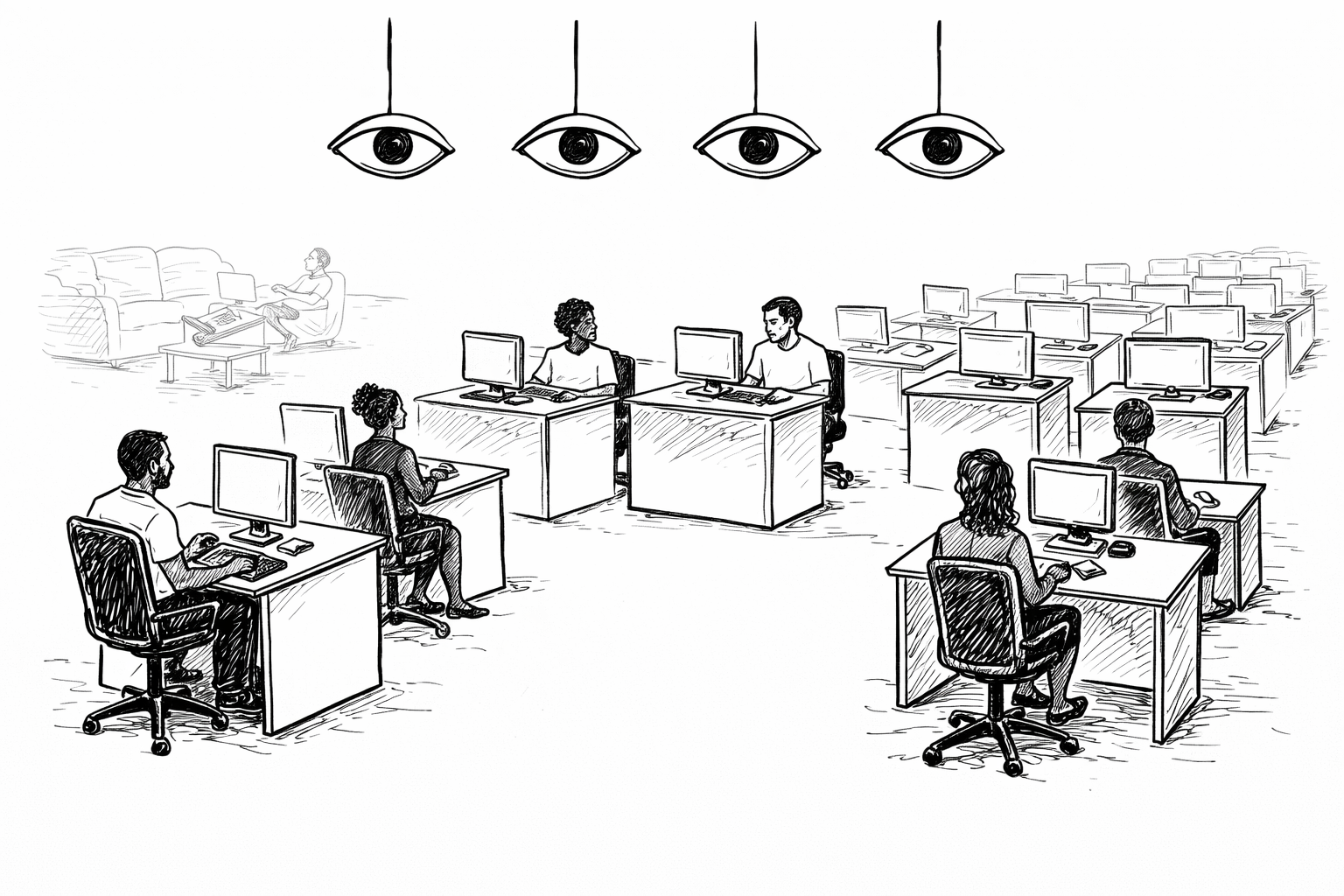
That disruption created a tension that companies are now attempting to resolve in a specific way. Remote work didn’t just change where people worked. It changed how much control organizations had over the workday itself. Visibility decreased. Informal monitoring disappeared. The ability to assess engagement through presence alone weakened. In response, return-to-office mandates are functioning less as cultural initiatives and more as mechanisms to reestablish oversight. Being back in the office is not just about proximity. It is about observability — and observability has always been as much about management comfort as it is about performance.
The language of collaboration helps soften that reality. The data does not support it. Research from Stanford economist Nicholas Bloom — among the most cited on remote and hybrid work — has consistently found that hybrid arrangements maintain productivity and in many cases improve it, depending on the role. What has been more consistently affected is management confidence. Leaders accustomed to equating presence with performance are navigating a model where that equation no longer holds as neatly. The office, in that context, becomes less about enabling work and more about simplifying how it is measured — and simplifying who can be seen to be working.
There is also a secondary layer that is harder to ignore. Return-to-office policies have become a quiet tool for workforce reduction. When mandates are strict, not everyone complies. Some employees leave voluntarily rather than reorganize their lives around a commute they no longer see as necessary. Companies don’t have to announce layoffs to reduce headcount. Attrition does the work for them. It’s a cleaner headline. The outcome is often the same.
What most coverage of the return-to-office debate has missed is who is leaving — and what they were gaining by staying home. Remote work was not equally valuable to all workers. It was disproportionately valuable to workers who navigate discrimination in physical workplace environments. Studies from McKinsey and others have documented that Black knowledge workers reported lower rates of feeling included and respected in physical office settings compared to remote ones — and higher rates of code-switching, microaggression exposure, and the cognitive tax of navigating predominantly white professional spaces in person. The office that companies are asking workers to return to is the same office where those dynamics existed before the pandemic. Remote work did not solve structural racism in the workplace. But it reduced the daily dose of it for workers who had been absorbing it for decades.
As SSC documented in The Black Recession Is Already Here and The Job Market Isn’t Crashing. It’s Closing., Black workers are consistently the most exposed when economic and workplace conditions shift. The return-to-office mandate is another version of that pattern — a policy decision made at the top of an organization, framed in neutral language, that distributes its costs unevenly along existing fault lines. The worker who leaves because the commute is untenable is not the same as the worker who leaves because the office was never a place where they were fully seen. Both are counted as voluntary attrition. They are not the same story.
The deeper negotiation this moment represents is about who controls the terms under which work happens. Over the past few years, employees briefly gained meaningful leverage in shaping those terms — enough to push back on compensation structures, to establish hybrid norms, to redefine what presence was required to mean. What we are seeing now is a recalibration. Organizations are reasserting control not through explicit confrontation but through policy, expectation, and environment. The office is the mechanism. The return mandate is the enforcement. And the language of culture and collaboration is the framing that makes both legible as something other than what they are.
As SSC covered in The AI Resume Screen, the systems that govern access to professional opportunity consistently reward proximity and penalize distance — not because proximity produces better outcomes, but because it produces more observable ones. Return-to-office is the physical version of that dynamic. It is a system that measures what it can see, and calls that measurement performance.
Why This Matters
The return-to-office debate is framed as a disagreement about preference. It is a negotiation over power — who controls time, who controls space, and who absorbs the cost when that control gets reasserted. For most workers, the cost is inconvenience. For Black workers navigating workplaces where physical presence has historically meant constant navigation of environments not designed for them, the cost is something more specific. The flexibility that remote work offered was never just about the commute. It was about the daily tax of being in the room. Understanding what is actually being taken away — and from whom — is the analysis the collaboration language is designed to prevent.