
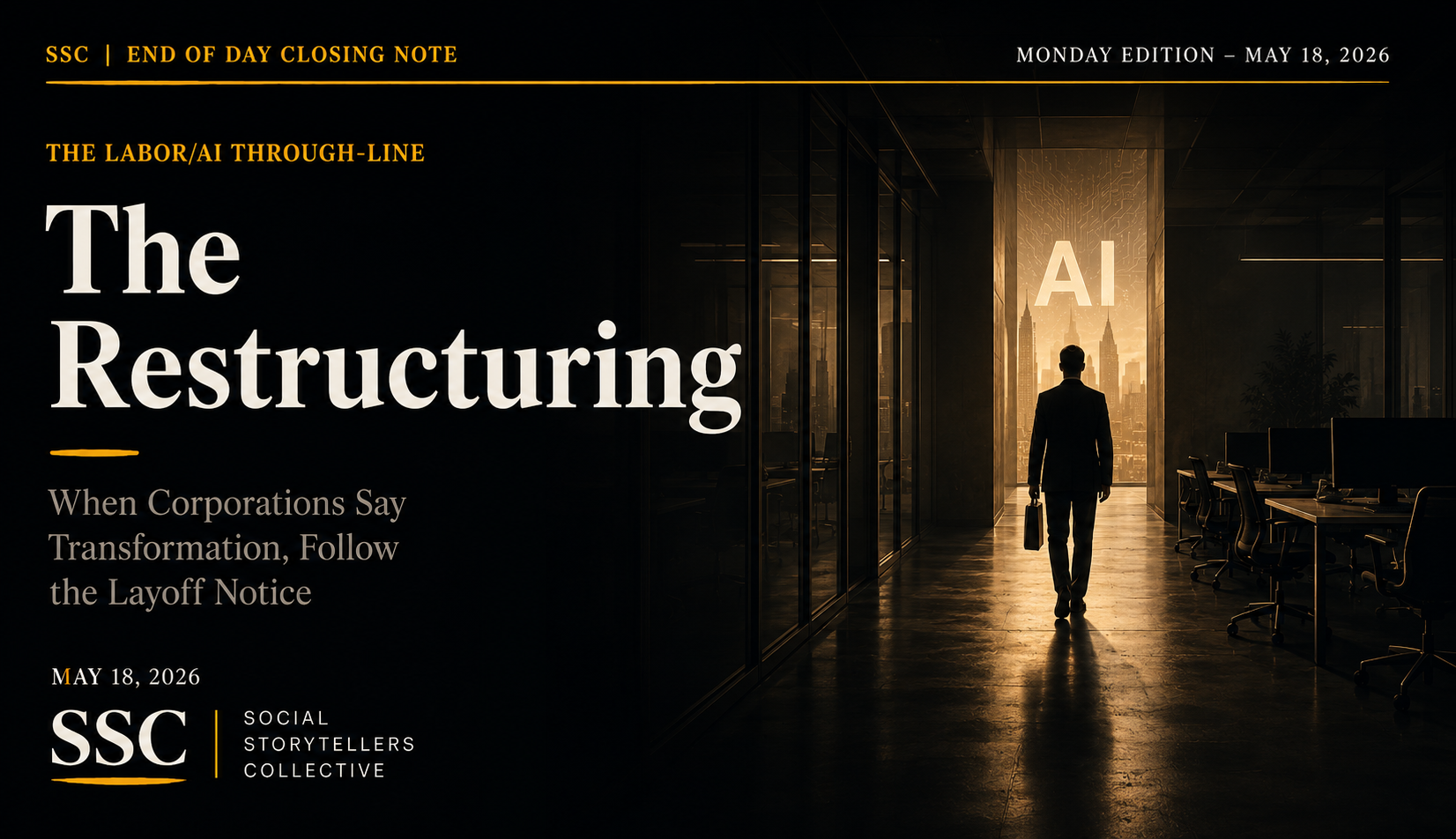
Somewhere in the Arizona desert, 77 bright yellow planes are sitting in silence. No passengers. No routes. No announcements. Just rows of Spirit Airlines jets sealed against the heat, waiting for someone to decide what they’re worth. That answer is in today’s note — along with everything else the word “transformation” is quietly doing this week.
The word arrived this week in press releases, policy memos, zoning hearings, and accreditation votes. Transformation. It showed up at PayPal, where it cost 4,760 people their jobs. It showed up at the ABA, where it cost the legal profession its only institutional obligation to diversify. It showed up in Hill County, Texas, where it arrived as a data center and left as a water problem. It showed up in business school brochures, where a 40% tuition cut is being packaged as accessibility rather than named for what it actually is: a distress signal. The word is doing enormous work across all of today’s stories. The question Monday keeps asking is the same one it asked last week — transformation for whom?

The fire sale on American graduate education is not a gift. The Degree Economy: The Credential Is Deflating — Part I of SSC’s new four-part series launching today — makes the case that Purdue cutting its MBA tuition 40%, UC Irvine slashing its Flex MBA from $129,000 to $99,000, and Johns Hopkins offering 50% scholarships across cohorts is not a story about accessibility. It is a story about a market that has already decided what the degree is worth. U.S. MBA applications have dropped 20–30% at many programs this cycle. International applications are down more than 40% at some schools. McKinsey, Goldman Sachs, and Bain quietly cut their MBA-hire classes 20–40% over the last two years. The pipeline did not slow down. The destination contracted. Not one top-20 program has cut tuition. The fire sale is happening below the prestige line — and the workers who most need the credential to work are the ones least positioned to use a discount that still costs tens of thousands of dollars and requires time away from an income they cannot afford to lose. Part II — AI Ate the ROI — publishes tomorrow.
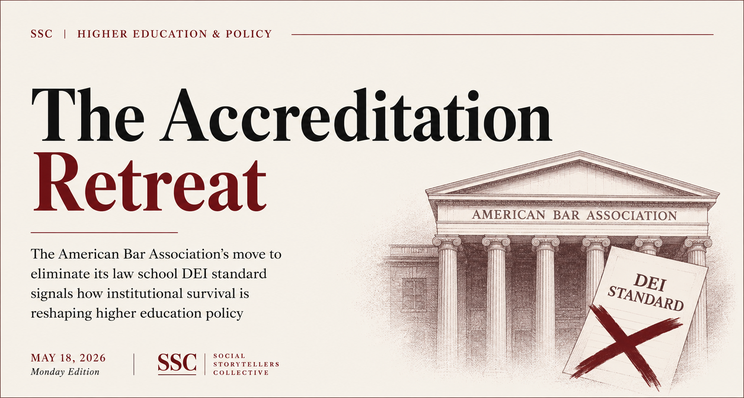
On the same week that business schools began discounting the credential, the American Bar Association voted to repeal Standard 206 — the accreditation requirement compelling law schools to demonstrate active commitments to diversity in admissions, recruitment, and student programming. The Accreditation Retreat traces the full sequence: the Supreme Court’s 2023 affirmative action ruling, the Trump administration’s April 2025 executive order targeting the ABA’s accreditor status, and the March 2026 Education Department letters that made the threat explicit. The ABA chose institutional survival. What it leaves behind: 5% of the legal profession is Black. 2.5% of law firm partners. Numbers that didn’t move in a decade of active effort will now be numbers that don’t move in a decade of no obligation. The bar has set a new standard. The standard is survival. Everything else is optional.
The physical infrastructure of the digital economy is producing its own version of the same argument. Hill County, Texas approved a one-year pause on new data center development this week after local officials raised concerns about water use, energy demand, and infrastructure strain tied to rapid AI expansion. The Cloud Has Physical Consequences follows that decision to the ground. Goldman Sachs projects global data center power demand could increase by as much as 160% by 2030, driven primarily by AI. Generating a 100-word AI response can consume roughly one bottle of water’s worth of cooling resources depending on server location. What appears digitally weightless on a smartphone screen depends on physical systems — pipes, substations, cooling towers, water access — running somewhere that is usually rural, usually under-resourced, and rarely represented in the policy discussions that put those systems there. The future conflict over artificial intelligence may not center on what the technology can do. It may center on what it costs, and who pays.

Spirit Airlines’ collapse is running the same logic in reverse. The Desert Is Where Budget Airlines Go to Disappear follows Spirit’s grounded yellow jets to the Arizona desert, where more than 77 aircraft were sidelined before the carrier officially shut down in May 2026. Desert storage runs approximately $5,000 per aircraft per month — placing Spirit’s inactive fleet near an estimated $400,000 monthly burden at its peak. The collapse did not happen because Spirit stopped being useful. It happened because ultra-low-cost aviation was always leveraged against conditions staying favorable. They did not. The planes being hollowed out for parts in the Arizona sun are the material version of what happens when a business model built on minimum margin meets maximum pressure simultaneously.
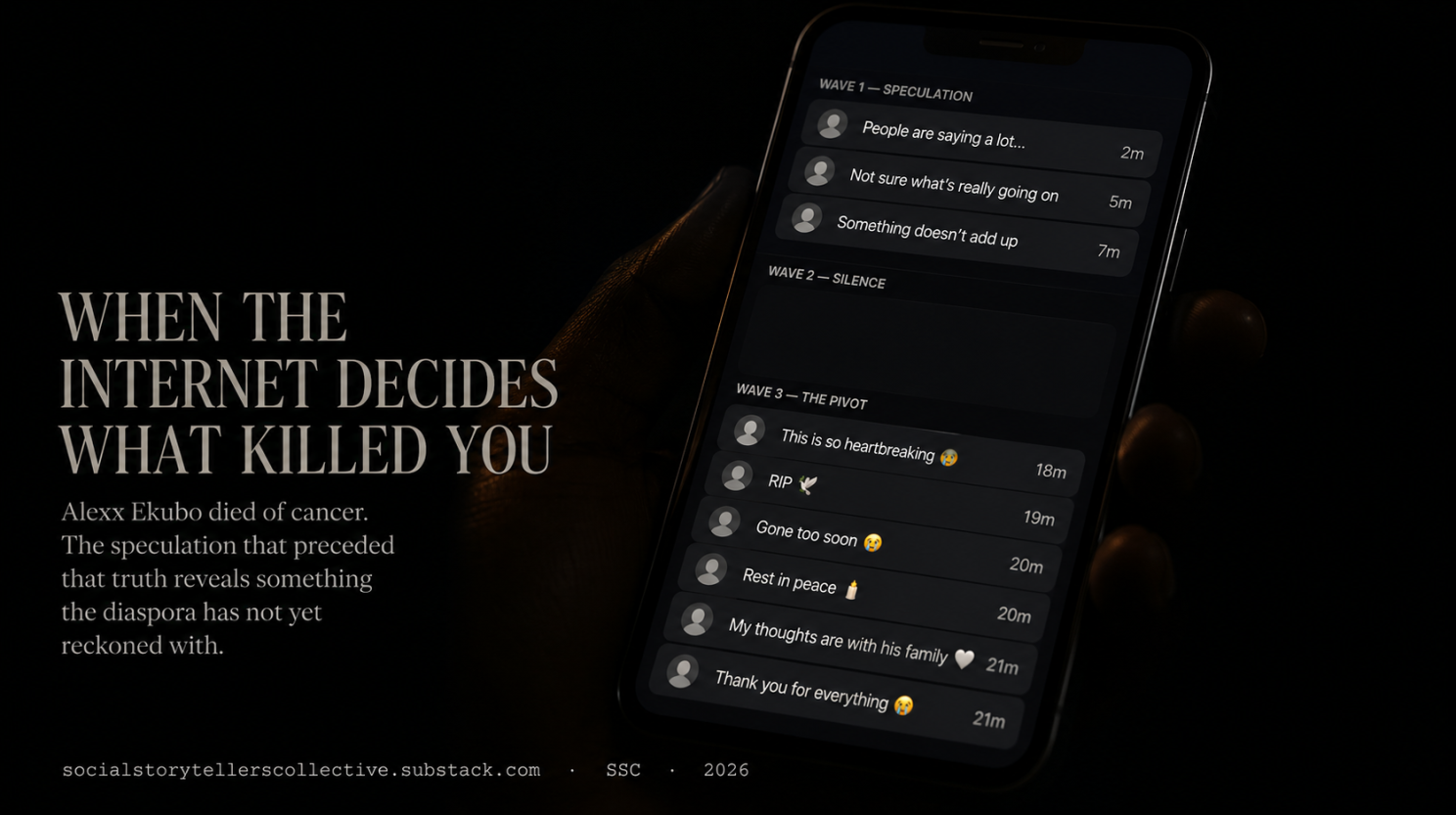
Alexx Ekubo died on May 11, 2026. He was 40 years old. He had been fighting stage 4 metastatic kidney cancer — privately, deliberately, on his own terms. By the time his death was announced, the internet had already spent months deciding what was wrong with him. When The Internet Decides What Killed You names what happened: the theory the Nigerian digital ecosystem reached for first — not universally, but consistently enough to name — was HIV/AIDS. That pattern is not unique to Nigeria. It is not unique to Ekubo. It is a diaspora-wide default that functions less like speculation and more like a setting. The piece holds two arguments simultaneously: the speculation was wrong, and the defense of his dignity cannot be conditional on what the illness turned out to be. There are people dying privately from HIV right now who deserve the same protection from the internet’s diagnosis that Ekubo deserved. Dignity is not a reward for having the right disease.
Missie P — @MissieISNice — posted what should have been a straightforward win. After 2.9 years, 1,685 rides, and a perfect 5.0 rating as a Lyft driver, she bought a Tesla and deleted the app. The internet made it about everything except her. Black Mobility Became the Real Debate — by Leena Alridge — documents what followed: the pile-on, the irony that broke containment, and the specific character of what happens when Black achievement becomes visible online. The most viral counter-argument in the thread — dragging her for Tesla on X, Musk’s own platform — reached 293,000 impressions because it named the contradiction cleanly and let it sit there. But the more important observation sits underneath both sides: Missie posted her win. The internet made it about everything except her.
FIFA released “Dai Dai” this week as the official anthem for the 2026 World Cup, pairing Shakira with Burna Boy and attaching the song to the FIFA Global Citizen Education Fund. Before the Anthem Starts explains what the song is actually selling. Afrobeats streams grew more than 550% globally between 2017 and 2022. Goldman Sachs projects the global music industry could surpass $130 billion annually by 2030. FIFA is building around that momentum — treating the World Cup not as a sports tournament that happens to include entertainment, but as a permanent culture platform designed to monetize attention across language, geography, and identity simultaneously. The anthem is not the opening act. It is the product launch.
Brandon Crenshaw’s Reaction Is the New Review examines what happened when Drake released Iceman alongside the surprise companion projects Habibti and Maid of Honour. By the time most listeners pressed play, they had already consumed hours of reactions, rankings, screenshots, and algorithmically amplified opinions. The reviews became the event. The argument stopped being about the music almost immediately. Modern music discourse rewards immediacy, emotional extremity, and tribal participation over slow evaluation. Drake did not create that system. He has simply learned to operate inside it more fluently than almost anyone else. The rollout is no longer separate from the discourse. The discourse is the rollout.
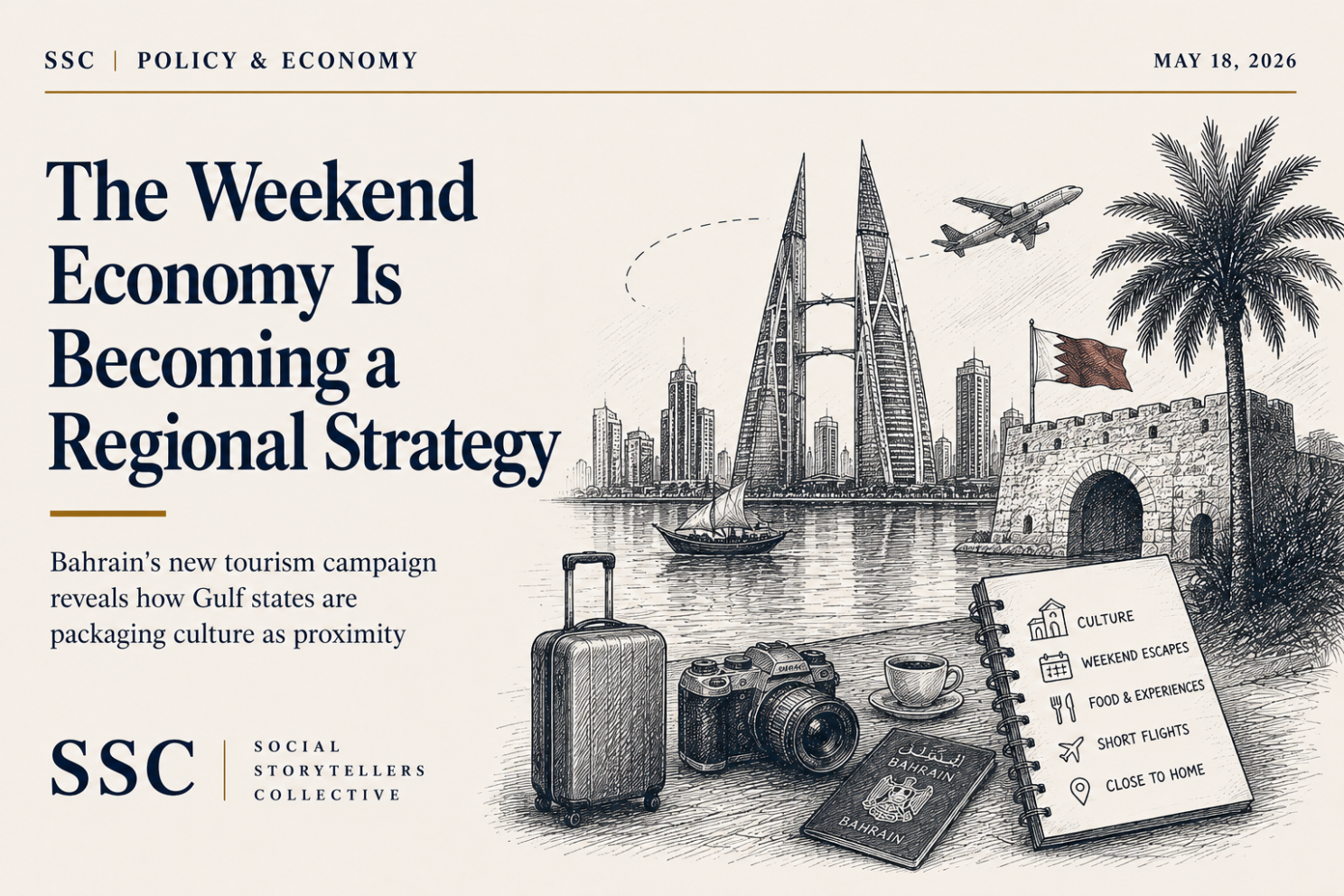
Bahrain launched a GCC-focused tourism campaign this week built around concerts, festivals, shopping, sports events, and hospitality packages aimed at short regional getaways. The Weekend Economy Is Becoming a Regional Strategyexplains what Bahrain is actually competing for. Saudi Arabia is targeting 150 million annual tourists by 2030. Dubai International Airport handled more than 86 million passengers in 2023. Gulf states are building the infrastructure of the weekend economy before most governments have recognized it as a category. The cities that move fastest will not simply capture more tourists. They will capture the definition of what a modern short-form experience is supposed to feel like — and that definition, once established, is difficult to displace.
Daily Visual Signal
A visual interpretation of the deeper systems, tensions, and structural shifts shaping the current moment — designed to translate complex societal changes into a single image.
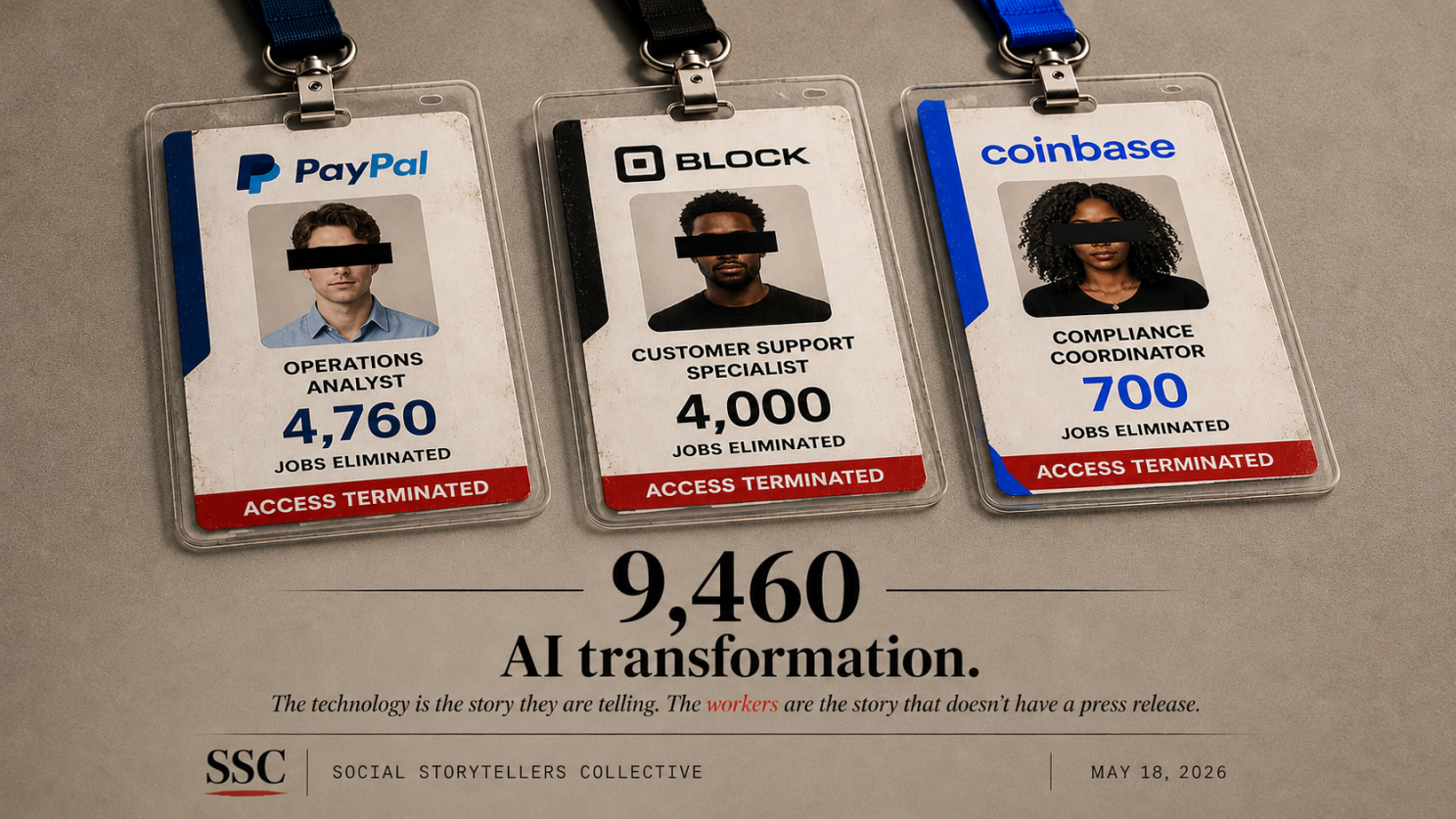
Badges on a Surface — Three employee ID badges laid flat. The names are redacted. The job titles are not. What remains after a mass layoff is not a number — it is a role that no longer needs a person to fill it. 9,460 of them. One quarter. Three companies. One word they all used to explain it.
Featured Story
Today’s featured story is The News Is Free Now — by Bryson Davis.

The Salt Lake Tribune dropped its paywall on May 14, making 155 years of Utah journalism free to anyone who wants to read it. No subscription required. No soft wall. Just open. The backdrop: American newsrooms have lost more than 60%of their employees since 2008, and Press Gazette tracked more than 3,400 journalism job cuts across the UK and US in 2025 alone. The Tribune’s nonprofit model separates access from payment entirely — three voluntary membership tiers, none required to read the journalism. At a moment when the dominant industry response to financial crisis has been to cut staff, restrict access, and retreat behind harder paywalls, a 155-year-old paper in Utah choosing the opposite direction is a data point worth understanding. The news is free now. The question the rest of the industry will be watching is whether that turns out to be a viable model or an admirable one — and whether, in local journalism, those two things can still be the same.
Today’s stories are not separate events. They are the same negotiation running across different institutions simultaneously. A profession dismantling its diversity mandate. A credential losing the market’s confidence. A cloud infrastructure running on rural water supplies. A business model grounded in a desert waiting to be cannibalized for parts. A woman who posted her win and watched the internet turn it into someone else’s argument. The word transformation is still circulating through all of it — in press releases, policy memos, accreditation votes, zoning hearings, and Substack articles. It is doing the same work in every register. Moving cost from institution to individual. Moving risk from corporation to worker. Moving accountability from system to person.
The question Monday keeps returning to is the one that has always been hardest to answer: who decides when transformation is complete — and who is still waiting to be included when that declaration is made.
We will be back tomorrow with more.
For the full experience, view this edition on desktop or laptop. If this briefing sharpened how you see the world, share it with someone else and subscribe to Social Storytellers Collective to stay ahead of the shifts shaping everything around us.