
In Idaho, a Medicaid contractor eliminated mobile mental health services in December. The program — called Assertive Community Treatment, or ACT — brought specialized psychiatric care directly to people with severe mental illness who could not reliably access traditional clinic settings. It was not supplemental. For the people receiving it, it was the system.
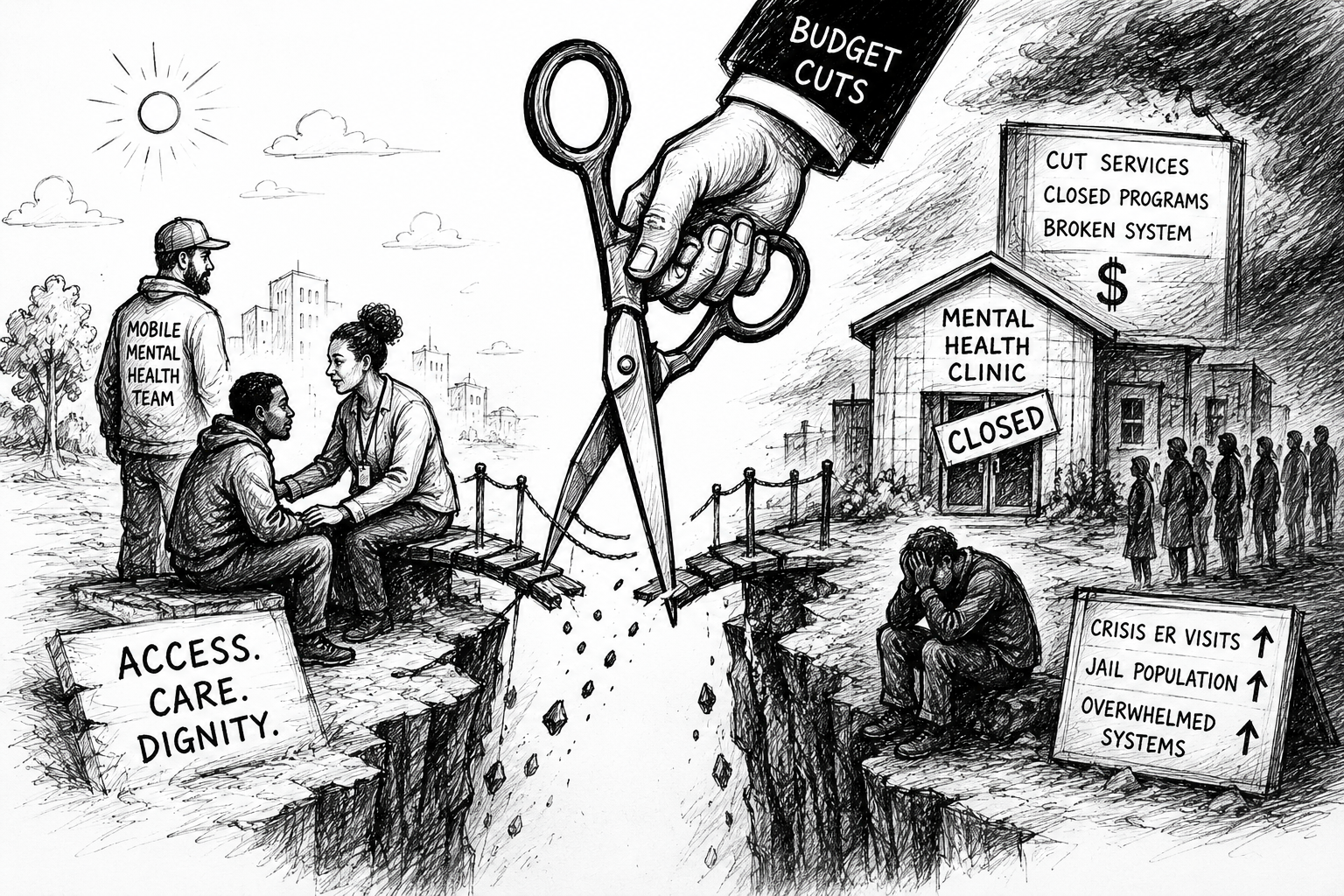
Two months after the cuts, two patients were dead. Crisis center visits in eastern Idaho rose 34% in December and 43% in January compared to the same months a year prior, according to the Idaho Capital Sun. Jails reported increased strain. Providers warned publicly that this would happen. State officials cut the program anyway to close a budget gap — and then expressed surprise at the consequences.
This is not a cautionary tale about what might happen somewhere else. It is documentation of what already happened. And Idaho is not an outlier. It is a preview.
The Law Behind the Cuts
The One Big Beautiful Bill Act, signed into law in July 2025, cut federal Medicaid funding by $1 trillion over ten years — the largest single reduction to the program since its creation in 1965. The mechanics matter. Starting January 1, 2026, the enhanced federal match rate that had incentivized states to expand Medicaid under the Affordable Care Act began sunsetting. That match had covered 90% of expansion costs — removing it does not just reduce future funding, it retroactively destabilizes the financial model states built their expanded programs around.
On October 1, 2026, Medicaid eligibility will narrow further for certain non-U.S. citizens. Work requirements — which the Congressional Budget Office has consistently found push people off coverage due to paperwork failures rather than actual ineligibility — are also built into the legislation. The CBO estimates that roughly 17 million Americans will lose Medicaid coverage as a result of the full bill, according to the National Alliance on Mental Illness. States are not waiting for October. They are making cuts now.
Why Mental Health Gets Cut First
Mental health and substance use services are classified as optional under Medicaid. That single word — optional — is doing enormous structural work. It means that when states face budget shortfalls and are required to maintain certain core services, behavioral health is almost always the first category reduced. Not because it is least important, but because it is legally least protected.
The workforce was already critically thin before a single dollar was cut. As of late 2024, more than 122 million Americans lived in designated mental health professional shortage areas, according to Stateline. One mental health provider for every 350 people nationally, per the Milbank Memorial Fund. Community mental health centers — which serve the highest-need, lowest-income patients — were already operating on margins so thin that a modest reduction in Medicaid reimbursement can trigger layoffs, reduced hours, or full closure.
When those providers close, the services do not redistribute. There is no backup system absorbing the patients. They end up in emergency rooms, in jails, or without care entirely. The Idaho data is granular enough to trace exactly what happened: the ACT program closed, crisis centers absorbed the overflow, and the capacity wasn’t there. Visits spiked. People died. The sequence is documented.
Who Absorbs It
The communities most exposed to these cuts were already navigating the fewest alternatives. Rural areas — where Medicaid often funds the only available behavioral health provider — face the steepest cliff. The Milbank Memorial Fund projects that Medicaid reimbursement for rural hospitals could decline by more than 20% under the current law, placing hundreds of facilities at risk of closure. The CBO projects that 156,000 people will lose access to medication for opioid use disorder, resulting in more than 1,000 excess fatal overdoses annually.
Communities of color are disproportionately represented in the Medicaid population and disproportionately likely to live in areas where Medicaid is the only viable payer for mental health services. The administration’s decision to simultaneously reduce federal funding, eliminate enhanced match rates, add work requirements, and restrict enrollment has not created a crisis from scratch. It has removed the infrastructure that was holding one at bay.
What makes the Idaho case important beyond its immediate tragedy is what it reveals about the timeline. The legislative debate framed these cuts as a future concern — something to be modeled, projected, and argued over in committee. Idaho is proof that the gap between policy decision and human consequence is much shorter than the legislative calendar implies. The bill was signed in July. People were dead by February.
The question is not whether this will happen elsewhere. The infrastructure conditions that produced Idaho’s outcome — optional behavioral health classification, thin provider margins, rural geography, Medicaid-dependent populations — exist across dozens of states. The question is whether the documentation will be sufficient to interrupt the pattern before it replicates.
On October 1, 2026, Medicaid eligibility will narrow further for certain non-U.S. citizens. Work requirements — which the Congressional Budget Office has consistently found push people off coverage due to paperwork failures rather than actual ineligibility — are also built into the legislation. The CBO estimates that roughly 17 million Americans will lose Medicaid coverage as a result of the full bill, according to the National Alliance on Mental Illness. States are not waiting for October. They are making cuts now.