
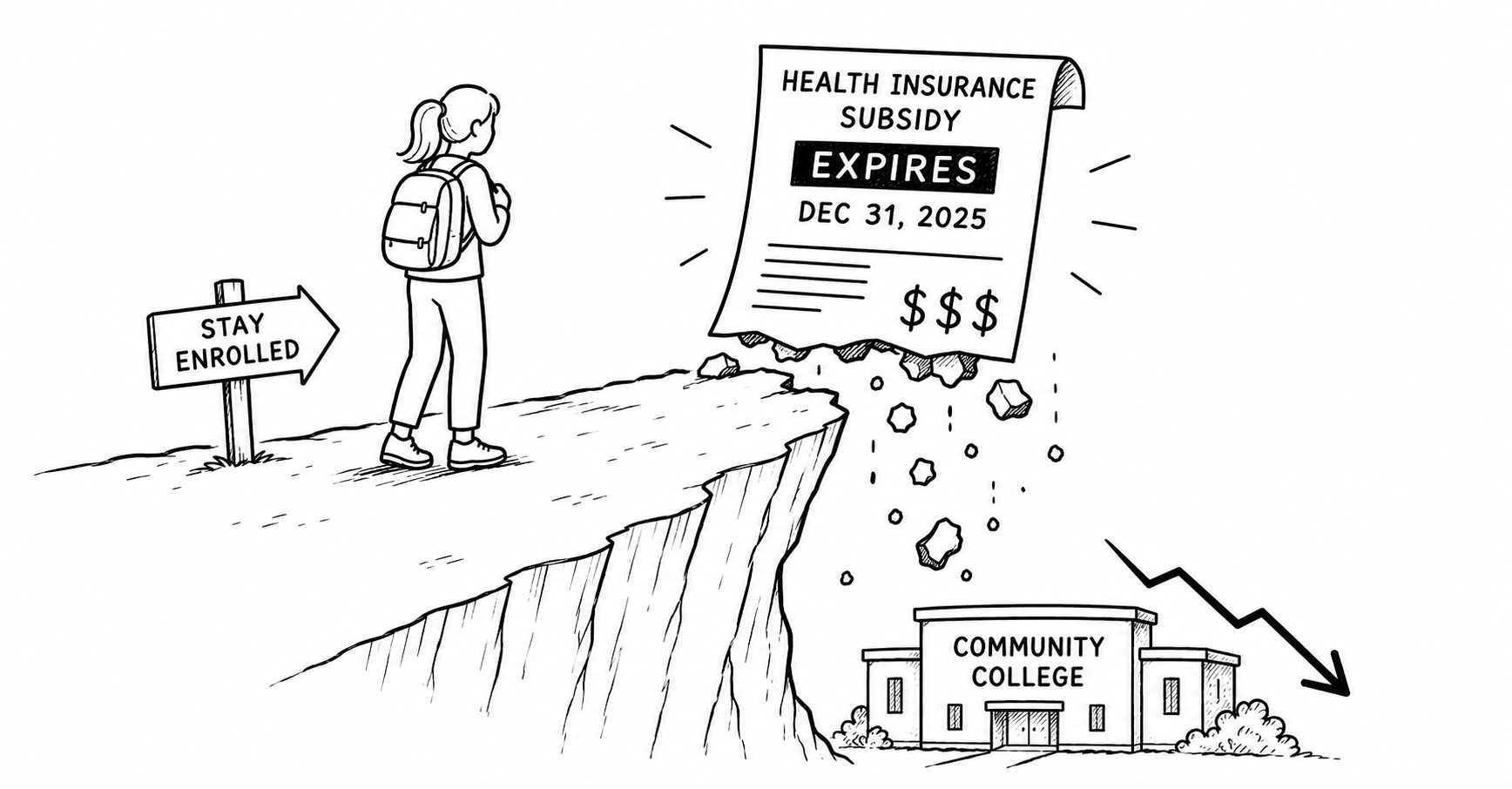
A policy change in federal health insurance subsidies is poised to hit one of the least-discussed access points in higher education: whether a student can stay enrolled at all.
Enhanced premium tax credits that improve affordability for ACA marketplace coverage are set to expire at the end of 2025, and as a result, millions of Americans will see premiums increase by as much as 75 percent. A Center for American Progress analysis found that young people with low incomes — particularly the demographic most likely to enroll in community colleges — would be hit hardest by these premium increases.
The mechanism connects two systems that aren’t usually discussed together. The recently passed OBBBA imposes new Medicaid work requirements that are estimated to cause 8.7 million Americans to lose coverage, while the expiration of marketplace premium tax credits will significantly increase costs for millions more — including young adults with low and modest incomes who may be priced out of coverage they currently afford.
For community college students specifically, this isn’t a side issue. Many community college students rely on Medicaid or ACA marketplace plans for health coverage, since they don’t receive insurance through an employer or a campus-based plan — and these changes may directly affect their ability to enroll in or complete college.
The affordability gap this lands on top of is already severe. Net prices for public institutions average roughly $15,000 per year for families with incomes around $45,000 — families that typically have limited assets to draw on. Strada’s State Opportunity Index measures affordability by calculating how many hours a student must work at the state’s median student wage to cover net costs after aid — in the most affordable states, that’s fewer than 10 hours per week during the school year. In less affordable states, the math gets considerably harder.
Cost remains the dominant access barrier independent of this new pressure. A National College Attainment Network report found cost remains the largest barrier to higher education. The federal government already provides roughly $114 billion annually in financial aid to nearly 10 million students, while federal student loan debt has grown past $1.6 trillion — a scale that shows how much of college access already depends on debt rather than direct affordability.
What this signals going forward: the insurance subsidy expiration won’t appear in higher education headlines, because it’s not framed as an education story. But for the population of students for whom a $200 monthly premium increase is the difference between staying enrolled and dropping out to work more hours, it functions as an access policy with the same effect as a tuition hike — just routed through a different federal agency, where no one is tracking the enrollment impact.
— SSC News Desk | Social Storytellers Collective
Get SSC analysis delivered to your inbox every day. Subscribe free on Beehiiv: socialstorytellerscollective.com/subscribe