
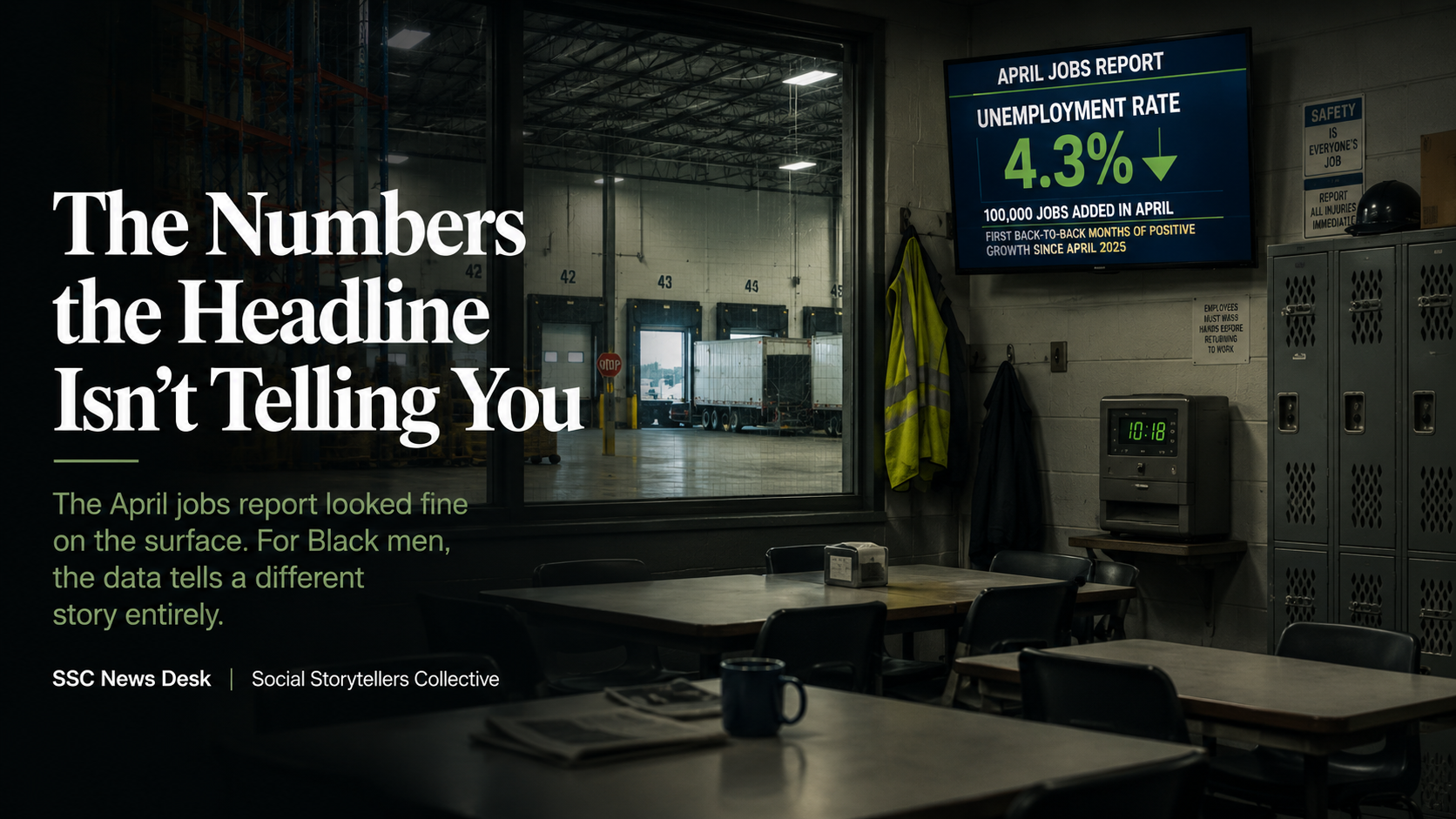
The headline number came in at 4.3% unemployment. 100,000 jobs added in April — the first back-to-back month of positive growth since April 2025. If you stopped reading there, you’d think the labor market was stabilizing.
You’d be wrong. Or at least, you’d be reading the wrong number.
The National Community Reinvestment Coalition released its May 2026 Race, Jobs and Economy Update this week, and the data underneath the headline tells a story that the headline was never designed to tell. The official unemployment rate only counts workers who have actively looked for a job within the last four weeks. It doesn’t count the workers who stopped looking — not because they found something, but because they stopped believing something was there to find.
When you expand the definition to include part-time workers seeking full-time work and workers who have left the market entirely out of discouragement, a different picture emerges. And for Black men specifically, that picture has been deteriorating for months.
What the Data Actually Shows
The number of unemployed Black men went down. That should be good news. It isn’t — because the number of Black men in the labor force went down at the same time. Their labor force participation rate declined across 2025 and into early 2026, while the rate for every other racial and gender group held constant or increased.
The implication is direct: Black men aren’t finding jobs at higher rates. They’re leaving the market. Since November 2025, the number of employed Black men over 20 has declined by roughly 650,000.
These are working-age men. They are not retiring. The NCRC report points to discouragement and an inability to find work as the driving force — and the structural explanation is not hard to find.
The Sector Nobody Is Talking About
Logistics is the largest sectoral employer of Black men. It has seen virtually no job growth since the summer of 2022. The tariff and trade war that began last year accelerated an already struggling industry — and since April 2025, the transportation and warehousing sector has lost nearly 90,000 jobs, including 22,000 truck drivers and 50,000 warehouse positions.
The Iran war’s energy shock is compounding the damage. Rising fuel costs are pushing the sector toward further contractions and bankruptcies. The closure of Spirit Airlines — driven in part by jet fuel shortages — is one visible data point. The 650,000 Black men who have quietly exited the labor force are another, less visible one.
Long-Term Unemployment Is Rising
The share of unemployed workers who have been jobless for longer than 27 weeks has crossed 26% and continues to climb. The average length of an unemployment spell is now roughly 25 weeks. Among Black men specifically, 30% of the unemployed have been jobless for longer than 27 weeks — the highest rate of any racial or ethnic group tracked by the Bureau of Labor Statistics.
Long-term unemployment is not a temporary dip. It reshapes a person’s relationship to the labor market, their household’s financial stability, and their community’s economic baseline. When 30% of unemployed Black men have been out of work for more than six months, that is not a blip in a jobs report. That is a structural condition.
What This Is Actually About
The April jobs report is not lying. It is just measuring something narrower than the problem. The headline unemployment rate captures the workers still actively in the search. It does not capture the workers the market has already lost — the ones who sent the applications, got no callbacks, and eventually stopped sending them.
The NCRC report notes that policies specifically targeting Black men have become politically toxic in the current environment. What remains available — ending the tariff war, expanding unemployment insurance, addressing the logistics sector’s structural collapse — are policies that would help all workers. The case for them does not require naming Black men specifically. The data does that work on its own.
The number to carry out of this report is not 4.3%. It is 650,000 — the Black men who were employed in November and aren’t counted in the labor force anymore. They didn’t disappear. The headline just stopped looking for them.