
The next phase of the weight-loss drug market is not being defined by what the drugs do. It’s being defined by how they’re taken.
Eli Lilly’s newly approved oral GLP-1 drug, Foundayo, removes one of the biggest barriers to adoption: injections. No needles, no fasting requirements, no strict timing. The pill can be taken at any point in the day — a shift the company is positioning as a breakthrough in accessibility rather than just efficacy. More than 20,000 patients have already accessed the drug since its April approval, and over 80% of them are new to GLP-1s, signaling that the format itself is expanding the market. What was once a category defined by clinical outcomes is now being reshaped by usability.
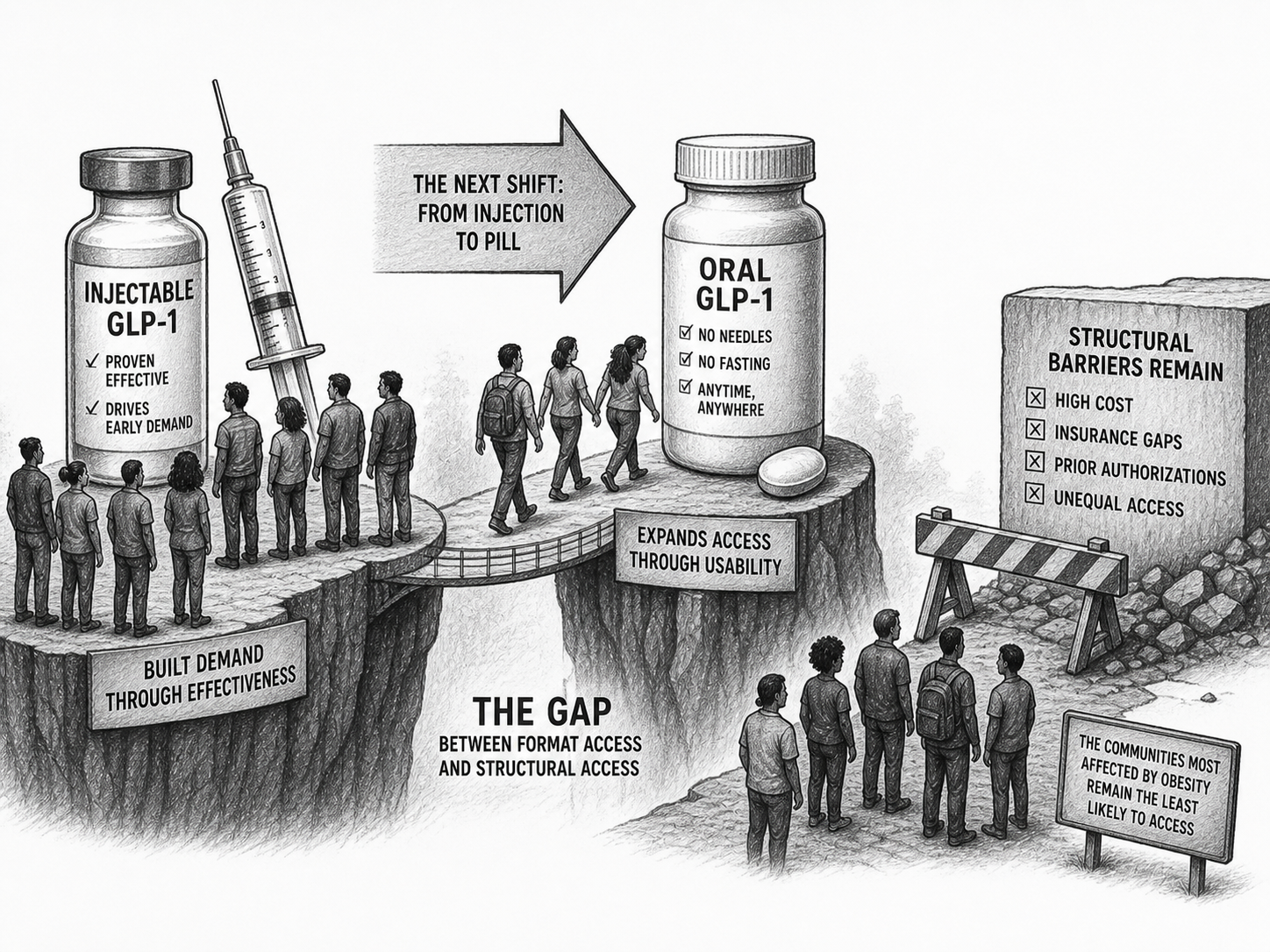
That shift matters because it reframes what competition looks like. Drugs like Ozempic and Wegovy built demand by proving effectiveness. Foundayo is entering the market by lowering friction. It does not necessarily outperform existing options in weight loss results, but it changes the conditions under which people are willing to participate. Ease of use becomes a form of value — one that can bring entirely new segments into the system.
But format accessibility and structural accessibility are not the same thing. As SSC reported in Medicare’s GLP-1 Coverage Program Collapsed Before It Started, the communities most affected by obesity remain the least likely to access these medications — not because of injection hesitancy, but because of cost, insurance coverage gaps, and prior authorization barriers that a pill cannot dissolve. And as The Weight-Loss Boom Is Becoming a Price War examined, even as prices for existing GLP-1s fall, the cost burden continues to shift directly onto consumers. Foundayo’s oral format lowers one barrier. The structural ones remain intact. As The GLP-1 Economy Is Being Redesigned Around a Drug Most People Can’t Afford made clear, format innovation and coverage policy are operating on entirely different timelines — and the people caught in that gap are the ones the market claims to be expanding toward.
At the same time, the expansion is not happening in isolation. Eli Lilly reported a 56% year-over-year increase in quarterly revenue, driven largely by GLP-1 demand, while continuing to invest heavily in pipeline development and acquisitions. Competitors like Novo Nordisk remain deeply embedded in the market with their own oral and injectable options, reinforcing that this is no longer a single-product race. It is an ecosystem being built in real time, with format, price, and coverage all becoming competitive variables simultaneously.
What emerges is a familiar pattern: once a product proves it works, the next phase is making it easier to access, easier to integrate, and easier to scale. The shift from injections to pills is not just a convenience upgrade. It is a signal that the market is moving from early adoption toward mass participation — and that the companies best positioned for that shift are the ones that understand usability as strategy, not just science.
That is where the real change begins. Not in the molecule itself, but in the system surrounding it — where design, accessibility, and behavior begin to matter as much as the outcome. The pill is the product. The question the market hasn’t fully answered is who the product is actually for.