
A federal judge pauses enforcement of a new artificial intelligence law in Colorado, ruling that the state’s attempt to regulate algorithmic discrimination cannot move forward — at least not yet. The law was designed to protect consumers from biased automated decision-making. Its delay does something else entirely: it reveals how far ahead the technology has moved compared to the systems meant to govern it. The gap isn’t just legal. It’s structural.
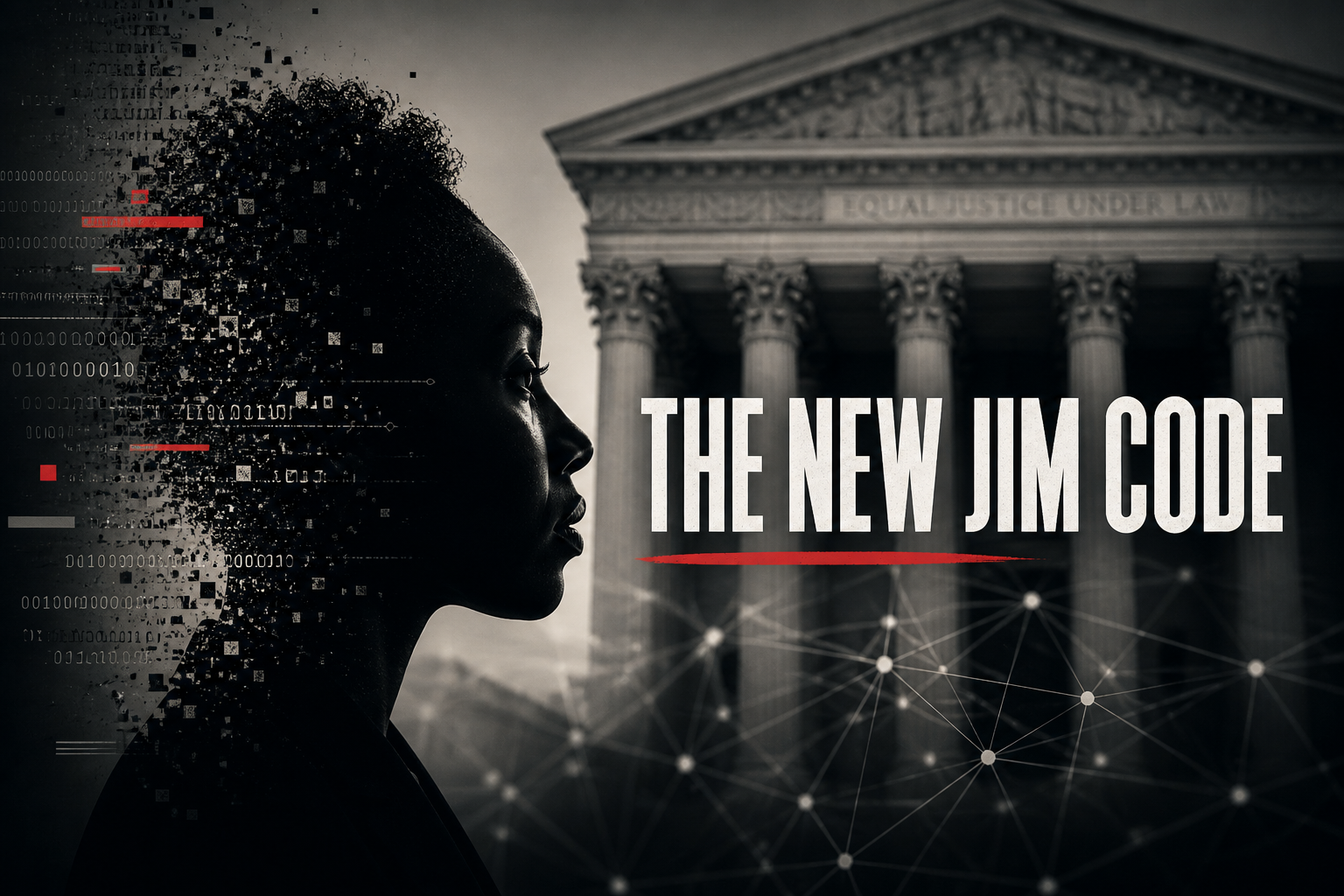
That moment connects directly to what scholars describe as the “New Jim Code,” a framework developed by Ruha Benjamin to explain how modern systems reproduce inequality under the appearance of neutrality. Where Jim Crow laws enforced discrimination through explicit rules, today’s systems embed it in algorithms, data models, and automated processes. The mechanism has shifted from policy to infrastructure — but the outcomes often follow the same lines.
The Colorado case makes that shift visible. Lawmakers attempted to intervene at the level of accountability, targeting how AI systems make decisions that impact hiring, lending, and access to services. But enforcement stalled before it could begin. What that reveals is not just legal friction — it highlights a deeper reality: governance is reacting to systems it doesn’t fully control. By the time regulation appears, the architecture of decision-making is already in place.
At the center of this issue is the idea that technology is objective. In practice, systems are trained on historical data, and historical data carries the imprint of existing inequalities. When those patterns are translated into code, they don’t disappear — they scale. A hiring algorithm trained on past selections will replicate past preferences. A predictive system trained on policing data will reinforce patterns of surveillance. The system doesn’t need intent to produce unequal outcomes. It only needs continuity.
What makes this version of inequality more durable is its invisibility. Under earlier systems, bias could be identified because it was explicit. Today, decisions are often attributed to automated processes, diffusing responsibility and complicating accountability. It becomes harder to challenge outcomes when they are framed as the result of “the system.” That framing doesn’t remove bias — it shields it.
Inequality has not been removed from modern systems — it has been restructured. Design replaces law as the primary instrument. Algorithms, platforms, and infrastructures quietly determine who has access, who is prioritized, and who is filtered out. And as artificial intelligence becomes more embedded across sectors, the stakes extend beyond individual decisions to entire populations. The system runs. The outcomes follow. The question is whether the oversight will ever catch up.