
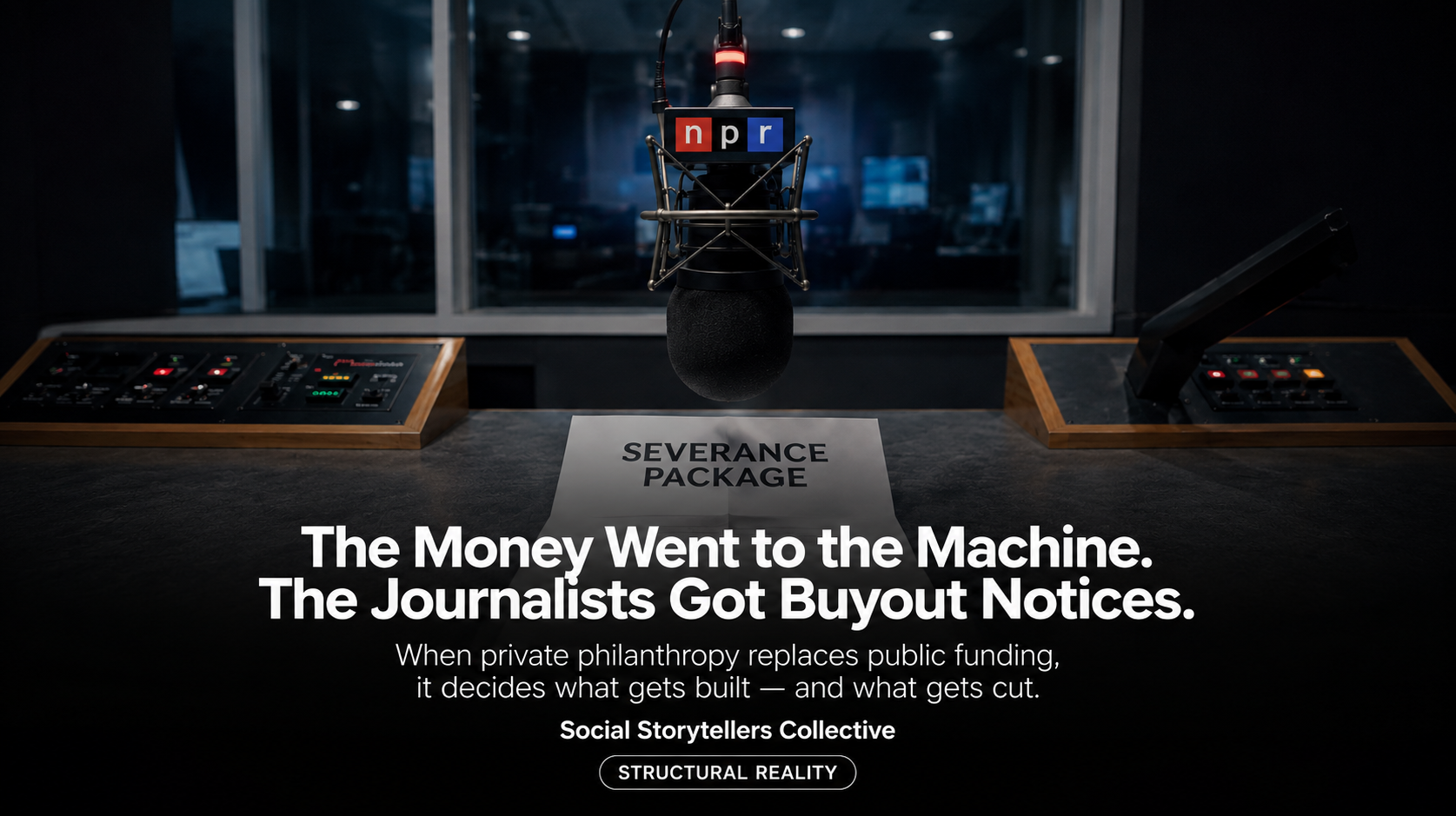
Two weeks ago, NPR announced it had received $113 million in private gifts — the second and third largest donations in the network’s 56-year history. The money was framed as a rescue. A stabilization. Proof that public media still had powerful believers willing to invest in its future.
This week, NPR offered buyouts to approximately 300 newsroom employees. Layoffs would follow if not enough people take them voluntarily by May 26.
These two facts are not in tension. They are the same sentence.
What the money is building
The $113 million is going primarily to technology infrastructure — digital modernization, platform development, audience expansion tools, and stronger coordination between NPR and its member station network. Those are legitimate investments. Public media operating on legacy infrastructure in a fragmented digital environment is a real problem, and the donors who funded this round understood it.
But infrastructure scales. Journalism doesn’t — not in the way a technology platform does. A content management system serves a thousand reporters as easily as it serves ten. An audience development tool doesn’t require a newsroom to function. The economics of infrastructure investment are fundamentally different from the economics of paying people to report, edit, and produce original work.
When NPR’s leadership decided what the $113 million would build, they were making a bet about what public media’s future looks like. The bet is on the container. The journalists are the contents. And the contents, it turns out, are negotiable.
The defunding architecture
This did not start with NPR’s donors. It started with Congress.
The elimination of federal subsidies for public broadcasting removed the predictable, recurring funding that allowed public media to plan across years rather than quarters. NPR CEO Katherine Maher has acknowledged an $8 million gap in the network’s $300 million annual budget — a number that sounds manageable until you understand that it sits on top of an expected $15 million shortfall in station fees and an anticipated drop in corporate sponsorship. The structural math was already broken before the buyouts were announced.
SSC covered the moment those gifts landed and named the tension embedded inside them: philanthropy can stabilize and innovate, but it cannot replace the predictability of public investment. What that piece could not yet name was what the replacement model would actually cost — and who would pay for it. Now we know. The donors fund the infrastructure. The journalists fund the gap with their jobs.
That is not a criticism of the donors. It is a description of what happens when public institutions lose public funding and survive on private generosity. The mission doesn’t disappear. It quietly reorients toward what the money was given to build.
Who absorbs the cut
NPR currently has 425 newsroom employees. The buyout offer targets approximately 300 of them — mostly within newsgathering desks. Hosts of flagship programs are not eligible. The network will accept up to 30 voluntary departures; targeted layoffs follow if that threshold isn’t met.
The people most likely to take a buyout are the ones with enough seniority to make the math work — which means the journalists with the deepest institutional knowledge, the longest source relationships, and the most embedded understanding of how to cover specific beats over time. That expertise does not transfer to a content management system. It walks out the door.
What remains is a newsroom that editor in chief Tom Dreyer has acknowledged is being cut deeper than he personally would favor — paired with a technology infrastructure funded at historic levels. The editorial chief wants more journalists. The philanthropic model is building more platform. Those are not the same organization.
The pattern is not unique to NPR
The Washington Post laid off hundreds of journalists earlier this year and narrowed its editorial focus to politics and national security. CBS cut more than 60 newsroom staffers. The Atlanta Journal-Constitution eliminated 15 percent of its staff. The Associated Press bought out or laid off roughly 60 journalists. Each of these institutions framed its cuts as restructuring. Each of them is still publishing. None of them is the same organization it was.
What is happening across American journalism is not a series of individual budget crises. It is a structural repricing of what journalism is worth to the institutions that once funded it — and a transfer of that funding decision from public accountability to private discretion. Federal dollars came with democratic accountability built in. Private philanthropy comes with donor intent built in. Those are not the same thing, and the difference compounds over time.
NPR’s journalism has historically reached communities that commercial media abandoned — rural areas, underserved regions, places where local news infrastructure has already been hollowed out. The audiences who most depend on that coverage are the least likely to show up in a donor’s calculation of what is worth preserving. They are also the least likely to have alternatives when it disappears.
What the buyouts are
The $113 million and the buyout notices are the same decision expressed in two different languages. One speaks to innovation. One speaks to cost. Together they describe an organization that has accepted the terms of private philanthropy and is now reorganizing itself around them.
That reorganization is not a failure of NPR’s leadership. It is the predictable outcome of removing public funding from a public institution and asking the private market to fill the gap. The market fills what it values. It builds what it can scale. It funds what it can measure. And it does not have a mandate to serve the communities that public media was built to reach.
The journalists walking out of NPR’s newsroom over the next several weeks are not leaving because public media failed. They are leaving because the system that was supposed to sustain public media was deliberately dismantled — and the replacement doesn’t need as many of them to run.
That is the structure. The buyouts are just the receipt.
Social Storytellers Collective covers race, identity, access, and structural inequality. Subscribe at socialstorytellerscollective.substack.com.