
The jury took less than two hours.
After three weeks of testimony, hundreds of pages of exhibits, and a parade of witnesses that included Elon Musk himself, a federal jury in Oakland unanimously rejected Musk’s claims against OpenAI and Sam Altman on Monday. The verdict was not a vindication of OpenAI’s conduct. It was a finding that Musk had waited too long to file — that his claims fell outside the statute of limitations. The substance of whether OpenAI betrayed its original mission was never adjudicated. The jury dismissed the case before it got there.
Musk called it a technicality. He is not wrong. He is also not the story.
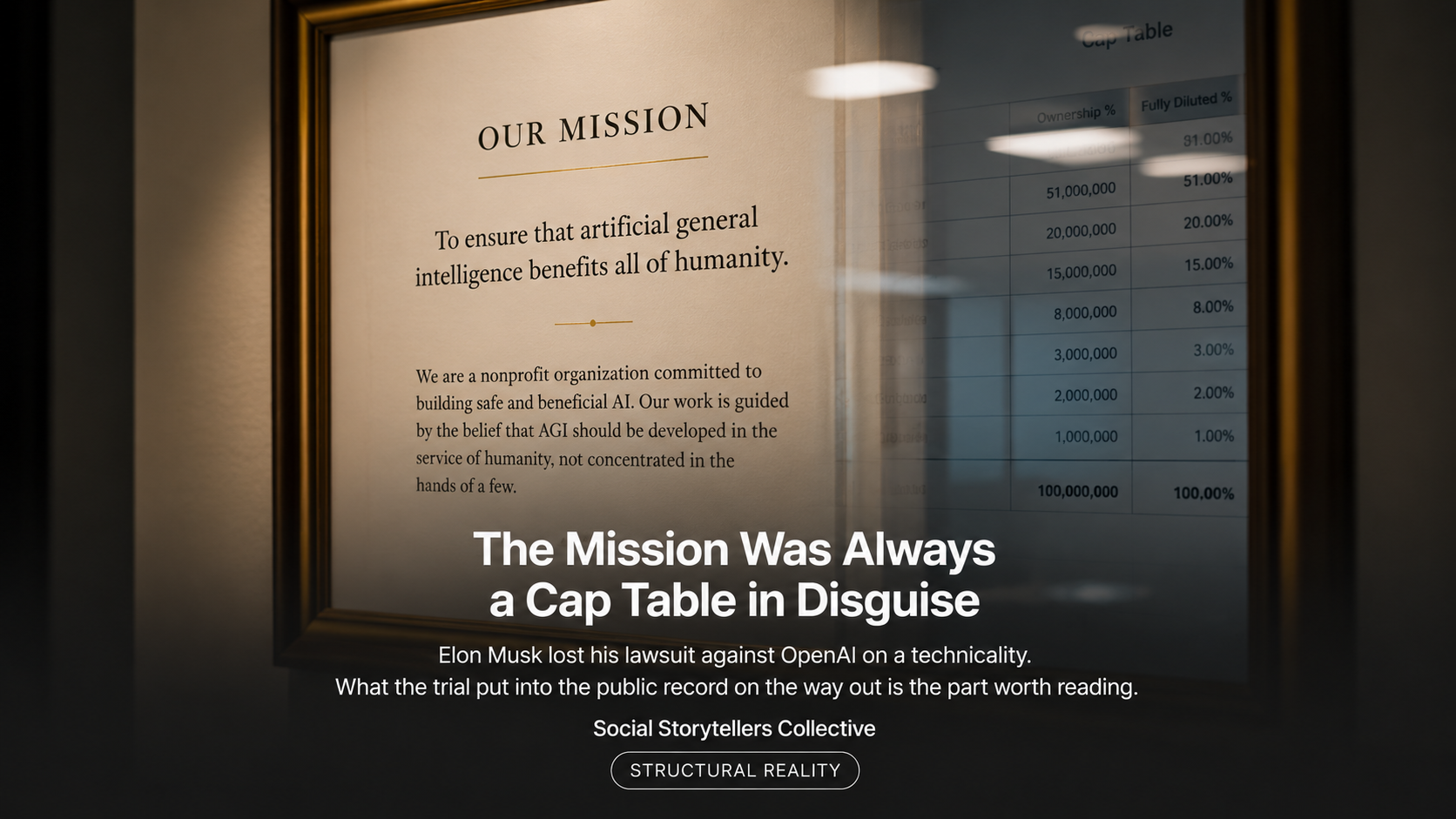
OpenAI was founded in 2015 as a nonprofit with a specific and explicit mandate: to ensure that artificial general intelligence benefits all of humanity. Not its investors. Not its partners. Not its cap table. Humanity. The nonprofit structure was the architecture of that promise — a legal form designed to subordinate financial returns to public benefit, to prevent the concentration of AI’s gains in the hands of a small number of people, to keep the most powerful technology in human history from becoming someone’s private asset.
The for-profit conversion happened anyway. OpenAI created a capped-profit subsidiary in 2019, restructured its governance, and attracted billions in investment from Microsoft and others. The company is now pursuing an IPO that could value it at hundreds of billions of dollars. The mission statement still says “for the benefit of humanity.” The financial architecture now says something different.
Musk’s lawsuit argued that the conversion violated the original agreement. The jury never ruled on whether he was right. But the trial did something the lawsuit itself could not accomplish: it forced OpenAI’s financial architecture into the public record. And what that record shows is worth sitting with regardless of how you feel about Elon Musk.
Greg Brockman, OpenAI’s co-founder and former president, holds an almost $30 billion stake in the company. Ilya Sutskever, another co-founder, holds roughly $7 billion. Sam Altman — who has repeatedly and publicly stated that he has no significant equity in OpenAI — holds over $2 billion in stakes in companies that have done business with OpenAI. Microsoft has spent over $100 billion on the company, including investments and infrastructure. These numbers did not come from a leak or an investigation. They came from a federal courthouse, under oath, in a trial about whether a nonprofit betrayed its public mission.
The mission statement said the technology would benefit humanity. The cap table says it has already made a small number of people extraordinarily wealthy — before a single share has traded publicly, before the IPO has priced, before most of the world has any meaningful access to or ownership of what OpenAI has built.
That is not an accusation. It is arithmetic.
The verdict clears the primary legal obstacle to OpenAI’s IPO. With Musk’s lawsuit dismissed, underwriters no longer have to flag active litigation around the for-profit conversion as a material disclosure risk. The path to public markets is cleaner than it was last week. OpenAI can now proceed with IPO preparations while the fundamental questions about its governance structure remain, as one analyst noted, “unexamined by judicial precedent.”
That phrase deserves more attention than it has received. The most consequential question the trial raised — whether a nonprofit can convert to a for-profit structure and retain the legal protections and public trust that nonprofit status conferred — was never answered. It was procedurally avoided. The question now passes to regulators, to future courts, and eventually to the public markets, where investors will be asked to price a company whose governance framework has no legal precedent and whose original mission has been structurally subordinated to its financial one.
Musk has vowed to appeal to the Ninth Circuit. His stated rationale — that “creating a precedent to loot charities is incredibly destructive to charitable giving in America” — is self-serving coming from the man who dissolved his own charitable foundation under legal pressure. But the argument underneath the self-interest is not wrong. If a nonprofit can raise hundreds of millions of dollars on the strength of a public-benefit mission, convert to a for-profit structure once the asset becomes valuable enough, and face no legal consequence because the people harmed by the conversion waited too long to sue — that is a precedent with implications well beyond OpenAI.
The Verge’s coverage noted that public opinion of the AI industry is already sinking, and that a parade of seemingly untrustworthy executives makes it look worse. That framing is accurate but incomplete. The problem is not that the executives seem untrustworthy. The problem is that the trial revealed the specific architecture of how trust was structured and then restructured — how a public-benefit promise was converted into a financial instrument, how the people who will benefit most from that conversion were already holding their stakes before most of the world understood what was being built.
OpenAI did not steal from the public in any legal sense the jury was asked to evaluate. What the trial record shows is something more precise: a group of people built an institution around a public mission, attracted talent, capital, and credibility on the strength of that mission, and then restructured the institution in ways that concentrated the financial returns of that mission among themselves — before the mission was complete, before the technology’s impact was fully understood, and before anyone outside the cap table had a meaningful say in how the gains would be distributed.
The jury found that Musk filed too late. The public record found everything else.
The IPO is coming. The cap table is already set. The mission statement is still there, on the website, unchanged.