
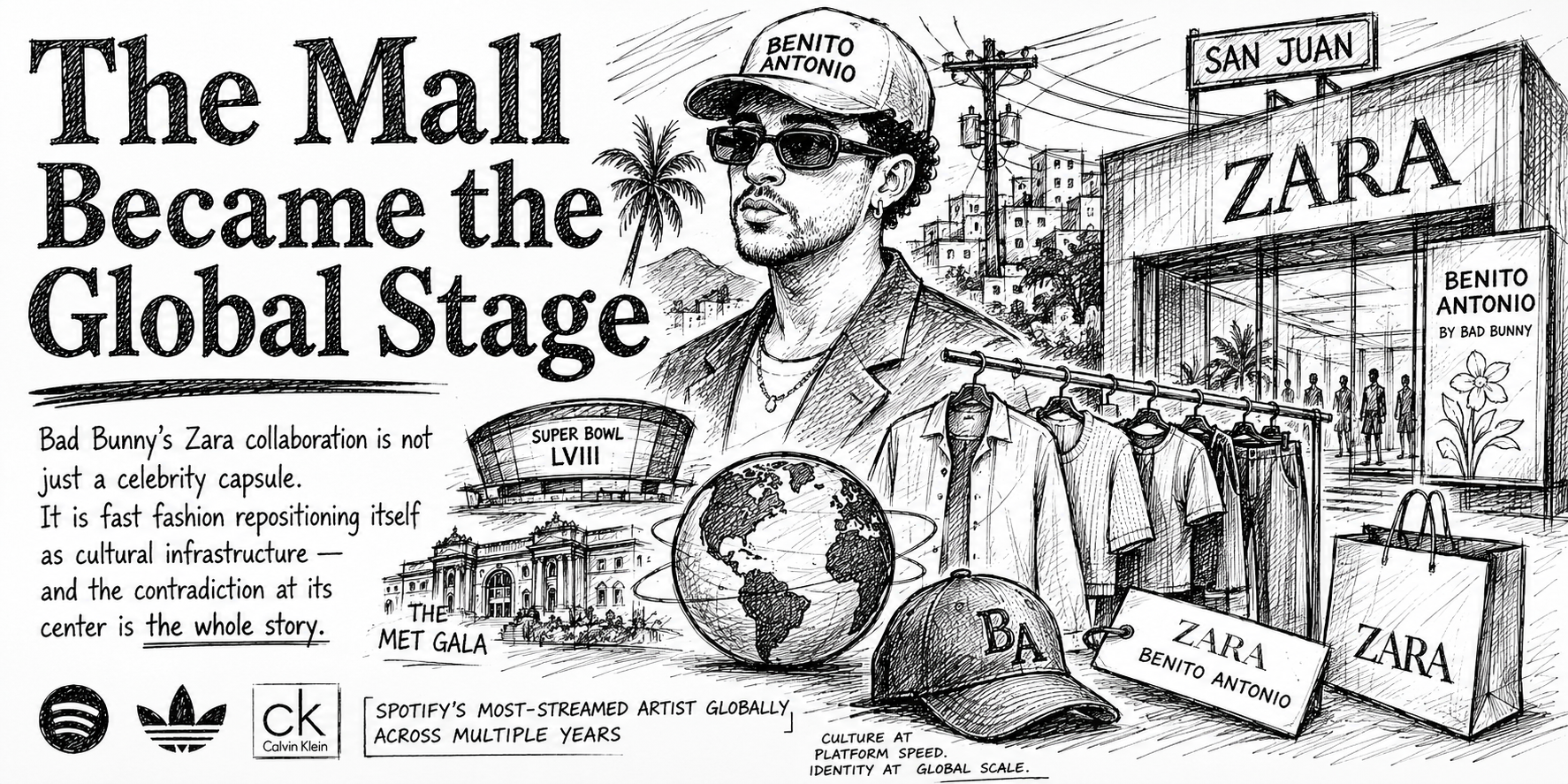
The collection is 150 pieces long. It launched first through a surprise pop-up in San Juan, Puerto Rico, before expanding globally through Zara’s retail network on May 21. Oversized tailoring. Linen separates. Baseball caps. Streetwear basics. Sun-faded Caribbean palettes. The line is called Benito Antonio — Bad Bunny’s real name, not his stage identity — and Zara transformed an entire SoHo storefront around it before most consumers even knew it existed.
That scale matters because this is no longer how celebrity merchandise works. This is not an artist putting a logo on hoodies and calling it a fashion line. Zara and Bad Bunny are doing something structurally different: collapsing the distance between luxury signaling, cultural identity, and mass retail distribution. The collection arrives after Bad Bunny wore Zara-designed looks at both the Super Bowl halftime show and the Met Gala earlier this year — two of the most visible cultural stages on earth. The breadcrumb trail was deliberate. By the time the collection launched, the campaign had already been embedded into entertainment infrastructure months earlier.
What makes the collaboration significant is not simply Bad Bunny’s influence. It is Zara’s repositioning. Fast fashion brands traditionally borrowed legitimacy downward — imitating runway trends after they appeared elsewhere. Zara is now attempting something more ambitious: building direct relationships with cultural figures powerful enough to bypass the runway hierarchy entirely. The company recently announced partnerships with John Galliano and Willy Chavarria. Bad Bunny enters that strategy from a different angle. Galliano gives Zara fashion credibility. Bad Bunny gives it cultural velocity.
The distinction matters because Bad Bunny is not functioning merely as a celebrity ambassador anymore. He is operating as infrastructure himself. Spotify’s most-streamed artist globally across multiple years, a Calvin Klein campaign that reportedly generated $8.4 million in media impact value within 48 hours, Super Bowl headliner, Met Gala co-chair, Adidas collaborator — his reach moves simultaneously through music, sports, luxury fashion, and mass retail. Zara is not partnering with a musician. It is partnering with a distribution system.
That distribution system also changes who fashion collaborations are built for. Historically, luxury brands extracted aesthetics from Puerto Rican, reggaetón, and Caribbean culture while keeping the actual products financially inaccessible to the audiences generating the style language in the first place. Zara’s global pricing structure changes the equation. Pieces in the collection range roughly from €29.95 to €149. That does not make the line cheap in an inflation-heavy economy, but it places the collection within reachable distance for consumers who would never realistically access Prada, Gucci, or Saint Laurent — brands Bad Bunny has also worked with extensively. Mainstream coverage treats accessibility as a side note. It is actually the central business innovation.
And then there is the tension the coverage keeps walking past.
Zara’s business model depends on speed, scale, and aggressive production economics. Bad Bunny’s public identity, meanwhile, has increasingly centered Puerto Rican specificity, local authorship, and cultural ownership. The Benito Antonio campaign reportedly incorporated visual references to Puerto Rican street infrastructure — electrical poles, handmade textures, everyday urban environments. The imagery is specific. The supply chain behind it is not. A collection that draws its visual language from a specific place and a specific people, then manufactures and distributes it at industrial scale through one of the world’s largest fast fashion retailers, is not making a clean cultural statement. It is making a complicated one.
The question is not whether Bad Bunny sold out. That framing misses the point. The question is whether global retail systems can authentically carry cultural specificity at scale — or whether the act of scaling it inevitably flattens it into aesthetic packaging, something that looks like a place without actually being accountable to it. Zara gets the visual language of San Juan. The workers and communities whose style informed that language get a collection they can almost afford. That gap does not cancel the collaboration. But it does define it. And it deserves to be named.
What Zara understands — before much of the fashion industry fully does — is that celebrity fashion is no longer about aspiration alone. Consumers increasingly buy into identity systems that feel culturally adjacent to how they already live, move, and listen. Bad Bunny’s influence works because audiences do not experience him as distant luxury. They experience him as proximity. Zara is attempting to industrialize that feeling at global scale.
That is what this collaboration actually signals. Fashion is moving away from the old hierarchy where luxury dictated culture from above and fast fashion translated it downward months later. The timeline has collapsed. Culture now moves at platform speed. Artists become global retail infrastructure. Retail brands become media companies. The mall becomes a cultural distribution channel competing directly with entertainment itself.
Bad Bunny x Zara is not important because a musician designed clothes. It is important because one of the largest retailers in the world has decided that cultural authority now matters more than fashion authority — and built its strategy accordingly. The collection is beautiful. The campaign was precise. The contradiction sitting at the center of all of it is exactly as complicated as it looks.