
Part of Society, Economy & Wellness — examining how economic pressure reshapes labor, access, and everyday life.
NEWS DESK | SOCIAL STORYTELLERS COLLECTIVE
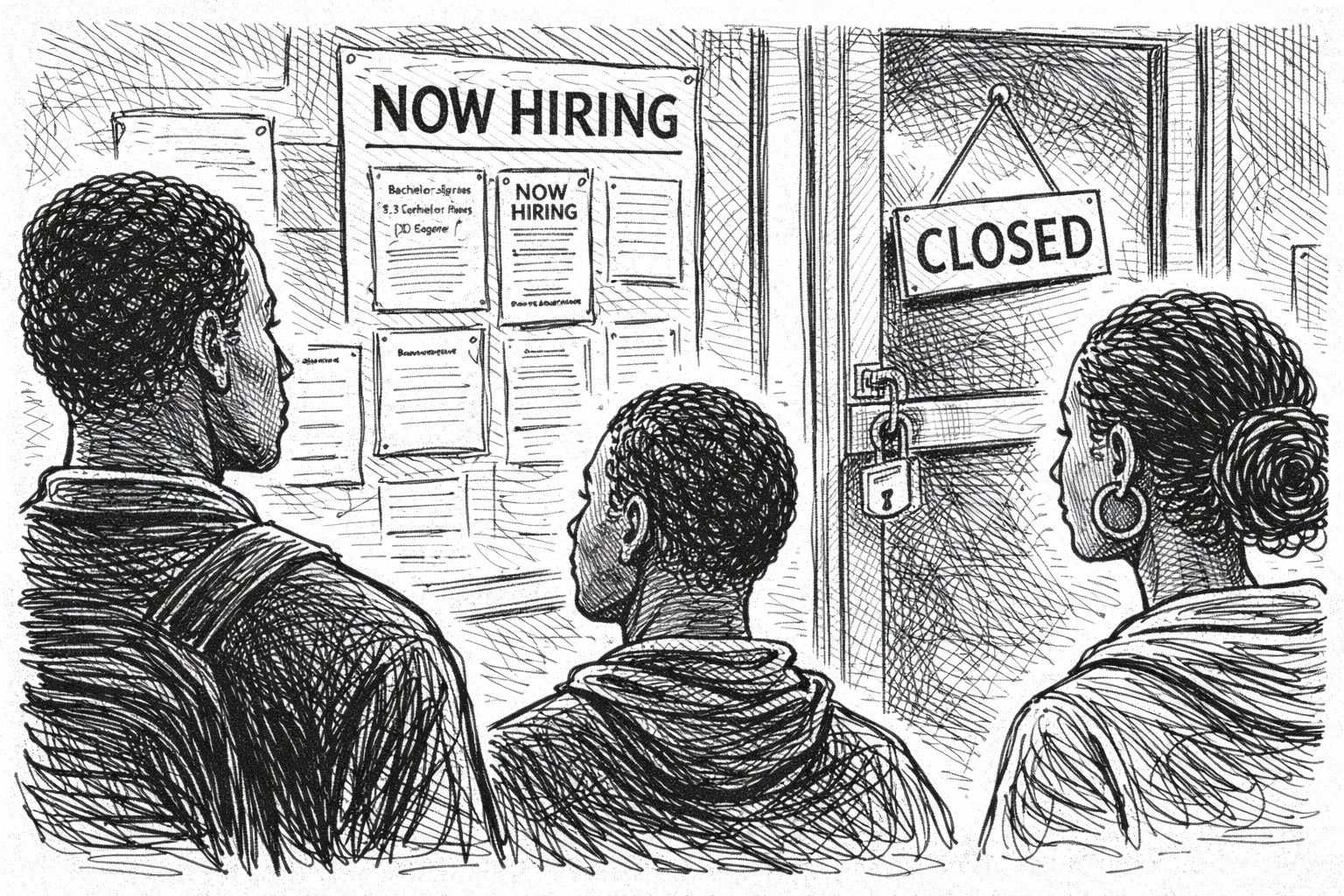
The labor market slowdown is not announcing itself through mass layoffs. It is showing up as hesitation. Hiring is slowing. Open roles are becoming more selective. Entry points are narrowing. The shift is subtle enough to avoid headlines but widespread enough to reshape how people experience work in real time.
Entry-level job postings in the U.S. are already down 35% since early 2023, according to research from Revelio Labs, with AI playing a major role. Only 30% of college graduates landed a full-time job in their field in 2025, down sharply from the year before. That contraction predates the current oil shock. What the Iran war is doing now is compressing a timeline that was already moving in the wrong direction.
Goldman Sachs estimates the oil shock is suppressing payroll growth by roughly 10,000 jobs per month, with leisure, hospitality, and retail absorbing the most damage — sectors that are often the first to contract when consumer spending tightens, and also the sectors where many workers enter, re-enter, or stabilize their income. When those pathways narrow, the impact extends beyond the jobs themselves. It reshapes how workers experience mobility, recovery, and economic security.
This is not happening in a vacuum. As SSC documented in The Black Recession Is Already Here and AI Isn’t Replacing Workers Yet — But It’s Already Closing the Door on New Ones, the labor market had already begun tightening before this latest shock arrived. Hiring processes were becoming more automated. “Ghost jobs” — postings that exist on paper but reflect no real hiring intent, used by companies to build candidate pipelines or project growth without committing to it — were inflating the perception of opportunity while actual available roles contracted. Workers were staying in roles longer not out of satisfaction but out of uncertainty about what would be on the other side of a transition. The Iran war is not creating those dynamics. It is accelerating them.
The result is a labor market that feels active on the surface but restrictive in practice. Jobs exist, but access to them is uneven. Movement becomes harder. Transitions take longer. For workers already navigating limited margin — particularly in sectors vulnerable to economic swings — the difference between a slowdown and a shutdown becomes harder to distinguish from the inside.
That distinction is especially important for Black workers, who remain overrepresented in the sectors most exposed to consumer pullback and underrepresented in the sectors with the most stability. When hiring slows, the effects do not distribute evenly. They concentrate where job security is already weakest and where recovery historically takes the longest. A labor market that is selective by design produces outcomes that mirror discrimination without requiring its intent.
Why This Matters
Economic downturns are typically defined by what is lost. This one may be defined by what becomes harder to reach. The labor market is not collapsing — it is becoming more selective, more constrained, and less forgiving of the workers who can least afford those conditions. For people trying to enter, move, or recover, that shift matters just as much as a layoff. It is quieter, harder to name, and easier to miss in the aggregate data. But it is being felt — in the applications that go unanswered, the roles that quietly disappear, and the transitions that simply never happen. That is the story the numbers are not yet fully telling.