
The Commonwealth Fund’s 2026 State Health Disparities Report documents what the healthcare system has spent decades trying to attribute to income, insurance, and access — and finds the gap survives all three.
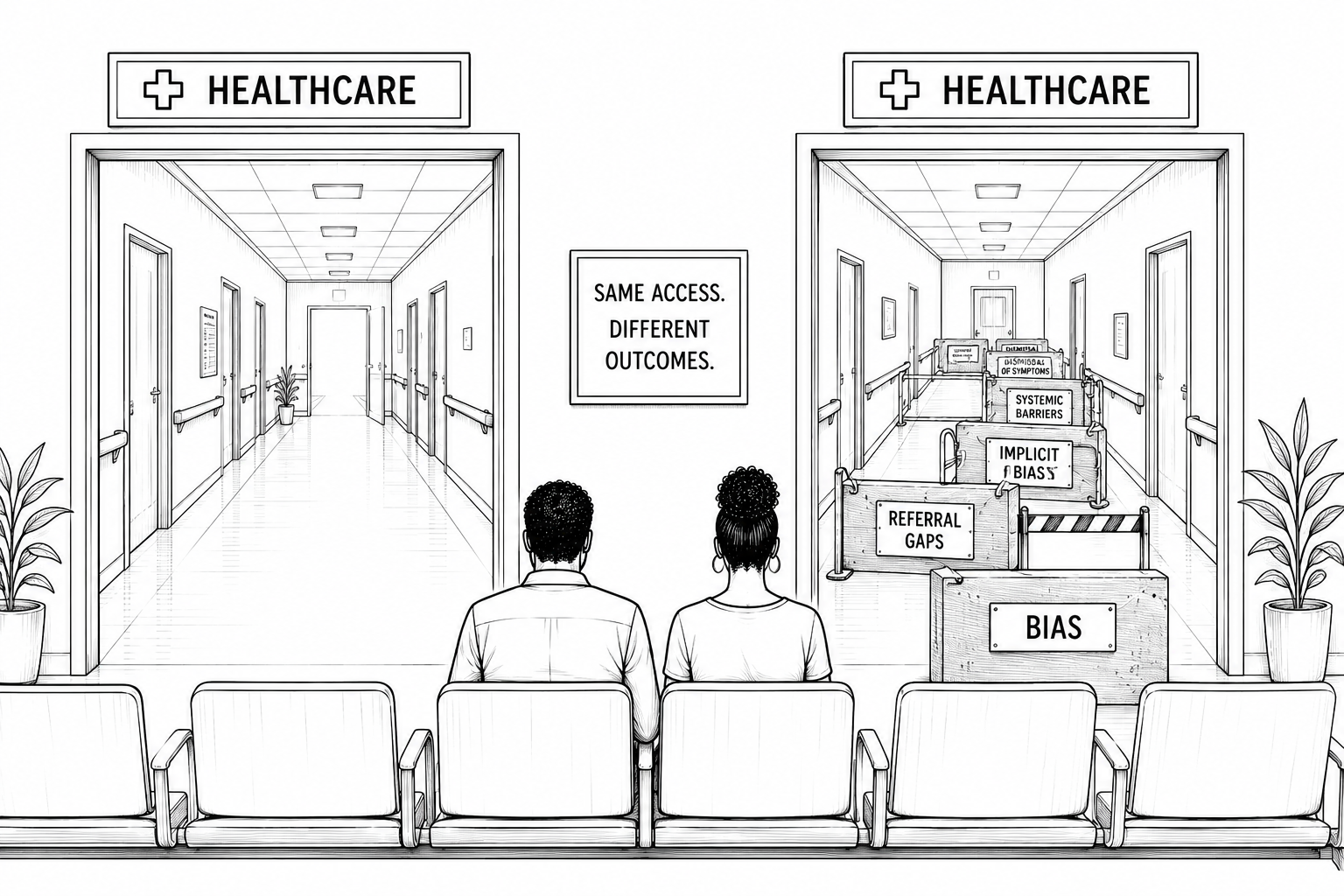
The Commonwealth Fund released its 2026 State Health Disparities Report in April, documenting persistent racial and ethnic gaps in health outcomes, coverage, and quality of care across the United States. The report, which focuses specifically on race and ethnicity as the primary variable, finds that disparities remain even after controlling for insurance coverage, income level, and geographic access to care. The conclusion that landmark studies have reached — and that this report reaffirms — is that the gap is not explained by the variables most commonly used to explain it.
That finding has a specific implication. If insurance coverage, income, and access cannot close the gap, the gap does not live in those variables. It lives in what produces unequal outcomes even when the measurable conditions are equal — referral networks, intake processes, implicit bias, and the historical institutional practices that determine where patients end up receiving care and how seriously their symptoms are taken when they arrive. A 2026 Johns Hopkins Bloomberg School of Public Health study found evidence of segregation within the healthcare system itself: a sorting of patients by race within the same neighborhood, driven by factors that are seen and unseen simultaneously. The system is not failing Black patients because they lack access. It is producing unequal outcomes by design features that access alone cannot override.
The report lands inside a political environment that is actively narrowing the institutional capacity to respond to it. Medicaid faces cuts under the One Big Beautiful Bill Act. Rural hospitals continue operating under financial strain. Federally qualified health centers — the primary care safety net for uninsured and underinsured populations — face regulatory pressure alongside fiscal uncertainty. The infrastructure designed to serve the populations most exposed to health disparities is contracting at the same moment a major national report confirms those disparities are structural rather than incidental.
The Commonwealth Fund data also connects directly to what SSC documented in its HIV Prevention Gap reporting: only 11% of Black Americans eligible for PrEP were prescribed it in 2022, compared to 82% of eligible white Americans. That ratio is not an insurance story. It is not an income story. It is a delivery story — about which communities healthcare institutions reach, how they reach them, and what assumptions shape clinical decision-making when patients from those communities walk through the door.
Racial health disparities in the United States are not a residual problem waiting for the right policy instrument. They are an output of a system that produces them reliably, across geographies, income levels, and insurance categories, in ways that controlling for each of those variables individually does not interrupt. The next decade of healthcare policy will determine whether that system is redesigned — or whether the gap is simply documented more precisely while it continues to widen.